

Uganda signals deeper agriculture reform push as new FAO envoy presents credentials
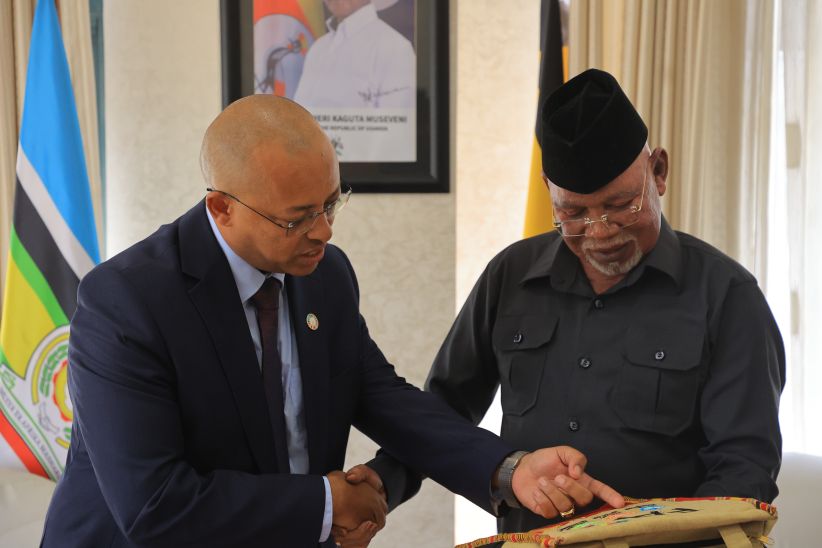 New FAO envoy to Uganda Ezana Getahun Kassa (left), with Foreign Affiars Minister Odongo Jeje in Abubakhar in Kampala Photo credit: Dennis Mulima/ MoFA
Uganda has reaffirmed its push for climate-resilient and culturally grounded agricultural transformation as the new FAO country representative assumes office, signalling deeper cooperation on food security and sector modernisation.
Uganda has restated its commitment to agricultural transformation and climate resilience following the accreditation of a new country representative of the Food and Agriculture Organization, signalling a fresh phase in cooperation with the UN agency.
Ezana Getahun Kassa presented his letters of credence to Foreign Affairs Minister Odongo Jeje Abubakhar in Kampala on May 6, with both sides underscoring shared priorities of food security, agricultural productivity and sustainable development.
During the engagement, Odongo Jeje positioned agriculture as central to Uganda’s economy, noting that the sector remains the backbone of livelihoods while also serving as a key driver of growth in the broader development agenda.
He said the government is pursuing a dual approach—modernising agriculture while safeguarding indigenous knowledge systems that have historically supported rural communities.
The minister also highlighted the growing urgency of climate adaptation, pointing to shifting weather patterns that are increasingly affecting production cycles and food security.
He called for balanced policy approaches that integrate innovation with cultural and socio-economic realities, particularly in sensitive areas such as biotechnology.
While acknowledging the potential of modern tools, including genetically modified organisms, to boost productivity, Odongo Jeje cautioned that adoption must be carefully calibrated.
“Uganda seeks to improve productivity while safeguarding what is uniquely ours,” he said, adding that partnerships with institutions such as FAO are critical in managing the transition.
Uganda’s equatorial climate, he noted, remains a strategic advantage for year-round agricultural production, although climate variability is beginning to test that resilience.
In response, Getahun described Uganda as a strategic partner in advancing regional food security, citing its agricultural potential and favourable natural conditions.
He reaffirmed FAO’s commitment to supporting the country’s development priorities, particularly through technical assistance and cross-sector collaboration.
Getahun also emphasised the multi-sectoral nature of agriculture, calling for broader engagement across government institutions beyond the agriculture ministry to drive more coordinated outcomes.
The minister welcomed the proposal, while stressing the importance of maintaining structured engagement through established diplomatic channels.
The meeting concluded with both sides committing to deepen cooperation, expand technical partnerships and support Uganda’s efforts to build a more resilient and sustainable agricultural sector.
The engagement comes at a time when Uganda is intensifying efforts to strengthen food systems, improve productivity and adapt to climate pressures, with international partnerships expected to play a pivotal role in delivering long-term transformation.
Related Posts
 Uganda Emerges as Africa’s Largest Organic Farming Country as Exports Reach USD225 Million
 Uganda Coffee Roasters Tap Richard Rugaya as Executive Director, with Focus on Commercial Growth
 Why Africa’s Institutions Must Turn Knowledge and Investment into Farmer Prosperity
 Forbes ranks MTN Group third globally on best telecom employer list
 Stanbic experts offer investment insights to navigate current market uncertainty
 Africa Carbon Markets Urged to Turn Potential into Investment and Delivery
Get business news delivered to you everyday
Latest News

Uganda Emerges as Africa’s Largest Organic Farming Country as Exports Reach USD225 Million

SITA Acquisition of Collins Airport Solutions Signals Moves to Consolidate Aviation Technology

Uganda Coffee Roasters Tap Richard Rugaya as Executive Director, with Focus on Commercial Growth

Equity Bank Reports UGX37.6 Billion in Green Loans as Uganda Seeks to Scale Climate Investment

Why Africa’s Institutions Must Turn Knowledge and Investment into Farmer Prosperity

Forbes ranks MTN Group third globally on best telecom employer list

Stanbic experts offer investment insights to navigate current market uncertainty

Bank of Uganda hikes base rate from 9.75% to 12% amidst global tensions

Corporate Buyers Could Help Unlock SAF Market Worth Millions of Tonnes by 2030

Airbus sees USD420bn Global Aviation Services Boom: Can Africa Capture its Share?