

East Africa leaders push governance, resilience agenda amid global volatility
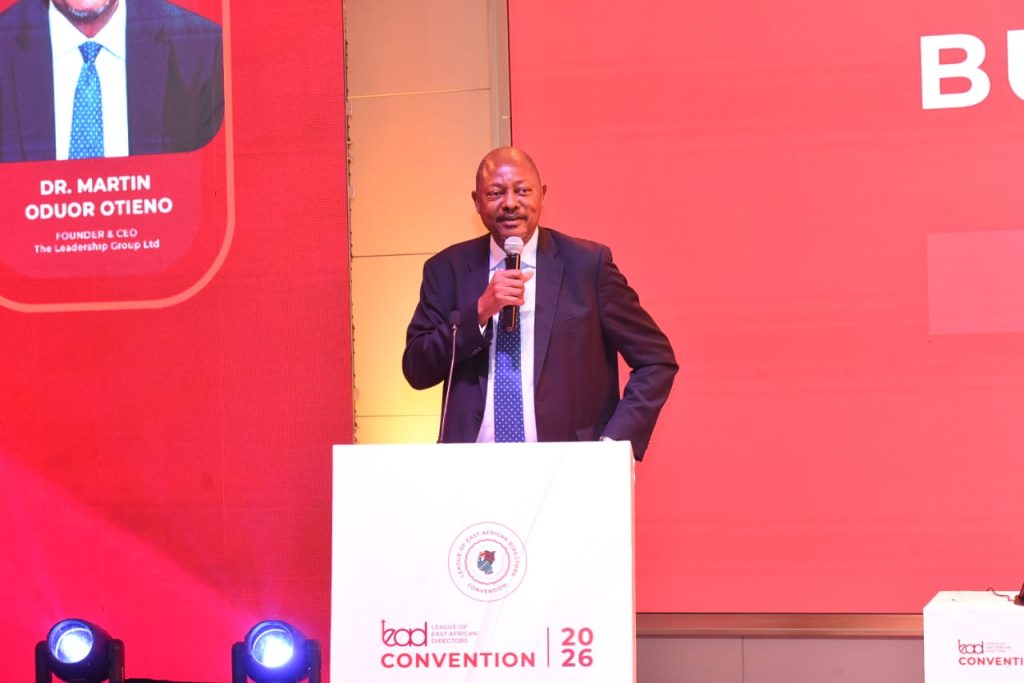
East African leaders meeting in Kampala for the LEAD Convention 2026 have amplified calls for stronger governance and institutional resilience, as businesses and governments navigate rising global volatility and shifting risk landscapes.
East African business and policy leaders are pushing a stronger governance and resilience agenda as global volatility—from geopolitical tensions to technological disruption—forces organisations to rethink how they manage risk and sustain growth.
Policymakers, corporate executives and governance professionals convened at the high-level forum to examine how institutions across the region can strengthen leadership, enhance resilience and sustain economic transformation.
The convention, organised by the League of East African Directors, held on April 30 at Arirang Hotel attracted more than 300 participants from across East Africa and beyond.
Held under the theme “Future-Proofing Business: Risk, Resilience and Responsibility—Leading Through Uncertainty,” discussions unfolded against a backdrop of geopolitical tensions, rapid technological disruption, climate risks and evolving regulatory pressures that are reshaping operating environments.
Organisers positioned the convention as a strategic platform to strengthen boardroom effectiveness, promote ethical leadership and elevate governance standards across both public and private sectors.
Deliberations centred on equipping leaders with tools to navigate increasingly complex risks, while shifting institutions from reactive responses to more anticipatory governance models.
Key focus areas included risk governance and strategic foresight, digital transformation and cyber resilience, and oversight of state-owned enterprises—issues increasingly seen as central to long-term competitiveness.
Gertrude Karugaba, Chairperson of the League, underscored the critical role of boards in setting strategic direction and ensuring accountability, particularly in periods of uncertainty.
“This room is full of leaders who understand that governance is not a commodity. It is a responsibility that carries weight in the lives of real people. In times of uncertainty, the boundaries between board and management matter most. Our role is to set the strategic direction, to determine the risk appetite, and to hold management accountable. Our work is to listen, to challenge, to question, but never to do,” she said.
The forum also deepened public-private dialogue, positioning governance as a core driver of economic transformation and investor confidence across the region.
As global volatility continues to test institutions, speakers called for leadership approaches that go beyond compliance to embrace values-driven decision-making.
Martin Oduor Otieno, Founder and CEO of The Leadership Group Ltd., argued that effective governance must be anchored in trust and human-centred leadership.
“The ultimate hedge against volatility and uncertainty is not a more complex algorithm. It is a leadership philosophy rooted in empathy, trust, and the restoration of human dignity at the centre of governance. As you go back to your boardrooms, look beyond the risk register and the audit reports. Look at the people. Build institutions that are not just future-proof, but future-wise,” he said.
Analysts say forums such as the LEAD Convention are increasingly significant as East Africa seeks to position itself as a competitive and well-governed investment destination.
With governance standards under growing scrutiny from investors and development partners, the region’s ability to strengthen boardroom accountability and institutional resilience is expected to play a decisive role in shaping its long-term economic trajectory.
Related Posts
 Uganda launches electric bus service in Kampala, targets nationwide rollout by 2030
 Equity Bank enrolls top Ugandan scholars into 2026 leadership pipeline
 Dr James Mwangi is CEO of the year as Equity Bank dominates Kenya Banking Awards
 IATA pilots Billing & Settlement Plan in Somalia
 80percent of the world’s blocked airline funds are in Africa as industry struggles to break even
 World Bank says knock-on effects of Middle East conflict will hit commodity markets
Get business news delivered to you everyday
Latest News

East Africa leaders push governance, resilience agenda amid global volatility

Uganda launches electric bus service in Kampala, targets nationwide rollout by 2030

Equity Bank enrolls top Ugandan scholars into 2026 leadership pipeline

Uganda breaks into ultra-fast Internet league with 1Gbps Broadband rollout

Dr James Mwangi is CEO of the year as Equity Bank dominates Kenya Banking Awards

IATA pilots Billing & Settlement Plan in Somalia

80percent of the world’s blocked airline funds are in Africa as industry struggles to break even

Regional technocrats meet to drive EAC cross-border government securities trading

Stanbic Bank CE cites up-skilling as vital to realizing oil sector gains

Airbus profits slump as engine shortages and lower deliveries weigh on Q1 performance