

Stanbic Bank CE cites up-skilling as vital to realizing oil sector gains
 Kalifungwa said the impending production phase presents both significant opportunities and complex challenges that require a highly skilled and adaptable workforce, however
he reaffirmed Stanbic Bank’s commitment to the sector, describing it as a catalyst for broad-based economic transformation and a cornerstone of national resilience.
Kalifungwa said the impending production phase presents both significant opportunities and complex challenges that require a highly skilled and adaptable workforce, however
he reaffirmed Stanbic Bank’s commitment to the sector, describing it as a catalyst for broad-based economic transformation and a cornerstone of national resilience.
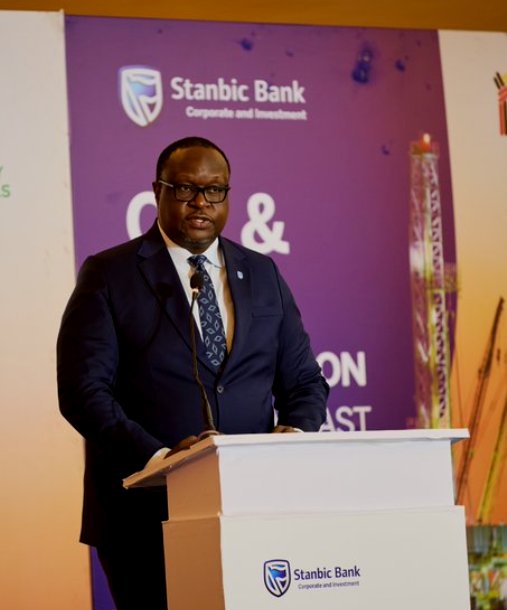
Mumba Kalifungwa, the Chief Executive of Stanbic Bank, has called on business leaders to invest in appropriate workforce upskilling, cautioning that companies risk falling behind as Uganda transitions into an oil-producing economy.
“Uganda is on the brink of a major economic shift. The critical question is whether our companies and more importantly, our people are adequately prepared to seize these opportunities and participate meaningfully in the oil and gas value chain, including upstream operations,” he said.
Kalifungwa made the remarks during the CEO’s Breakfast Meeting at the ongoing 11th Oil and Gas Convention at Speke Resort Munyonyo under the theme First Oil: Fulfilling the Promise, Forging the Future.
He said the impending production phase presents both significant opportunities and complex challenges that require a highly skilled and adaptable workforce. Kalifungwa reaffirmed Stanbic Bank’s commitment to the sector, describing it as a catalyst for broad-based economic transformation and a cornerstone of national resilience.
The annual convention convenes policymakers, financiers, and industry leaders to assess progress and shape Uganda’s oil and gas journey, which is widely regarded as a defining chapter in the country’s economic future.
Thomas Tayebwa, the Deputy Speaker of Parliament, underscored the need for accountability and institutional discipline as Uganda approaches first oil. “We must get this right from the outset. The laws, oversight, and discipline in implementation will determine whether oil becomes a blessing or a burden,” Tayebwa said. He called for transparency and robust governance frameworks.
Meanwhile, Ruth Nankabirwa, Minister of Energy and Mineral Development, reaffirmed government’s commitment to delivering First Oil while ensuring inclusive national benefits.
She said Uganda has moved from planning to execution, with key projects such as Tilenga, Kingfisher, and the East African Crude Oil Pipeline progressing steadily.
“We are not simply preparing for First Oil; we are laying the foundation for a transformed economy. Every investment must translate into jobs, skills, and opportunities for our people,” she said. She highlighted new infrastructure developments including Kabalega International Airport and the emerging industrial parks.
Damoni Kitabire, Chairperson of the Stanbic Bank Board, linked Uganda’s oil ambitions within the broader global energy transition, describing the current moment as one of “profound contradiction.”
“As Uganda approaches First oOil, the world is simultaneously accelerating toward a low-carbon future. Yet recent geopolitical developments have exposed the fragility of global energy systems and reaffirmed the enduring centrality of oil,” he said.
Kitabire argued that global economic realities continue to underscore oil’s importance, even amid transition efforts. While acknowledging criticism surrounding fossil fuel investments, particularly projects such as the East African Crude Oil Pipeline, he emphasized the need for a pragmatic and inclusive pathway for emerging economies.
“Climate change is real and urgent. However, the transition must be practical, sequenced, and inclusive, especially for Africa. Uganda’s first oil is not a contradiction of the energy transition; it is part of it,” he said.
He reiterated Stanbic’s alignment with its parent, Standard Bank Group, in supporting a ‘just and patient’ transition, leveraging current oil resources to finance future renewable energy systems while safeguarding economic growth and energy access.
Kalifungwa emphasized that the true measure of success for Uganda’s oil and gas sector will extend beyond production volumes to its wider economic impact. “The opportunity before us is to ensure that oil revenues circulate within the domestic economy, creating enterprises, generating employment, and delivering long-term prosperity,” he said.
He said Stanbic’s involvement in major projects such as the East African Crude Oil Pipeline goes beyond financing infrastructure to enabling a broader ecosystem of value creation.
Through sector expertise and advisory services, the bank supports both public and private stakeholders in managing risks, navigating volatility, and building resilience.
He highlighted local content development as central to this vision. He cited initiatives such as the Stanbic Business Incubator in partnership with institutions including the African Development Bank and other development partners, to support hundreds of Ugandan enterprises to achieve international standards and competitively participate in the oil and gas value chain.
Eva Mpalampa, Head of Oil and Gas at Stanbic Bank, said the convention reflects a broader industry shift from planning to execution. “For over a decade, this forum has focused on projections. Today, we are firmly in the implementation phase,” she said.
She spoke of Stanbic’s deep sector expertise and local market knowledge, positioning the bank as a strategic financial partner throughout Uganda’s oil and gas journey.
She highlighted the bank’s 35-year presence in Uganda as evidence of its long-term commitment, supported by an extensive branch network, including a strong footprint within the oil-producing regions. Mpalampa said First Oil should be viewed as a foundation rather than an endpoint.
“Energy independence is not the destination; it is the starting point. Revenues generated today must be reinvested into renewable energy, infrastructure, and human capital to power the next phase of growth,” she said.
She also identified agriculture, workforce development, and women-led enterprises as priority areas to ensure inclusive benefits, stressing the importance of creating a ripple effect across the wider economy.
Mpalampa said, “Stanbic provides a comprehensive suite of financial solutions, including risk management, trade services, and market advisory enabling clients to navigate evolving market conditions and access deeper liquidity across both domestic and international markets.”
Related Posts
 Uganda’s Oil Refinery Still Makes Sense in a USD500 Billion Economy
 CMA Opens Dangote Refinery IPO to Uganda’s Wealthy investors as SBG Securities Uganda Limited Becomes Sole Intermediary
 JPMorgan Abandons Oil Price Baseline as Iran Conflict Deepens Market Uncertainty
 Uganda Breaks Ground on USD310m Kampala Fuel Terminal, Targets September 2028 Completion
 Oil Money’s First Test Will be Uganda’s Ability to Stop it Leaking Through Flawed Procurement
 Appellation: Uganda Gives its Crude a Brand as ‘Pearl Sweet’ Ahead of November First Oil
Get business news delivered to you everyday
Latest News

Uganda Emerges as Africa’s Largest Organic Farming Country as Exports Reach USD225 Million

SITA Acquisition of Collins Airport Solutions Signals Moves to Consolidate Aviation Technology

Uganda Coffee Roasters Tap Richard Rugaya as Executive Director, with Focus on Commercial Growth

Equity Bank Reports UGX37.6 Billion in Green Loans as Uganda Seeks to Scale Climate Investment

Why Africa’s Institutions Must Turn Knowledge and Investment into Farmer Prosperity

Forbes ranks MTN Group third globally on best telecom employer list

Stanbic experts offer investment insights to navigate current market uncertainty

Africa Carbon Markets Urged to Turn Potential into Investment and Delivery

Bank of Uganda hikes base rate from 9.75% to 12% amidst global tensions

Corporate Buyers Could Help Unlock SAF Market Worth Millions of Tonnes by 2030