

SITA: Why African airports are investing more but getting less value
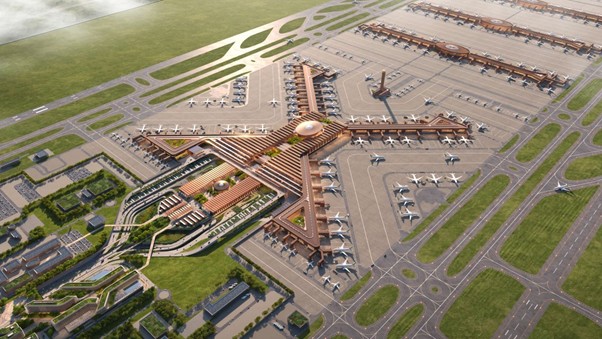 A schematic image of the first phase of Ethiopia’s new Bishoftu Airport in Addis-Ababa. Once complete towards the end of the 2030s, the mega hub will have an annual capacity of 110 million passengers
As airlines and airports across Africa race to expand capacity, a new report by aviation industry IT provider SITA, suggests the region may not be getting the full value from its technology spend.
The Air Transport IT Insights 2025 Report shows that while airlines in the Middle East and Africa are increasing investment in digital systems, airports are lagging behind—creating fragmentation across the aviation ecosystem. Only 43 percent of airports in the region plan to increase technology spending, compared to 63 percent globally.
In this interview with 256 Business News,’ Aviation & Technology Lead Michael Wakabi, SITA President for the Middle East, Africa and Türkiye, Selim Bouri, explains why data integration matters more than new terminals, why AI is only as good as the data behind it, and why Africa has a unique chance to build smarter aviation systems from the ground up.
Q: Your report suggests Africa and the Middle East are not getting the full value from aviation technology investments. What is the problem?
Selim Bouri: The issue is not that investment is too low—it is that the value coming from that investment is often limited because systems are still fragmented.
The challenge is global, not just African. Airlines and airports are investing more in technology, which is positive, but what they get from that technology depends on data quality, data integration, and how connected those systems are.
In Africa and the Middle East, airlines are investing aggressively, and all of them plan to continue doing so. But airports are moving much more slowly. Only 43 percent of airports in the region plan to increase technology investment, while 12 percent are actually considering reducing it.
That is worrying because aviation challenges today cannot be solved by infrastructure expansion alone. Building bigger airports or buying more aircraft takes time. Technology helps solve immediate capacity constraints, disruptions, and sustainability challenges right now.
Q: So how can airlines and airports harmonise performance across the ecosystem?
Selim Bouri: We are seeing progress. About 73 percent of airlines and a similar number of airports are investing in data-driven decision-making systems.
For airlines, this includes tools that optimise aircraft trajectories using data from weather, fuel consumption, and aircraft performance. For airports, it includes biometrics, self-service systems, passenger flow management, and AI-driven customer service.
The problem is that many of these solutions still operate in isolation.
You can optimise passenger flow in one terminal, but if that is not linked to aircraft turnaround, baggage handling, fuel coordination, or slot management, delays simply move somewhere else.
That is why integration is critical. Improving one point in the system is not enough. The next stage is linking everything together so the entire ecosystem improves at once.
Q: Why is integration still so limited? Is it a technology problem or a mindset problem?
Selim Bouri: It is a combination of both, but mostly complexity.
Air transport involves many players—airlines, airports, governments, border agencies, ground handlers, and passengers. Each has different systems, different standards, and different levels of data maturity.
Airlines are often ahead because they control more of their own operations. Airports are more complex because they must coordinate with multiple airlines, governments, and service providers.
The technology exists. The real challenge is agreeing on standards, funding models, and collaboration.
Even basic IT and telecommunications infrastructure is still the number one investment priority for 56 percent of airports globally. Without that foundation, you cannot even collect and trust the data needed for advanced systems.
Q: Are the costs of fragmentation that obvious?

The new addition to the departure terminal at Entebbe that is set to open in May
Selim Bouri: Absolutely—and Africa actually has an opportunity here.
In some regions, airports have had to keep layering new technology on top of outdated systems. That creates inefficiency. In Africa, many airports still have the chance to go directly to smarter systems from the start.
It is like mobile networks. If you are building today, you do not start with 2G—you go directly to 5G.
The same logic applies in aviation.
For example, around 40 percent of airlines already use AI-based tools that optimise fuel consumption by 3 to 10 percent on the same route with the same aircraft. On a typical narrow-body flight, that can mean savings of between $75,000 and $150,000 without buying a new aircraft.
That is immediate return on investment.
Q: How can cash-strapped African airports avoid a patchwork approach as technology keeps evolving?
Selim Bouri: The answer is not chasing every new technology. It is focusing on the fundamentals.
The fundamentals are data collection, open interfaces, standardisation, modularity, and scalability.
Whatever system is chosen must be flexible enough to evolve without forcing the airport to rebuild everything later.
Airports are long-term investments. You are not building for one year—you are building for the next 10 to 20 years.
That means choosing technology that can scale with future traffic, future disruptions, and future operational demands.
Technology will change, but the need for interoperability will not.
Q: Is there a risk Africa could overinvest in hardware and underinvest elsewhere?
Selim Bouri: The bigger question is what strategic role a country wants aviation to play.
Do you want a national airline? A regional hub? A cargo gateway? A maintenance centre? A tourism destination?
Those choices determine investment priorities.
What is clear is that aviation is a major force for economic growth in Africa, and Africa is one of the fastest-growing aviation markets in the world.
Technology should be the first strategic pillar, not the last.
IT spending may represent only about 3.6 percent of airline revenue and around 8 percent of airport revenue, but it is often the most transformative investment an airport can make.
Q: If you had to prioritise, what are the top three things’ airports and airlines must do now?
Selim Bouri: First, implement AI where it creates operational value. Not because AI is fashionable, but because it helps make better decisions at the right time.
Second, improve data integration and data integrity. AI is only as good as the data behind it. If the data is weak, AI creates more disruption, not less.
Third, address capacity and sustainability in two stages—immediate technology upgrades first, and longer-term infrastructure expansion second.
Africa has a unique opportunity to build smarter from the beginning.
Instead of building first and fixing later, airports can use technology to define what should be built in the first place. That is where the real competitive advantage lies.
Q: Thank you for your time, Mr Bouri
Selim Bouri: Thank you for having me
Related Posts
 Uganda Coffee Roasters Tap Richard Rugaya as Executive Director, with Focus on Commercial Growth
 Why Africa’s Institutions Must Turn Knowledge and Investment into Farmer Prosperity
 Forbes ranks MTN Group third globally on best telecom employer list
 Stanbic experts offer investment insights to navigate current market uncertainty
 Africa Carbon Markets Urged to Turn Potential into Investment and Delivery
 Corporate Buyers Could Help Unlock SAF Market Worth Millions of Tonnes by 2030
Get business news delivered to you everyday
Latest News

Uganda Coffee Roasters Tap Richard Rugaya as Executive Director, with Focus on Commercial Growth

Equity Bank Reports UGX37.6 Billion in Green Loans as Uganda Seeks to Scale Climate Investment

Why Africa’s Institutions Must Turn Knowledge and Investment into Farmer Prosperity

Forbes ranks MTN Group third globally on best telecom employer list

Stanbic experts offer investment insights to navigate current market uncertainty

Africa Carbon Markets Urged to Turn Potential into Investment and Delivery

Bank of Uganda hikes base rate from 9.75% to 12% amidst global tensions

Airbus sees USD420bn Global Aviation Services Boom: Can Africa Capture its Share?

Nile Breweries Celebrates 75 Years of Growing with Uganda

Nawangwe Urges Architects to Document Uganda’s Built Heritage