

Stanbic-backed farmer venture opens Bunyoro’s chilli exports route to Europe
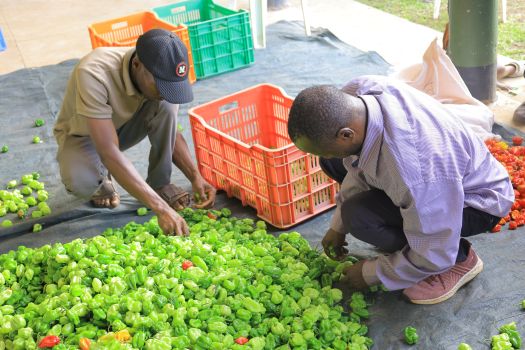
A group of horticultural farmers in Bunyoro has entered a joint venture with exporter KK Foods to supply chilli and hot pepper to European markets, turning training from Stanbic Business Incubator and UNOC into a practical export pathway for rural incomes and agribusiness growth.
Horticultural farmers in Uganda’s Bunyoro sub-region are stepping into global trade after forming a joint venture with local exporter KK Foods to supply fresh chilli and hot pepper to Western Europe, including the United Kingdom, in a move expected to raise rural incomes and deepen agribusiness participation in export markets.
The partnership, signed under the Albertine Farmers Association (AFA), marks a significant transition from subsistence and local market farming to structured export-oriented production. It also highlights how corporate-backed incubation programmes are increasingly becoming catalysts for regional enterprise growth.
The venture was officially launched at Ageteraine Agro-Processing Facility in Hoima City, where farmers and stakeholders described the agreement as a major breakthrough for the region’s horticulture sector.
AFA Chairperson Julius Kwamya said the decision to begin with hot pepper and chilli was strategic because of the crops’ strong international demand, short production cycles and high turnover potential.
“During the training, we agreed on the way forward. We agreed to start with hot pepper and chilli for now, but we will scale to other enterprises,” Kwamya said.
He noted that the association currently has 1,930 registered members and is targeting 10,000 by the end of 2026, positioning it as one of the largest organised farmer groups in the Albertine region.
Demand for fresh chilli products in Europe continues to grow, driven by immigration-led culinary diversification and increased appetite for exotic and spicy foods. France, Spain, the United Kingdom and Germany remain among the leading importers of fresh chilli.
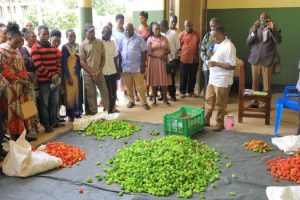
Farmers attending a briefing session by Nicholas Atukwase
The export arrangement is one of the key outcomes of an August 2025 capacity-building workshop that trained more than 30 horticultural farmers under the Albertine Agribusiness Development Programme (ADP), implemented by Stanbic Business Incubator Limited (SBIL) in partnership with the Uganda National Oil Company (UNOC).
For Stanbic, the development reinforces its broader strategy of supporting enterprises beyond financing by building practical market linkages.
SBIL Chief Executive Catherine Poran said the partnership demonstrates the importance of connecting farmers to viable buyers rather than focusing only on production.
“It is one thing for farmers to grow food, but it is another to link them to markets and see the fruits of their labour,” Poran said.
“At Stanbic Business Incubator, our mandate lies in supporting enterprises to scale and reach their potential, all in line with our purpose of driving Uganda’s growth.”
KK Foods, which exports fresh horticultural produce, said the European market has room for significant volumes, but farmers must consistently meet strict quality standards.
Nicholas Atukwase, a Production Manager at KK Foods, said the company requires at least 50 tonnes of produce per week to satisfy demand.
“There is a lot of demand for products like chilli and hot pepper. Farmers will benefit, but they must uphold the pillars of quality, quantity, consistency, customer requirements and regulatory guidelines,” he said.
That requirement presents both opportunity and challenge.
Farmers in Hoima and the wider Bunyoro region continue to face limited access to agricultural extension services, affecting productivity and compliance with export standards.
Kwamya urged government to strengthen support systems at the grassroots, particularly through more extension workers who can guide farmers on best agronomic practices and export compliance.
The Ministry of Agriculture says export horticulture remains one of Uganda’s strongest untapped opportunities, but success depends heavily on meeting phytosanitary and traceability requirements.
Emmanuel Blair Niyitegeka, a Senior Agricultural Inspector in the Department of Crop Inspection and Certification, said hot pepper products have strong demand not only in Europe but also in the Middle East and parts of Asia.
However, he warned that markets such as the European Union and the UK have some of the most stringent standards.
“The pepper must be free from pests. Farmers must control pests at the farm, install insect traps and ensure pesticide application is done at the right time and with the correct dosage,” he said.
He added that by harvest time, produce must fully comply with inspection standards to avoid rejection in destination markets.
To improve traceability, Hoima District is pushing farmer certification and coding systems that allow every farm to be identified and monitored individually.
District Production Officer Dr Charles Kajura said coding helps authorities quickly trace any quality issues back to the source farm.
“Each farmer must be coded. When produce reaches the export market and there is any problem, we must be able to return to that specific farm without hesitation,” he said.
Kajura said the district is also promoting group-based extension models and training Community-Based Facilitators to bridge staffing gaps.
Instead of relying solely on district extension officers, two facilitators are being selected per parish to provide hands-on support when government officers are unavailable.
For UNOC, the programme fits within a wider national content agenda aimed at ensuring oil and gas investments create benefits across the broader economy.

Catherine Poran, the Chief Executive of Stanbic Business Incubator
Percy Mucunguzi, UNOC’s National Content Officer in charge of Measurements and Reporting, said agriculture must be viewed as a critical support sector for oil and gas development.
“We cannot just look at oil and gas because it is the hot cake in this region. We have to look at food supply, medical services, insurance, transport and others. That is how benefits flow from oil and gas to the rest of the economy,” he said.
He encouraged farmers to diversify into multiple enterprises to strengthen household incomes and reduce dependency on a single value chain.
The Hoima venture is increasingly being seen as a model for how business incubation, public-private partnerships and organised farmer groups can transform local agriculture into a serious export business.
For Stanbic, it is also proof that incubation is most effective when it moves beyond classrooms, into contracts—where farmers can convert knowledge into sustainable commercial returns.
Related Posts
 Uganda Emerges as Africa’s Largest Organic Farming Country as Exports Reach USD225 Million
 Uganda Coffee Roasters Tap Richard Rugaya as Executive Director, with Focus on Commercial Growth
 Why Africa’s Institutions Must Turn Knowledge and Investment into Farmer Prosperity
 Forbes ranks MTN Group third globally on best telecom employer list
 Stanbic experts offer investment insights to navigate current market uncertainty
 Africa Carbon Markets Urged to Turn Potential into Investment and Delivery
Get business news delivered to you everyday
Latest News

Uganda Emerges as Africa’s Largest Organic Farming Country as Exports Reach USD225 Million

SITA Acquisition of Collins Airport Solutions Signals Moves to Consolidate Aviation Technology

Uganda Coffee Roasters Tap Richard Rugaya as Executive Director, with Focus on Commercial Growth

Equity Bank Reports UGX37.6 Billion in Green Loans as Uganda Seeks to Scale Climate Investment

Why Africa’s Institutions Must Turn Knowledge and Investment into Farmer Prosperity

Forbes ranks MTN Group third globally on best telecom employer list

Stanbic experts offer investment insights to navigate current market uncertainty

Bank of Uganda hikes base rate from 9.75% to 12% amidst global tensions

Corporate Buyers Could Help Unlock SAF Market Worth Millions of Tonnes by 2030

Airbus sees USD420bn Global Aviation Services Boom: Can Africa Capture its Share?