

Equity Bank warns on public Wi-Fi as courts shift burden to banking customers
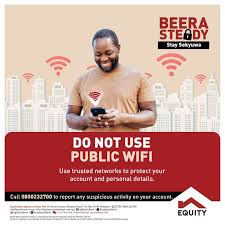
Equity Bank Uganda has warned customers against using public Wi-Fi for banking, highlighting rising cyber risks as court rulings and industry campaigns place greater responsibility on users to safeguard their credentials.
Equity Bank Uganda has stepped up warnings over the use of public Wi-Fi networks for banking, citing rising exposure to cyber threats and financial fraud as more customers shift to digital channels.
The advisory comes against the backdrop of recent court rulings in Uganda that have placed primary responsibility for safeguarding account credentials on customers, reinforcing the need for stronger user vigilance in an increasingly digital financial ecosystem.
In a message shared on X under its “Beera Steady” campaign, the bank cautioned that public internet connections—commonly found in cafes, hotels, and airports—are often unsecured and can expose users to data theft and unauthorised account access.
“Public networks are not secure. Always use your mobile data when accessing your bank account,” the bank said.
The lender urged customers to avoid conducting sensitive transactions such as mobile banking, online transfers, and account logins while connected to public Wi-Fi, warning that such environments can be easily exploited by cybercriminals.
Security experts note that public Wi-Fi networks are particularly vulnerable to attacks such as data interception and spoofing, where malicious actors can capture login credentials, banking details, and other personal information transmitted over unsecured connections.
The warning reflects a broader shift in Uganda’s banking landscape, where mobile and online platforms have become central to financial transactions. While this transition has improved convenience and access, it has also widened the attack surface for fraud and cybercrime.
As a result, banks are increasingly investing in customer awareness initiatives to complement internal security systems. Equity Bank Uganda’s “Beera Steady” campaign is part of this wider industry effort to promote safe digital practices and reduce incidents of avoidable fraud.
The push for greater awareness gained momentum following a series of high-profile cases involving unauthorised access to customer accounts. Investigations into these incidents often revealed that compromised credentials—rather than system breaches—were the primary point of failure, with some customers unknowingly sharing sensitive information or storing login details on unsecured devices.
In response, the Uganda Bankers Association, working alongside the Bank of Uganda and the Ministry of ICT and National Guidance, launched a sector-wide public awareness campaign aimed at educating users on digital banking risks and the importance of safeguarding personal credentials.
That campaign marked a turning point in how responsibility for digital security is communicated, with greater emphasis placed on user behaviour alongside institutional safeguards.
Analysts say the latest advisory from Equity Bank Uganda reinforces the message that even the most secure banking systems can be undermined by unsafe user practices.
Customers are now being encouraged to adopt basic but critical precautions, including using personal mobile data instead of public Wi-Fi, avoiding sharing passwords or PINs, enabling two-factor authentication where available, and regularly monitoring account activity for suspicious transactions.
As Uganda’s financial sector continues its transition toward cashless and mobile-first services, the balance between convenience and security is becoming increasingly important.
Equity Bank Uganda’s warning underscores a growing consensus within the industry—that digital banking safety is no longer solely the responsibility of financial institutions, but a shared obligation requiring informed and cautious users.
Related Posts
 SITA Acquisition of Collins Airport Solutions Signals Moves to Consolidate Aviation Technology
 Uganda Coffee Roasters Tap Richard Rugaya as Executive Director, with Focus on Commercial Growth
 Equity Bank Reports UGX37.6 Billion in Green Loans as Uganda Seeks to Scale Climate Investment
 Nile Breweries Celebrates 75 Years of Growing with Uganda
 Stanbic installs solar power system at Mbale School for the Deaf
 Airbus-Kratos Valkyrie Unmanned Combat Aircraft Completes First Flight Ahead of 2029 Combat Target
Get business news delivered to you everyday
Latest News

Uganda Emerges as Africa’s Largest Organic Farming Country as Exports Reach USD225 Million

SITA Acquisition of Collins Airport Solutions Signals Moves to Consolidate Aviation Technology

Uganda Coffee Roasters Tap Richard Rugaya as Executive Director, with Focus on Commercial Growth

Equity Bank Reports UGX37.6 Billion in Green Loans as Uganda Seeks to Scale Climate Investment

Why Africa’s Institutions Must Turn Knowledge and Investment into Farmer Prosperity

Forbes ranks MTN Group third globally on best telecom employer list

Stanbic experts offer investment insights to navigate current market uncertainty

Africa Carbon Markets Urged to Turn Potential into Investment and Delivery

Bank of Uganda hikes base rate from 9.75% to 12% amidst global tensions

Corporate Buyers Could Help Unlock SAF Market Worth Millions of Tonnes by 2030