

ICEA LION pushes data-driven trust as Uganda’s insurance sector faces credibility test
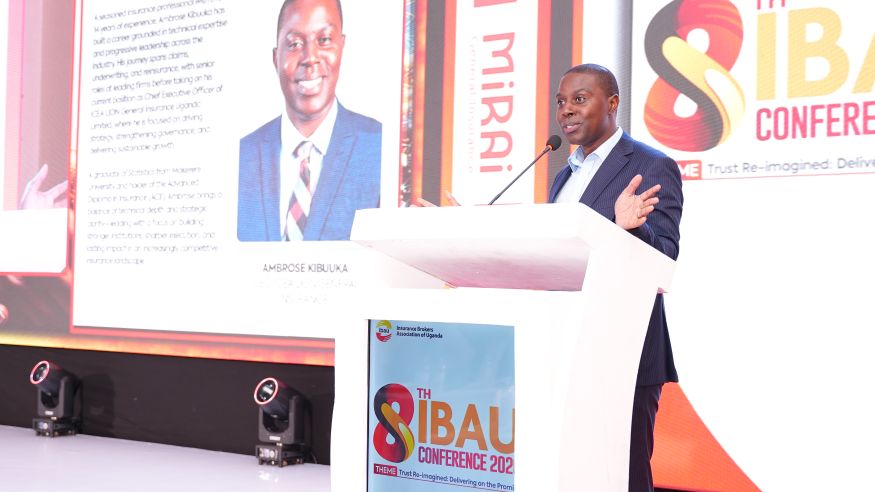
As Uganda’s insurance sector grows past UGX 2 trillion in gross written premiums, industry leaders are warning that growth without trust is unsustainable. At the IBAU Conference in Mbarara, ICEA LION called for a data-driven, connected insurance model where faster claims, stronger broker collaboration, and meaningful customer engagement rebuild confidence across the industry.
Uganda’s insurance industry is growing fast, but at the 8th Annual Insurance Brokers Association of Uganda (IBAU) Conference in Mbarara this week, the conversation was less about expansion and more about something harder to quantify—trust.
Held at Hotel Triangle from April 23 to 24 under the theme “Trust Reimagined: Delivering on the Promise,” the conference brought together regulators, brokers, insurers, and financial sector leaders to confront a pressing question: can the industry sustain growth without strengthening confidence where it matters most—claims settlement?
The numbers suggest momentum. Gross written premiums rose to UGX 2.02 trillion in 2025, up from UGX 1.76 trillion the previous year. Claims payouts also climbed sharply to UGX 950 billion, nearly half of total premiums, reflecting greater responsiveness across the sector.
Yet beneath the growth lies a more fragile reality. Brokers now handle 28.03 percent of premiums, down from over 30 percent in previous years, signaling changing market dynamics and growing concern over whether customer confidence is keeping pace with industry expansion.
Opening the conference, Insurance Regulatory Authority CEO Alhaj Kaddunabbi Ibrahim Lubega warned that trust in insurance is not built through marketing campaigns or policy documents, but through the claims experience.
“Trust is not built in policies or presentations,” he told delegates. “It is tested at the moment of claims. That is where the industry either proves its promise or loses it.”
His remarks struck at the core of the sector’s long-standing challenge. In insurance, value is often invisible until a crisis occurs, and delays, disputes, or poor customer experience during claims processing can quickly destroy years of relationship building.
Bank of Uganda Deputy Governor Augustus Nuwagaba expanded the discussion beyond the sector itself, describing insurance as a key pillar of economic resilience rather than a luxury product.
“An economy is not stable if its people are unprotected,” Nuwagaba said. “We have macroeconomic stability, low inflation, a resilient financial system, but millions remain exposed to risk. That gap is not just financial, it is structural.”
Despite economic progress, insurance penetration in Uganda remains low, especially among informal workers, rural households, and small businesses. For many Ugandans, insurance is still seen as expensive, complex, and disconnected from daily realities.
It is within this context that ICEA LION positioned itself not just as a conference sponsor, but as a voice pushing for a more connected and data-driven future.
Speaking during the conference, ICEA LION Group CEO Ambrose Kibuuka argued that trust in modern insurance must be built through stronger, continuous engagement rather than isolated customer interactions.
“In the digital economy, trust is no longer built in isolation,” Kibuuka said. “It is built through connection.”
He described the future of insurance through the idea of the “connected carrier,” where insurers move beyond the traditional cycle of onboarding, renewals, and claims to create real-time engagement supported by seamless data sharing and predictive insights.
The approach reflects how digital behaviour already shapes modern consumer expectations—from personalised recommendations to real-time service delivery—and Kibuuka believes insurance must evolve in the same direction.
ICEA LION Life CEO Emmanuel Mwaka reinforced that message, stressing that data itself is not the solution unless it is used responsibly and meaningfully.
“The real value of data is only realised when it is shared responsibly, interpreted properly, and used meaningfully,” Mwaka said.
That means breaking down silos not only within insurance firms but across the broader value chain, including brokers, intermediaries, and customers. The goal, he said, is to shift from transactional insurance to relationship-driven insurance, where companies anticipate and help prevent risk rather than simply responding after loss occurs.
This remains especially important in Uganda’s broker-driven market. With only 55 licensed brokers among more than 140 insurance players, brokers remain critical to helping customers understand products, assess risks, and navigate claims.
However, their declining share of premiums suggests the industry is changing in ways that demand adaptation.
ICEA LION’s argument is that the answer may not be more products alone, but better listening, faster responses, and simpler customer journeys.
Still, conference participants repeatedly returned to one unavoidable truth: execution matters more than strategy.
“We can have all the strategies and frameworks,” said Isabella Akareut, CEO of ayo Insurance Brokers Uganda, “but without execution, nothing changes.”
That execution gap remains most visible in claims management, where delays, paperwork, and customer frustration continue to undermine confidence across the sector.
For ICEA LION, technology is not meant to replace human relationships, but to strengthen them. Artificial intelligence, data analytics, and digital platforms are only valuable if they make insurance faster, clearer, and more dependable for the people who rely on it.
Because ultimately, insurance is not about policies or premiums. It is about families protecting livelihoods, businesses managing uncertainty, and institutions delivering support when it matters most.
As the conference closed, one message stood out clearly: trust is no longer a branding exercise—it is an operational requirement.
And in a business where promises are tested only in moments of vulnerability, the insurers that succeed will be those that deliver not just coverage, but confidence.
Related Posts
 Uganda Emerges as Africa’s Largest Organic Farming Country as Exports Reach USD225 Million
 Uganda Coffee Roasters Tap Richard Rugaya as Executive Director, with Focus on Commercial Growth
 Why Africa’s Institutions Must Turn Knowledge and Investment into Farmer Prosperity
 Forbes ranks MTN Group third globally on best telecom employer list
 Stanbic experts offer investment insights to navigate current market uncertainty
 Africa Carbon Markets Urged to Turn Potential into Investment and Delivery
Get business news delivered to you everyday
Latest News

Uganda Emerges as Africa’s Largest Organic Farming Country as Exports Reach USD225 Million

SITA Acquisition of Collins Airport Solutions Signals Moves to Consolidate Aviation Technology

Uganda Coffee Roasters Tap Richard Rugaya as Executive Director, with Focus on Commercial Growth

Equity Bank Reports UGX37.6 Billion in Green Loans as Uganda Seeks to Scale Climate Investment

Why Africa’s Institutions Must Turn Knowledge and Investment into Farmer Prosperity

Forbes ranks MTN Group third globally on best telecom employer list

Stanbic experts offer investment insights to navigate current market uncertainty

Bank of Uganda hikes base rate from 9.75% to 12% amidst global tensions

Corporate Buyers Could Help Unlock SAF Market Worth Millions of Tonnes by 2030

Airbus sees USD420bn Global Aviation Services Boom: Can Africa Capture its Share?