
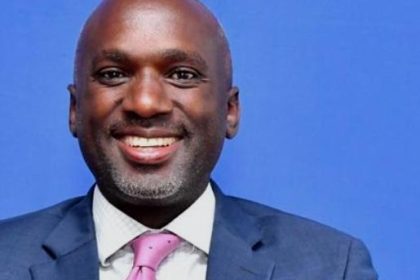
James Mwangi challenges Africa’s leaders to turn inclusion into economic power
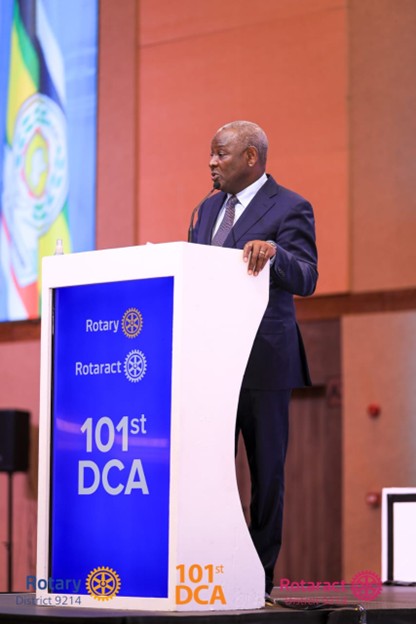
Equity Group CEO Dr James Mwangi has urged African leaders to move beyond dependency and build institutions that create shared prosperity, saying inclusive growth—not charity—will determine the continent’s place in the global economy.
Africa must stop being treated as a spectator in the global economy and begin shaping its own future through bold leadership, stronger institutions and inclusive growth, Equity Group Managing Director and CEO Dr James Mwangi has said.
Speaking at the Rotary District 9214 Conference and Assembly 2026 at Speke Resort Munyonyo, Mwangi challenged business leaders, policymakers and civic organisations to rethink development through the lens of dignity, opportunity and shared prosperity.
In a simple but pointed message, Mwangi said Africa can no longer afford to remain “on the menu” of global economic decisions and it must claim its seat “at the table.”
Reflecting on the global economic order, Mwangi noted that much of today’s international financial architecture was designed in the late 1940s, at a time when Africa had little or no voice in shaping it.
That legacy, he argued, still influences how the continent is positioned today—often as a recipient rather than a decision-maker.
But with Africa’s demographic strength, expanding markets and growing entrepreneurial base, he said the moment has come for the continent to define its own terms of engagement.
“This is a defining moment in history for Africa to choose its path,” he said, adding that leadership, and not just opportunity, will determine whether the continent transforms its potential into power.
Mwangi particularly praised Rotarians as a values-driven movement capable of accelerating that transformation through service, ethics and institution-building.
He said organisations like Rotary have a unique role to play because sustainable development requires more than capital; it requires trusted networks and purpose-driven leadership.
Drawing from the experience of Equity Group Holdings Plc, Mwangi said the most resilient institutions are those that integrate social impact directly into their business models rather than treating it as charity on the margins.
He pointed to one of the bank’s most important internal findings: nearly 40 percent of loan defaults were linked to health shocks affecting borrowers and their families.
That discovery forced the institution to rethink risk not just as a financial issue, but as a social one.
In response, Equity expanded its healthcare interventions through the Equity Group Foundation, establishing the Equity Afya network, which now supports more than 150 medical centres across the region.
The goal, he said, was not philanthropy alone, but protecting livelihoods and improving the economic resilience of communities.
“When people are healthy, they remain productive, businesses survive and families preserve dignity,” he said.
That same philosophy has shaped Equity’s broader investment in education, entrepreneurship and financial inclusion.
Mwangi said the group has so far awarded more than 60,000 scholarships under its Education and Leadership Development programmes, helping build a pipeline of future leaders from often underserved communities.
More than 2.4 million women and youth have been trained in financial literacy, while over 962,000 micro, small and medium enterprises have received entrepreneurship training.
The institution has also supported more than 3.8 million farmers and reached nearly 6 million people through social protection programmes aimed at improving household resilience.
These numbers, Mwangi said, are not just statistics but reflect a long-term strategy built around expanding wealth creation opportunities for people who are often excluded from formal systems.
He described this as a shared prosperity model, where institutions grow only when the communities around them also grow.
That approach has become central to Equity’s identity as it expands across Africa.
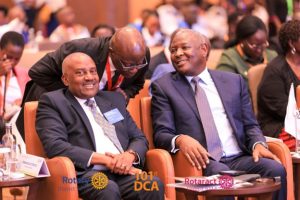
Rotary International Director for Africa Emmanuel Katongole and Equity Group Managing Director and CEO Dr James Mwangi at the Rotary District 9214 Conference and Assembly at Speak Resort Munyonyo earlier today
Despite being recognised as one of Africa’s strongest and most valuable financial brands, the group continues to allocate 2 percent of its annual revenue to social impact initiatives—a model Mwangi says is essential for sustainable corporate success.
He also linked economic inclusion to climate resilience, noting that long-term prosperity cannot be separated from environmental sustainability.
Through its sustainability programmes, Equity has facilitated the planting of more than 44.6 million trees and distributed over 542,000 clean energy products, helping communities reduce environmental risk while improving livelihoods.
For business leaders attending the conference, the takeaway was that profitability and purpose are no longer competing goals. In fact, Mwangi argued, the future belongs to institutions that understand both must move together.
Mwangi said partnerships between business, civic organisations and governments will be critical in making that transition work.
He reaffirmed Equity’s commitment to supporting such partnerships and standing with movements that strengthen Africa’s voice and agency.
“The future of Africa will be defined by the choices we make today,” he said, throwing a challenge to leaders not simply to build bigger institutions, but to build systems where more people can rise with them.
Related Posts
 Uganda Emerges as Africa’s Largest Organic Farming Country as Exports Reach USD225 Million
 SITA Acquisition of Collins Airport Solutions Signals Moves to Consolidate Aviation Technology
 Uganda Coffee Roasters Tap Richard Rugaya as Executive Director, with Focus on Commercial Growth
 Equity Bank Reports UGX37.6 Billion in Green Loans as Uganda Seeks to Scale Climate Investment
 Why Africa’s Institutions Must Turn Knowledge and Investment into Farmer Prosperity
 Stanbic experts offer investment insights to navigate current market uncertainty
Get business news delivered to you everyday
Latest News

Uganda Emerges as Africa’s Largest Organic Farming Country as Exports Reach USD225 Million

SITA Acquisition of Collins Airport Solutions Signals Moves to Consolidate Aviation Technology

Uganda Coffee Roasters Tap Richard Rugaya as Executive Director, with Focus on Commercial Growth

Equity Bank Reports UGX37.6 Billion in Green Loans as Uganda Seeks to Scale Climate Investment

Why Africa’s Institutions Must Turn Knowledge and Investment into Farmer Prosperity

Forbes ranks MTN Group third globally on best telecom employer list

Africa Carbon Markets Urged to Turn Potential into Investment and Delivery

Bank of Uganda hikes base rate from 9.75% to 12% amidst global tensions

Corporate Buyers Could Help Unlock SAF Market Worth Millions of Tonnes by 2030

Airbus sees USD420bn Global Aviation Services Boom: Can Africa Capture its Share?