

IFAD, Equity Launch USD200m Mechanism to Take Climate Finance to East Africa’s Farmers
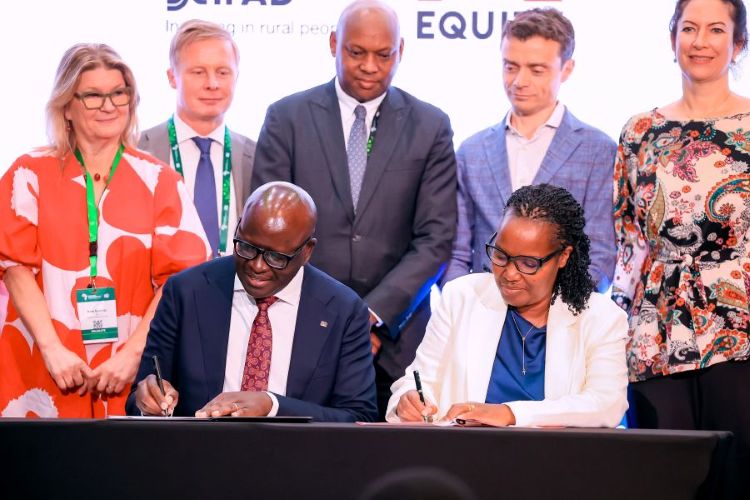
The International Fund for Agricultural Development (IFAD) and Equity Group have launched a USD200 million financing mechanism designed to push climate adaptation finance deeper into East Africa’s agricultural economy, targeting smallholder farmers and rural businesses often left outside conventional climate finance channels.
The Africa Rural Climate Adaptation Finance Mechanism (ARCAFIM), launched at the Africa Food Systems Forum 2026 in Kigali, will operate across Kenya, Uganda, Tanzania and Rwanda over 12 years, with the ambition of reaching approximately 260,000 smallholder producers and 500 rural micro, small and medium-sized enterprises (MSMEs).
At least 50pc of intended beneficiaries will be women and 30pc youth. The initiative is expected to strengthen food security for about 1.2 million people and benefit an estimated 1.5 million people directly and indirectly.
The mechanism is backed by IFAD, Equity Group and international financing partners, including the Green Climate Fund (GCF), the Ministry for Foreign Affairs of Finland, the Nordic Development Fund, Denmark and the European Union.
Its distinctive feature is that Equity is putting its own balance sheet alongside concessional public capital, rather than simply administering development funds.
ARCAFIM comprises USD180 million in lending capital and approximately USD20 million in technical assistance. Equity Group will provide USD90 million from its own balance sheet, matching the concessional contribution on a one-for-one basis.
Because the lending capital is expected to revolve through roughly four investment cycles, the mechanism is projected to generate about USD266 million in loans to smallholder farmers and MSMEs across East Africa’s food systems.
The structure also spreads risk among the participating financiers. International financing partners will cover a first-loss layer, a mezzanine layer will be shared with the bank, while Equity carries the senior risk.
The financing is intended to support investments that can help agricultural producers withstand increasingly difficult climate conditions while improving their productive capacity and incomes.
These include irrigation and water harvesting, more resilient dairy and livestock production, post-harvest storage, renewable energy and climate-resilient agro-processing.
The programme also includes a climate adaptation taxonomy intended to help participating financial institutions and rural businesses identify viable adaptation investments.
The technical assistance component is built into the financial architecture rather than treated as an additional programme. It will help microfinance institutions and savings and credit cooperative societies (SACCOs) develop the capacity to originate adaptation lending, while giving farmers and rural enterprises the technical knowledge to identify investments capable of protecting their businesses against climate risks.
Dr Gérardine Mukeshimana, IFAD Vice President, said the challenge was to translate global climate commitments into tangible investments in rural communities.
“ARCAFIM’s ambition is to make rural climate adaptation a recognizable, viable and sustainable business line for African financial institutions,” she said.
The model is intended to extend beyond its initial East African focus. IFAD and Equity Group have identified Southern and West Africa as potential next regions for replication.
Equity Group Managing Director and Chief Executive Officer Dr James Mwangi said the mechanism represents a shift in how financial institutions view rural borrowers.
“Africa’s smallholder farmers are not waiting to be rescued. They are entrepreneurs operating in the most demanding risk environment on earth, and what they have lacked is a financial system built to back them,” he said.
By committing its own balance sheet alongside concessional capital, Mwangi said, Equity was seeking to build a market in which financing climate resilience becomes an ordinary banking business rather than an act of charity.
For Equity Bank Kenya Managing Director Moses Nyabanda, the focus will be on translating the financing structure into practical investments by farmers and agricultural value-chain businesses.
The bank will finance farmers and agricultural producers directly and through microfinance institutions, SACCOs and value-chain companies, while extending financing to rural MSMEs.
The Green Climate Fund is contributing USD55 million to ARCAFIM. Catherine Koffman, Director of the GCF’s Department of Africa Region, said the mechanism demonstrated the fund’s catalytic role in bringing public and private capital together to scale investment in climate-resilient agriculture.
Finland is contributing a USD30 million returnable capital contribution, while the Nordic Development Fund is supporting the mechanism through concessional financing and risk-sharing alongside its international partners.
The underlying proposition is that climate adaptation will require more than grants and public development finance.
ARCAFIM is designed around the idea that commercial financial institutions can become part of the long-term financing architecture for climate resilience if risks are appropriately shared and lenders develop the expertise to identify viable adaptation investments.
The objective is for climate-resilience lending to survive as an ordinary business line for African financial institutions after the concessional capital has been deployed.
This approach addresses one of the persistent challenges in climate finance: getting capital from global and institutional sources into productive investments at the level of farmers and rural businesses.
By strengthening financial intermediation and private lending channels across agricultural value chains, ARCAFIM seeks to demonstrate that adaptation finance can become commercially sustainable while expanding access for underserved rural communities.
Related Posts
 Agroecology Week Targets Stronger links Between Farmers, Policy and Markets
 Energy Ministry and Equity Bank target lower hotel energy costs through green investment initiative
 FAA Certifies Boeing 737-10, Clearing Path for Deliveries of Largest 737 MAX Variant
 Aviation Industry Coalition Presses EU to Protect Voluntary use of Biometric Travel Technology
 Stanbic Donates UGX40 Million in Maternal Health Equipment to Obongi Facility
 Airlink Adds Lanseria–Harare Route, Expands Regional Flights for Summer
Get business news delivered to you everyday
Latest News

Agroecology Week Targets Stronger links Between Farmers, Policy and Markets

Stanbic Commits UGX20m to Virunga Gorilla Marathon’s Conservation Drive

Energy Ministry and Equity Bank target lower hotel energy costs through green investment initiative

FAA Certifies Boeing 737-10, Clearing Path for Deliveries of Largest 737 MAX Variant

Aviation Industry Coalition Presses EU to Protect Voluntary use of Biometric Travel Technology

Somalia Recognises IATA Safety Audits in Push for Common African Aviation Standards

Stanbic Donates UGX40 Million in Maternal Health Equipment to Obongi Facility

Uganda SGR Nears €1bn Funding Milestone as OPEC Fund Targets November Approval for €150m

Solar Power Linked to More Births and Better Patient Access at Rural Ugandan Clinics

China’s GPMI Interface Leapfrogs HDMI, USB With 192Gbps Speeds and 480W Power