

Inside Dr Silver Mugisha and NWSC’s Long Game to Keep Kampala’s Taps Running into the Future
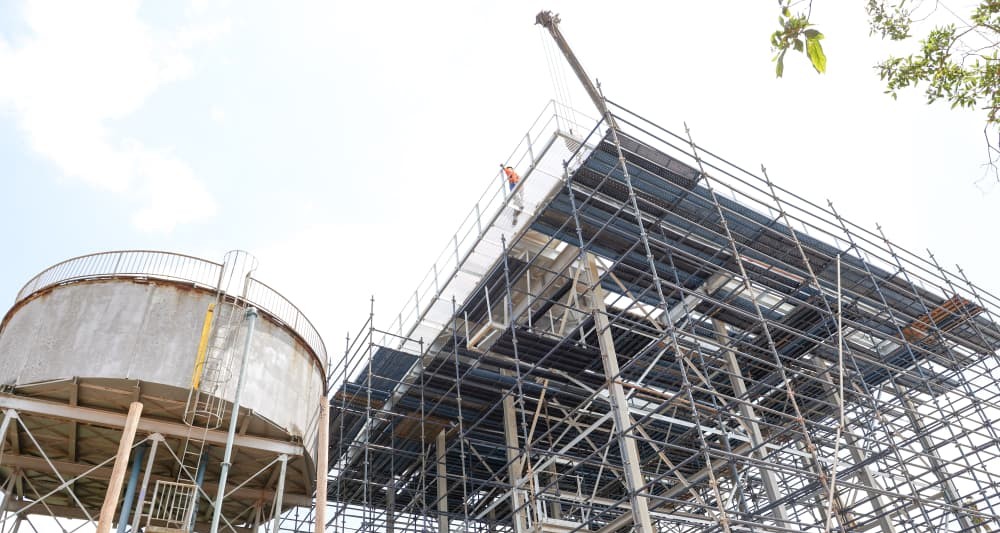 The new 1 million-litre steel tank under construction on Mutungo hill. Left is the old tank it is replacing
NWSC is taking a long-term approach to Kampala’s water challenge, investing in transmission mains, reservoirs, booster stations and new Katosi evacuation capacity to stay ahead of the capital’s rapid urban growth. Under Dr Silver Mugisha, the utility is also using internal engineering, technology, risk management and cost-saving innovations to stretch scarce resources and build a water network designed for the Kampala of 2040 and beyond.
Michael Wakabi
As Kampala expands geographically, rises vertically and fills out with increasingly dense settlements, a quiet infrastructure crisis has been building beneath the city. The population is growing faster than many of the water networks designed to serve it, putting decades-old infrastructure under mounting pressure.
For National Water and Sewerage Corporation (NWSC), which today has the much bigger mandate of supplying safe water to more than 290 urban centres across Uganda, the conventional response would be to keep adding production whenever demand rises.
Managing Director Dr Silver Mugisha is taking a different view. His strategy is increasingly about staying ahead of the demand curve rather than chasing it. That means building not only more treatment capacity, but the transmission mains, reservoirs, booster stations, control systems and institutional capabilities needed to ensure that water already produced actually reaches the consumer.
Perhaps nowhere is the dilemma created by Kampala’s growth more vividly demonstrated than on Mutungo Hill, on the eastern edge of the city. As property development climbed the upper contours of the hill, new high-value homes found themselves literally above the level of the small reservoir that had historically served the area. The problem was not simply a shortage of water, because there was water in the system in place. But the network had not been designed for a city growing upwards and outwards at the pace Kampala is experiencing.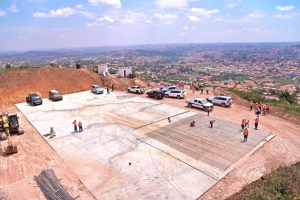
NWSC is responding by constructing a new 1-million-litre reservoir at Mutungo as part of a much larger network expansion programme. Properties located above the reservoir will also be connected through specialised delivery arrangements capable of pushing water uphill from lower elevations.
It is a small illustration of a much larger transformation taking place beneath Kampala and its satellite towns.
Quietly, a labyrinth of large-diameter pipes is spreading across the metropolitan area. Some are so large that an average-height person can stand inside them. They are being connected to massive reservoirs, booster stations and control systems designed to move water across increasingly distant and elevated settlements.
At the centre of this strategy is Katosi. The Katosi Water Treatment Plant added 160 million litres of treated water a day to Kampala’s potential supply when it came online. Yet NWSC says the plant is currently operating at only about 52 per cent of its capacity because the distribution network has not been able to evacuate all the water it can produce.
For Dr Mugisha, this represents a fundamental infrastructure mismatch. The problem is no longer simply how to produce more water. It is how to move the water that is already available.
That is the strategic logic behind Package 2B, the latest major intervention to overhaul, expand and re-zone the Greater Kampala Metropolitan Area (GKMA) water network. The project is formally known as the Rehabilitation, Restructuring, Rezoning and Extension of the GKMA Water Supply Network Project, Package 2B.
Financed principally by the French Development Agency (AFD), with support from the European Union, the European Investment Bank and Germany’s KfW, the €92.4 million project is being implemented by Sogea Satom under the supervision of the ARTELIA–Gauff Association.
The programme involves approximately 70 kilometres of new transmission mains, three reservoirs and booster stations, as well as an upgrade of Kampala Water’s SCADA control system.
The reservoirs include a 10-million-litre concrete tank at Kanyanya, a 3.89-million-litre steel tank at Kabulengwa and the 1-million-litre steel tank at Mutungo. Booster stations are being constructed at Kungu and Kabulengwa.
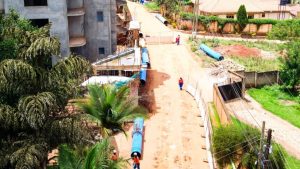
Laying the pipes sometimes has to be done under existing infrastructure. In this picture is part of the line running from the Kira-kandagati road to the Kungu booster
The objective is to create enough distribution capacity to allow Katosi to deliver its full potential to consumers while strengthening the network for the growth expected through 2040.
During a recent tour of the Package 2B works by media practitioners, officials made clear that the project is not simply another infrastructure programme to be completed at some point in the future.
“The demand for water in the Greater Kampala Metropolitan Service Area is growing every day, and customers need answers. The project must be delivered on time and within budget,” says Dr. Mugisha.
The corporation says Package 2B is already about 35 per cent complete. The Kungu booster station is about 70 per cent complete, Kabulengwa is at approximately 65 per cent and the Mutungo reservoir about 55 per cent. About 25 kilometres of the transmission mains had been laid, with the overall pipe-laying component roughly a third complete. The full project is scheduled for completion in 2027.
But NWSC does not want residents to wait until then to see the benefits. The contractor is pursuing sectional handovers, allowing completed sections of the network to be commissioned before the entire project is finished.
Among the first major benefits is the 7.7-kilometre bulk pipeline from Namugongo through Bulindo, Nsasa and Mulawa to the Kira–Kasangati road, expected to be ready from December 2026. It is designed to improve supply to Namugongo, Kira, Buwaate, Bulindo, Mulawa, Kasangati and surrounding areas.
The wider project will ultimately strengthen supply across a huge swathe of the metropolitan area, including communities in Wakiso, Kakiri, Gayaza, Nansana, Kanyanya, Luteete and Matugga.
The list of beneficiaries reads almost like a map of Kampala’s expansion – Kira, Kasangati, Gayaza, Matugga, Kawempe, Nansana, Wakiso and dozens of rapidly urbanising settlements in between.
That geographical spread is important because Kampala’s water challenge is increasingly a metropolitan one. The 2024 National Population and Housing Census put the combined population of Kampala and Wakiso at more than 5.2 million people, with Wakiso now the country’s most populous district.
Much of this growth has taken place outside the boundaries of the traditional city, creating a sprawling urban ecosystem in which settlements that were once rural are becoming suburbs, commercial centres and eventually towns in their own right.
Water infrastructure, however, does not expand automatically when houses appear. It has to be designed, financed, constructed and maintained years before the full demand materialises.
That is where Dr Mugisha’s long-game philosophy becomes particularly significant. NWSC’s immediate challenge is to unlock the investment already made at Katosi. The corporation says Package 2B will enable it to evacuate Katosi’s full current output of 160 million litres a day.
At the same time, Dr Mugisha has directed engineers to begin work on an additional water-evacuation line designed to support a future expansion of the plant towards 240 million litres a day.
“We have a lot of water at Katosi, and plans are under way to evacuate more and serve Kampala,” he said.
Greater use of Katosi would also reduce pressure on the older Ggaba water works, which have carried much of Kampala’s water burden for decades.
This represents an important shift in thinking. For years, the instinct of rapidly growing cities has been to build another treatment plant whenever supply falls short of demand.
But production without distribution creates its own form of waste. The strategic question becomes whether the utility can move treated water to the right place, at the right pressure and at the right time.
That is why the enormous pipes now being laid around Kampala may ultimately be as important as the treatment plants themselves.
Building for the city Kampala will become
The engineers involved in Package 2B are not designing a temporary fix. Project consultant David Gaunt says the network is being built to last for more than 50 years. That long lifespan is critical in a city whose physical form is changing rapidly.
NWSC’s Senior Director for Engineering Services, Alex Gisagara, says the corporation has also been building internal capacity to manage the infrastructure after the contractors leave.
“Our team is already handling the Katosi and Kagera water works, which are new. Once Katosi Package 2B is done, our team is ready to effectively manage and maintain the system,” he said.
The emphasis on internal capability is part of a broader institutional strategy that Dr Mugisha has been pursuing.
During a media roundtable on August 14, he outlined a number of measures that have allowed NWSC to continue investing despite operating in a sector where pricing is politically and socially sensitive.
One is the increasing use of force account contracting, through which the corporation undertakes some works using its own teams and resources rather than relying entirely on external contractors.
Another is the development of internal engineering and technology capabilities.
Dr Mugisha says NWSC has significantly reduced its dependence on externally procured IT systems by developing applications and systems internally.
“I know of institutions that have spent UGX17 billion to buy IT systems,” he said. “In the past 10 years, we have not bought any IT system.”
Instead, the corporation has been phasing out legacy systems, including an externally procured finance management system.
The benefit, he argues, is not merely financial. Internal ownership gives the corporation greater control over its systems, reduces downtime and allows engineers to respond more quickly when problems occur.
That capability was tested during a cyberattack which, according to Dr Mugisha, was resolved quickly because the affected system had been developed internally.
Subsequent investigations, he said, pointed to internal collusion involving an individual who had deliberately left system vulnerabilities open.
The episode illustrates another element of NWSC’s strategy: building institutional resilience alongside physical infrastructure.
The economics behind the pipes
The more interesting question is how a public utility selling an essential commodity at socially sensitive prices can generate enough efficiency to keep making such investments.
Dr Mugisha’s answer is partly about controlling costs before looking for more revenue.
Internal engineering design capabilities have reduced investment costs. Special internal audits are intended to limit leakage and corruption. Internal incentive contracting rewards teams when they achieve defined performance targets.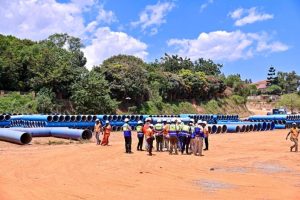
And the corporation has also changed how it approaches risk. Dr Mugisha recalled that NWSC was once spending about UGX25 billion a year on insurance against risks with a very small probability of occurring, including coverage against a potential claim of only about UGX400 million.
He sought authorisation for the corporation to retain more of those risks internally. NWSC subsequently established an internal risk management unit and allocated funds to it.
The result, according to Dr Mugisha, has been savings of about UGX10 billion over the past five years. These savings may not attract the same attention as a new reservoir or a giant transmission pipeline.
But they are part of the less visible infrastructure of a utility – the management systems, engineering skills, financial discipline and technology capabilities that determine whether physical assets can be expanded and maintained sustainably.
A utility trying to get ahead of the city
Kampala’s water challenge will not disappear when Package 2B is completed.
Population growth will continue. New apartment blocks will rise. Former agricultural land will be absorbed into the metropolitan economy. More people will live farther from the traditional urban core and at higher elevations.
The pressure will therefore continue moving outward. The significance of NWSC’s current investment is that it is attempting to anticipate that future rather than merely respond to yesterday’s shortages.
The 70 kilometres of transmission mains, the reservoirs and booster stations, the Katosi evacuation capacity and the upgraded control systems are effectively the plumbing architecture of Kampala’s next phase of growth.
There is also a lesson here for urban planning more broadly. A city does not become resilient simply because it builds more houses, roads and commercial centres. The invisible systems beneath it—water, sewerage, power, drainage, communications and waste management—must expand at the same speed, or preferably ahead of it.
For NWSC, the immediate goal is to get more Katosi water into the network. The larger objective is more ambitious, seeking to build a water system capable of serving a metropolitan population that has not yet arrived.
That is the essence of Dr Mugisha’s long game. Rather than waiting for Kampala’s taps to run dry before responding, NWSC is betting that the best way to keep them running is to build the capacity today for the city Uganda will have tomorrow.
Related Posts
 Agroecology Week Targets Stronger links Between Farmers, Policy and Markets
 Stanbic Commits UGX20m to Virunga Gorilla Marathon’s Conservation Drive
 Energy Ministry and Equity Bank target lower hotel energy costs through green investment initiative
 Aviation Industry Coalition Presses EU to Protect Voluntary use of Biometric Travel Technology
 Somalia Recognises IATA Safety Audits in Push for Common African Aviation Standards
 Stanbic Donates UGX40 Million in Maternal Health Equipment to Obongi Facility
Get business news delivered to you everyday
Latest News

Agroecology Week Targets Stronger links Between Farmers, Policy and Markets

Stanbic Commits UGX20m to Virunga Gorilla Marathon’s Conservation Drive

Energy Ministry and Equity Bank target lower hotel energy costs through green investment initiative

FAA Certifies Boeing 737-10, Clearing Path for Deliveries of Largest 737 MAX Variant

Aviation Industry Coalition Presses EU to Protect Voluntary use of Biometric Travel Technology

Somalia Recognises IATA Safety Audits in Push for Common African Aviation Standards

Airlink Adds Lanseria–Harare Route, Expands Regional Flights for Summer

Uganda SGR Nears €1bn Funding Milestone as OPEC Fund Targets November Approval for €150m

Solar Power Linked to More Births and Better Patient Access at Rural Ugandan Clinics

China’s GPMI Interface Leapfrogs HDMI, USB With 192Gbps Speeds and 480W Power