
Equity’s MSME Financing Helps Fill the Missing Middle in Uganda’s Economy
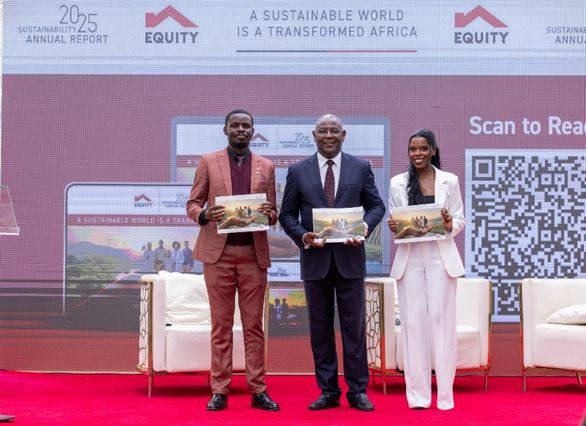 From Left to Right: Lamech Opiyo – Environmental Sustainability Leader, Climate Action Champion and Rotary International Youth Representative to the United Nations in Africa, Equity Group Managing Director and CEO, Dr. James Mwangi and Loise Njeri, an Equity Leaders Program alumna, and the Founder and Managing Director of Luxe Laundry during the launch of the Equity Group 2025 Sustainability Report.
Commentary
Uganda’s economic growth story has long carried a contradiction. Despite decades of positive GDP growth and substantial investment, the economy remains vulnerable to external shocks, while employment creation has consistently struggled to keep pace with economic expansion. Part of the explanation lies in the structure of the economy itself, and particularly the weakness of its middle.
Uganda has a broad base of micro and small enterprises, alongside a relatively small number of large corporations, but too few businesses making the transition from small-scale operations into medium-sized and ultimately large enterprises. This hollow middle has constrained economic diversification, limited the depth of domestic value chains and left the economy more exposed to disruptions in international markets.
It is against this structural weakness that Equity Group’s enterprise financing interventions deserve recognition. The Group disbursed UGX12.57 trillion (USD3.11 billion) to micro, small and medium-sized enterprises (MSMEs) across its markets in 2025. This is a substantial contribution to the financing of the very segment that must expand if Uganda and the wider region are to build more resilient and employment-intensive economies.
The significance of this intervention goes beyond the volume of credit. MSMEs are not merely smaller versions of established corporations. They are the foundation of local production, distribution, services and employment. But many remain trapped at subsistence level, unable to acquire equipment, expand capacity, enter new markets or meet the standards required to participate in larger supply chains. Access to appropriately structured finance can help change that trajectory.
Credit alone, however, is not enough. The quality of enterprise development also depends on business skills, market access, reliable procurement opportunities and the capacity to manage growth. Equity’s training of 962,924 entrepreneurs during the year is therefore an important complement to its lending programme. Equally significant is the fact that local suppliers accounted for 90 per cent of the Group’s procurement expenditure, valued at UGX1.48 trillion. This demonstrates how a large institution can use its purchasing power to create business opportunities beyond its immediate lending portfolio.
There is an important economic lesson here. When large enterprises deliberately source goods and services locally, they create markets for smaller businesses, stimulate domestic production and help retain more value within the economy. When financial institutions combine lending with enterprise development and procurement opportunities, they contribute to building the linkages through which small businesses can graduate into larger and more productive enterprises.
The wider sustainability figures reinforce the scale of Equity’s interventions. The Group invested UGX3.10 trillion (USD771 million) in social impact and sustainability initiatives in 2025, including UGX809.12 billion in sustainable finance. It also reached 622,525 small and medium-sized farmers through climate-smart financing and value-chain support, extending the enterprise development agenda into agriculture, where productivity gains and stronger market connections are equally important.
These interventions are particularly relevant at a time when climate pressures, geopolitical disruptions and volatile international markets are exposing the vulnerabilities of economies with narrow production bases and limited domestic capacity.
Nevertheless, the scale of financing should not obscure the need to examine its outcomes. The real test is whether businesses receiving this support become more productive, employ more people, deepen local supply chains and graduate into higher levels of enterprise. The distinction between lending to sustain existing activity and financing that enables businesses to expand is an important one.
Government also has a responsibility to complement such private-sector initiatives through a more predictable business environment, better infrastructure, affordable energy, accessible markets and policies that reward local production and value addition. Banks cannot single-handedly resolve structural weaknesses that have accumulated over decades, but they can play a big role in addressing access to capital, one of the most persistent constraints.
Equity Group’s enterprise financing therefore represents more than a corporate sustainability achievement. It is an intervention in the productive architecture of the economy. By directing substantial resources towards the businesses that occupy the space between subsistence enterprise and big business, the Group is helping address the missing middle.
For Uganda, the challenge now is to ensure that this kind of financing translates into a larger, more competitive domestic enterprise base. Sustainable growth will ultimately depend not simply on how fast the economy expands, but on how many businesses it creates, how many people they employ and how much productive capacity they retain within the country.
Related Posts
 Beyond Gold Exports, Uganda’s Next Test Is Economic Transformation
 Why Community-Led Climate Action Is Essential to Building Climate Resilience
 Why Africa’s Institutions Must Turn Knowledge and Investment into Farmer Prosperity
 Lt Gen Frederick Alexander Okecho: The Gallant Soldier Who Knew When to be Still
 Uganda’s Oil Refinery Still Makes Sense in a USD500 Billion Economy
 Beyond the Classroom: A Ugandan Student Inside China’s Manufacturing World
Get business news delivered to you everyday
Latest News

Financing Gap Hobbles Uganda’s Shift to Mercury-Free Gold Mining

Equity’s MSME Financing Helps Fill the Missing Middle in Uganda’s Economy

Commonwealth Study finds AI Could add USD900m to Uganda’s GDP by 2036

Equity Group Reports UGX3.1 trillion in Sustainability Investments

Tumwebaze Urges Purpose-driven Approach as Uganda Targets Organic Food Markets

Emirates Group Defies Gulf Conflict to Deliver USD1.1bn Half-year Profit

UDB Mobilises USD200m for Climate Finance Ahead of COP31

Africa’s Leisure Spending Projected at USD150 Billion in 2026

€145 Million Lake Victoria Water Project Targets Greater Kampala’s Western Supply Gap

Uganda Cuts New HIV Infections by 64pc as Youth Remain a Prevention Priority