

Commonwealth Study finds AI Could add USD900m to Uganda’s GDP by 2036
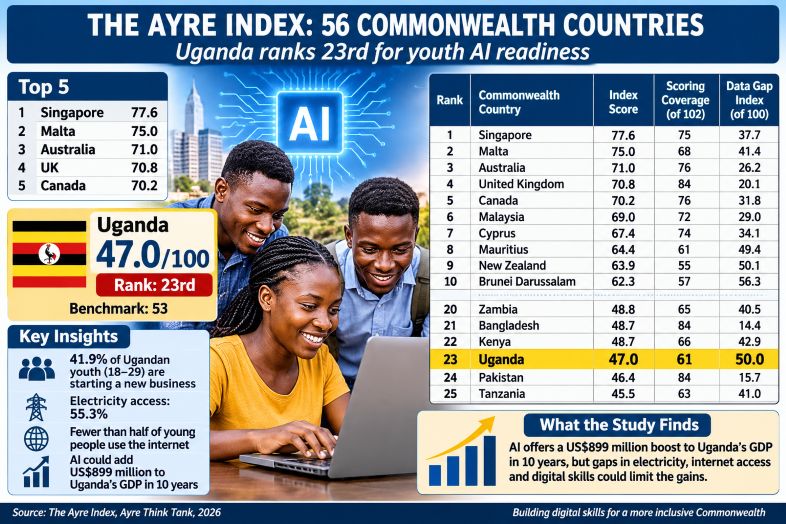
Uganda could gain USD900 million in GDP over a decade from AI, but electricity, internet access and digital skills remain major obstacles to realising the opportunity.
Artificial intelligence could add USD899 million to Uganda’s GDP over the next decade, but the country’s ability to capture the opportunity will depend on addressing gaps in electricity, internet access and digital skills, a new Commonwealth study has found.
The Ayre Index, produced by the Ayre Think Tank, ranks Uganda 23rd among 56 Commonwealth countries for youth AI readiness, with a score of 47 out of 100, below the study’s benchmark of 53.
The research identifies Uganda’s entrepreneurial youth population as a potential driver of AI-led economic growth, while highlighting infrastructure and affordability constraints that could limit their participation in the emerging technology economy.
Using scenarios developed by the International Monetary Fund, researchers estimate that AI could increase the level of Uganda’s GDP by USD899 million after ten years under a moderate adoption scenario. The projected gain ranges from USD434 million under a conservative scenario to USD1.364 billion under an optimistic outlook.
Uganda has an estimated 13.4 million people aged 15 to 29, many of whom are already engaged in entrepreneurship. The study found that 41.9 per cent of young people aged 18 to 29 were starting or running new businesses, while 20.6 per cent owned established businesses.
AI could help these enterprises reach wider markets, reduce operating costs and improve productivity, potentially translating into higher incomes and employment.
However, the country faces significant barriers to wider adoption. Electricity access stands at 55.3 per cent of the population, fewer than half of young people report using the internet, while high mobile-data costs continue to constrain access among lower-income households.
Uganda scored 47.0 in the index, placing it just behind Kenya in 22nd position but ahead of Tanzania in 25th and Rwanda in 47th. The study drew on 1,128 research sources to assess the conditions shaping AI opportunities for approximately 732 million young people across the Commonwealth.
There are emerging efforts to bridge the skills gap. In July 2026, 83 young innovators joined a government-backed entrepreneurship programme intended to develop technology-based businesses, while another 144 graduated from an UN-supported digital skills initiative covering artificial intelligence, software development and cybersecurity.
The researchers nevertheless identify gaps in evidence on how young Ugandans are using AI and their level of competence in the technology. A 2026 survey involving 609 volunteers indicated growing adoption, but available data was insufficient to assess the country’s digital and AI skills adequately.
The study identifies affordable and reliable technology access, practical skills development, stronger links between training and employment, locally relevant AI tools and safeguards around automated decision-making as priorities for governments and development partners.
Calvin Ayre, founder of the Ayre Think Tank, said the index was intended to help governments identify gaps in their readiness for AI and determine where investment would have the greatest impact.
The findings suggest that Uganda’s potential AI dividend will depend less on the availability of the technology itself than on whether young entrepreneurs can access the infrastructure, skills and tools needed to put it to productive use.
Related Posts
 Equity Group Reports UGX3.1 trillion in Sustainability Investments
 Emirates Group Defies Gulf Conflict to Deliver USD1.1bn Half-year Profit
 UDB Mobilises USD200m for Climate Finance Ahead of COP31
 Africa’s Leisure Spending Projected at USD150 Billion in 2026
 €145 Million Lake Victoria Water Project Targets Greater Kampala’s Western Supply Gap
 Uganda Cuts New HIV Infections by 64pc as Youth Remain a Prevention Priority
Get business news delivered to you everyday
Latest News

Commonwealth Study finds AI Could add USD900m to Uganda’s GDP by 2036

Equity Group Reports UGX3.1 trillion in Sustainability Investments

Tumwebaze Urges Purpose-driven Approach as Uganda Targets Organic Food Markets

Emirates Group Defies Gulf Conflict to Deliver USD1.1bn Half-year Profit

UDB Mobilises USD200m for Climate Finance Ahead of COP31

Africa’s Leisure Spending Projected at USD150 Billion in 2026

€145 Million Lake Victoria Water Project Targets Greater Kampala’s Western Supply Gap

Behind the Surge in Equity Bank Uganda’s Bancassurance Portfolio

African Airlines Lead Passenger Growth but Struggle to Fill Expanding Capacity

Shift to Value sees Equity Bank Bancassurance Premiums Rise to UGX16.13bn