

€145 Million Lake Victoria Water Project Targets Greater Kampala’s Western Supply Gap
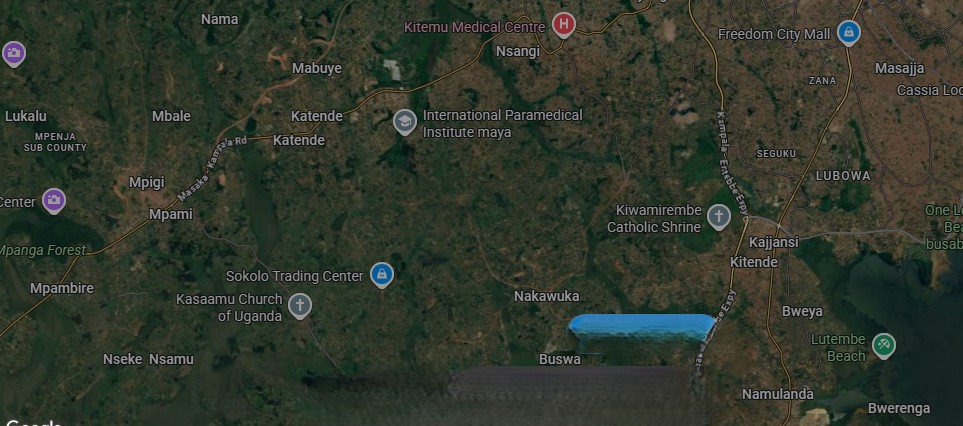
The UGX694 billion Wakiso West Water and Sanitation Project will establish a new Lake Victoria supply corridor serving more than one million people, addressing distribution bottlenecks in Greater Kampala’s rapidly expanding western suburbs.
Uganda is investing UGX694 billion (€145) in a new Lake Victoria water supply system to address mounting shortages in the rapidly expanding western suburbs of Greater Kampala, marking a significant shift in the infrastructure underpinning the metropolitan area’s water network.
The Wakiso West Water and Sanitation Project, launched by the Government through National Water and Sewerage Corporation (NWSC), will establish a new treatment and distribution system drawing water from Bwerenga on the north-western shores of Lake Victoria, to serve more than one million people across Kyengera, Nsangi, Kajjansi, Kasanje, Kiringente, Wakiso and Mpigi.
The corporation on Tuesday signed a consultancy agreement worth approximately UGX47.5 billion with a joint venture comprising Denmark’s NIRAS A/S and Germany’s Fichtner GmbH & Co. KG, working with Ugandan firms M&E Associates and Alliance Consultants.
The consultants will undertake detailed engineering designs, prepare procurement documents and supervise construction.
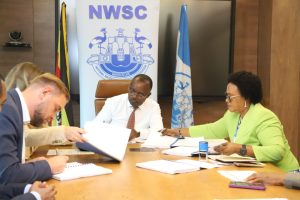
NWSC Managing Director Dr Silver Mugisha and representatives of Denmark’s NIRAS A/S and Germany’s Fichtner GmbH & Co. KG sign the Shs47.5 billion design consultancy agreement. The two firms will lead a joint venture working with Ugandan firms M&E Associates and Alliance Consultants.
According to the national water utility, the investment comes as population growth and urban expansion continue to exert pressure on existing supply infrastructure, leaving some communities dependent on rationed supplies despite the availability of substantial water treatment capacity elsewhere in the metropolitan area.
The project is particularly significant because it seeks to address a geographical imbalance in Greater Kampala’s water infrastructure. The Ggaba and Katosi treatment plants, which supply much of the metropolitan area, are located east of Kampala, requiring water to travel considerable distances through an increasingly stretched distribution network to reach western settlements.
Officials say the new Bwerenga facility is intended to provide a more direct supply source for this growing corridor, reducing dependence on long-distance transmission from existing treatment plants.
NWSC Managing Director Dr Silver Mugisha said the project would provide more than one million people with uninterrupted access to safe and reliable drinking water upon completion.
The planned treatment plant will have an initial capacity of 62.5 million litres a day, while its intake infrastructure will be capable of drawing up to 200 million litres daily. The system will include 94.2 kilometres of transmission mains and 78.5 kilometres of secondary distribution pipes.
Five reservoirs at Kaga, Nsangi, Nanziga, Mpigi and Bukasa will provide combined storage capacity exceeding 15.25 million litres, supported by pumping stations at Buloba, Katende, Maya and Ssekiwunga.
The distribution network is expected to cover approximately 4,300 hectares.
Beyond expanding bulk supply, the project has a significant inclusion component. Some 160,000 of the intended beneficiaries live in informal settlements, where access to piped water remains limited and households often depend on private vendors or alternative sources.
NWSC plans to install 941 community water dispensers and yard taps fitted with electronic prepaid meters across 19 parishes, including Kimbejja, Katereke, Nsangi, Kasenge, Kikajjo, Kitende, Namulanda and Ssisa.
The intervention is intended to extend access to regulated water services in settlements where conventional household connections are often constrained by housing arrangements, affordability and inadequate infrastructure.
The need is already evident in Kyengera, where residents have reported buying water from wells at between UGX1,000 and 2,000 per jerrycan.
The investment also recognises that expanding water supply without corresponding sanitation infrastructure could create additional environmental and public health pressures.
A faecal sludge treatment plant along Ssekiwunga Road in Kajjansi will have capacity to process at least 400,000 litres daily, helping reduce indiscriminate waste disposal and contamination of surface and groundwater resources.
The project will additionally install solar power systems with a combined generation capacity of at least 2,945 kilowatts at selected sites, potentially reducing the energy burden associated with operating the water infrastructure.
Wakiso West forms part of a wider programme to expand water distribution capacity across Greater Kampala, where the challenge is increasingly not only producing sufficient treated water but moving it efficiently to areas experiencing rapid urbanisation.
The Katosi treatment plant, commissioned in December 2022 with capacity to produce 160 million litres daily, currently operates at approximately half that level because the distribution network cannot yet accommodate its full output. Plans are under way to expand its capacity to 240 million litres daily.
Meanwhile, the 70-kilometre Package 2B pipeline project, which began construction in February 2025, is expected to extend supply to about one million additional people in Kira, Kasangati, Gayaza, Kawempe, Nansana, Matugga and other parts of Wakiso.
These investments reflect the growing infrastructure demands of a metropolitan area whose population and economic activity have expanded considerably beyond Kampala’s administrative boundaries.
The 2024 national census placed the combined population of Kampala and Wakiso above 5.2 million, with Wakiso emerging as Uganda’s most populous district.
For NWSC, the challenge is to ensure that infrastructure expansion keeps pace with this growth while extending services to communities that have historically remained outside the formal water distribution network.
The Wakiso West consultancy will be implemented in two phases. The first, valued at approximately UGX20 billion, will cover detailed designs and tender documentation and is fully funded through an Impact Fund Denmark grant. It is expected to take 20 months.
The second phase, valued at approximately UGX27.6 billion, will cover construction supervision over 30 months and a further 12-month defects liability period. It will be financed through a concessional loan incorporating a 50 percent grant component.
The wider investment is also consistent with NWSC’s expansion ambitions. The corporation currently serves an estimated 22 million people through more than one million connections across 287 towns, compared with just 23 towns in 2013. Under its 2025–2030 strategic plan, the utility targets service coverage of 26 million people by the end of the decade.
Related Posts
 Uganda Cuts New HIV Infections by 64pc as Youth Remain a Prevention Priority
 Behind the Surge in Equity Bank Uganda’s Bancassurance Portfolio
 African Airlines Lead Passenger Growth but Struggle to Fill Expanding Capacity
 Uganda Airlines Expands its West-African Footprint with Direct Service to Accra
 Airlines Spent USD 24.5bn Processing Payments in 2025, IATA Says
 Uganda Returnees Look to Rebuild Livelihoods as Government Pledges UGX2bn
Get business news delivered to you everyday
Latest News

€145 Million Lake Victoria Water Project Targets Greater Kampala’s Western Supply Gap

Uganda Cuts New HIV Infections by 64pc as Youth Remain a Prevention Priority

Behind the Surge in Equity Bank Uganda’s Bancassurance Portfolio

African Airlines Lead Passenger Growth but Struggle to Fill Expanding Capacity

Shift to Value sees Equity Bank Bancassurance Premiums Rise to UGX16.13bn

Uganda Airlines Expands its West-African Footprint with Direct Service to Accra

Airlines Spent USD 24.5bn Processing Payments in 2025, IATA Says

Beyond Gold Exports, Uganda’s Next Test Is Economic Transformation

ERAM Award puts Uganda’s Animal-Health Manufacturing Ambitions in Focus

Why Community-Led Climate Action Is Essential to Building Climate Resilience