

Saving the Mubende Goat: ASARECA leads race to reclaim Uganda’s vanishing breed
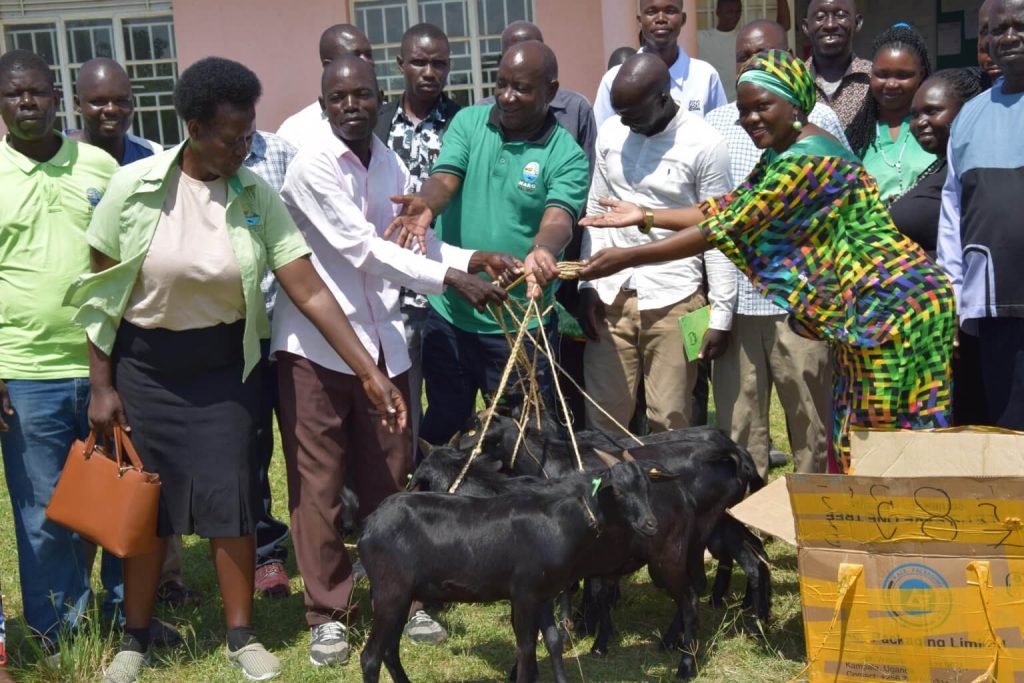
On the plains of western Uganda, the familiar bleating of goats carries a new warning. Uganda’s indigenous goat breeds — once hardy symbols of rural resilience — are quietly disappearing, eroded by decades of uncoordinated crossbreeding, misguided donor projects, and market pressures that prize size over survival.
That stark reality confronted scientists and policymakers earlier this month as the Association for Strengthening Agricultural Research in Eastern and Central Africa (ASARECA) sought to source pure Mubende bucks to support farmer-led breeding programmes in Kibaale and Buliisa districts. Of the 36 farmers’ groups inspected, more than 80 percent of goats presented for selection turned out to be Boer crossbreeds, revealing how deeply Uganda’s indigenous genetics have been diluted.
Now, in the dusty kraals of Buseesa and Kirama, the quiet work of restoring the Mubende goat has begun — a mission that could determine the future of an entire genetic lineage, and with it, a vital part of Uganda’s agricultural heritage.
Between October 7–9, a team of breeders led by scientists from the National Agricultural Research Organisation (NARO) and ASARECA guided farmers through the rigours of identifying, selecting, and documenting the best local breeding stock. This followed a round of mindset-change training held in August, where farmers were introduced to the principles of Community-Based Breeding Programmes (CBBPs) — a model that puts farmers at the centre of breed improvement.

Dr Zuena Nantongo, addressing community goat breeders in Kibaale
“The fastest erosion of any species starts by losing the males,” warns Dr. Zuena Nantongo, a livestock breeder at NARO’s Nakyesasa Livestock Research Institute. “People are killing indigenous males for meat, leaving only the females. Once that happens, the genetic foundation collapses — what remains may look local, but it’s no longer truly ours.”
The Mubende goat, long prized for its lean meat, disease resistance, and adaptability to Uganda’s varied climates, has now become a rarity in its own homeland.
“The trend here has been that if you have a female goat, you introduce a Boer male,” explains Rashid Mubiru, Senior Veterinary Officer for Buliisa District. “Farmers wanted fast growth and better prices — but we ended up losing our base breed.”
According to Mubiru, well-intentioned development programmes inadvertently worsened the problem. “Projects like the National Livestock Productivity Project and the District Livelihood Improvement Programme encouraged crossbreeding with Boer and Kalahari goats,” he says. “Farmers were even urged to castrate their local males to promote the new breeds. We disabled natural selection and erased indigenous knowledge, thinking new technology alone would lift farmers from poverty — but it hasn’t.”
While Boer goats promised quick profits, they have proven fragile in Uganda’s humid conditions — prone to disease, high maintenance, and poor kid survival rates. “They brought stress, not wealth,” Mubiru reflects.
Dr. Nantongo agrees. “There is a real threat that indigenous goat breeds in Uganda are fast disappearing,” she warns. “This project is a mitigation strategy against the risk of becoming totally dependent on exotic breeds that lack the unique hardiness and flavour of our local goats.”
Her team is using data-driven selective breeding to rebuild the Mubende line. “We want to breed a goat that works for the farmer — resilient, productive, and affordable to manage,” she explains. “With proper care and selection, the Mubende goat can achieve growth rates and twinning comparable to the Boer.”
Over the next three years, the project will monitor growth and reproductive performance from birth to maturity, using records to retain only the best offspring. “Growth data at six months will determine the next breeders. Those that grow faster, reproduce well, and produce twins or triplets will be kept — the rest will be phased out,” Dr. Nantongo says.
At the community level, the programme has stirred a quiet sense of pride. “Until now, we were breeding local and exotic goats without guidance,” says Justine Atuhaire, treasurer of the Buseesa Livestock Farmers Association in Kibaale. “Now we understand that our local goats are stronger, and their meat is preferred by consumers.”
Her group received five Mubende bucks to launch the new breeding cycle. “Within five years, we expect to have pure local breeds again — goats that grow well and survive well,” she says.
Moses Mwesigwa, Acting Director at NARO Bulindi ZARDI, reminds farmers that genetics alone won’t secure success. “Breed, nutrition, and care — that’s the trinity of performance,” he says. “We can fix the breed, but 65 percent of productivity depends on how farmers feed and manage their goats.”
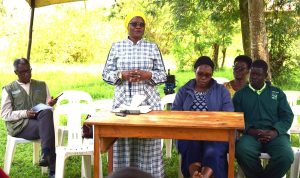
ASARECA Head of Finance Annet Hadijah Wanyana, implored beneficiaries to take ownership of the Community Based Breeding Projects for sustainability
ASARECA’s Head of Finance, Annet Hadijah Wanyana, stresses that the programme’s sustainability now rests with communities. “We’ve provided the breeding bucks and tracking tags,” she says. “But record-keeping and good husbandry are the farmers’ responsibility.”
Wanyana also emphasises the importance of maintaining group cohesion. “Livestock is one of the quickest pathways out of poverty,” she notes. “To get there, farmers must keep their groups vibrant and use them to support one another. ASARECA has made its contribution, but outcomes will depend on how individual farmers manage their herds.”
According to Dr. William Guma, an animal research scientist at Bulindi ZARDI, the Bunyoro subregion has high potential for goat production. With a human population of 2.7 million, it accounts for nearly 5 percent of Uganda’s 17 million goats. Although exotic breeds and crossbreeds are now common, Guma says the situation is far from irredeemable.
“A major problem has been the loss of local knowledge — few people could identify the Mubende goat with certainty,” he explains. “We’ve now addressed that through training and distribution of breeding bucks. We should see a resurgence of the Mubende goat within a few years.”
The Ugandan initiative builds on 16 years of proven success in Ethiopia, where the International Center for Agricultural Research in the Dry Areas (ICARDA) pioneered CBBPs that now reach over 300 villages. “We have all the evidence that community-based breeding improves livelihoods and preserves biodiversity,” says Dr. Aynalem Haile, ICARDA’s small ruminant expert.
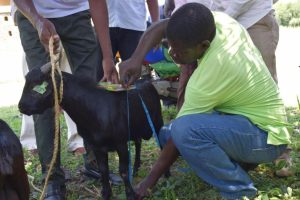
Dr William Guma, take farmers through assessment criteria of goats’ growth characteristics
By combining scientific data collection — on growth rates, birth weights, and reproductive maturity — with farmer participation, the model ensures that genetic improvement remains locally owned and adapted.
For a country where goats are both a staple source of protein and a rural safety net, reclaiming the Mubende’s legacy is as much about identity as it is about income.
“Losing our indigenous breeds is not just a technical problem,” says Mubiru. “It’s a loss of heritage and autonomy. If we depend entirely on imported genetics, we become captive to those who own them.”
As Dr. Zuena reflects, “The answer isn’t in replacing what’s ours, but in improving it. Our goats have always known how to survive here — we just forgot to let them.”
In the quiet countryside of Kibaale and Buliisa, that lesson is taking root. And with it, perhaps, the rebirth of Uganda’s most enduring goat.
Related Posts
 Uganda Coffee Roasters Tap Richard Rugaya as Executive Director, with Focus on Commercial Growth
 Why Africa’s Institutions Must Turn Knowledge and Investment into Farmer Prosperity
 Forbes ranks MTN Group third globally on best telecom employer list
 Stanbic experts offer investment insights to navigate current market uncertainty
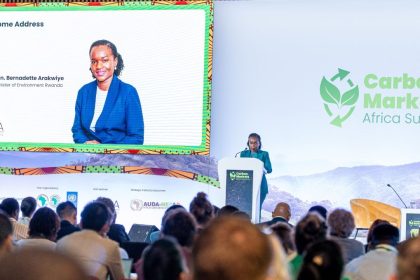 Africa Carbon Markets Urged to Turn Potential into Investment and Delivery
 Corporate Buyers Could Help Unlock SAF Market Worth Millions of Tonnes by 2030
Get business news delivered to you everyday
Latest News

SITA Acquisition of Collins Airport Solutions Signals Moves to Consolidate Aviation Technology

Uganda Coffee Roasters Tap Richard Rugaya as Executive Director, with Focus on Commercial Growth

Equity Bank Reports UGX37.6 Billion in Green Loans as Uganda Seeks to Scale Climate Investment

Why Africa’s Institutions Must Turn Knowledge and Investment into Farmer Prosperity

Forbes ranks MTN Group third globally on best telecom employer list

Stanbic experts offer investment insights to navigate current market uncertainty

Africa Carbon Markets Urged to Turn Potential into Investment and Delivery

Bank of Uganda hikes base rate from 9.75% to 12% amidst global tensions

Airbus sees USD420bn Global Aviation Services Boom: Can Africa Capture its Share?

Nile Breweries Celebrates 75 Years of Growing with Uganda