

UDB Approves UGX63bn Recapitalisation as Profit Hits UGX63.4bn
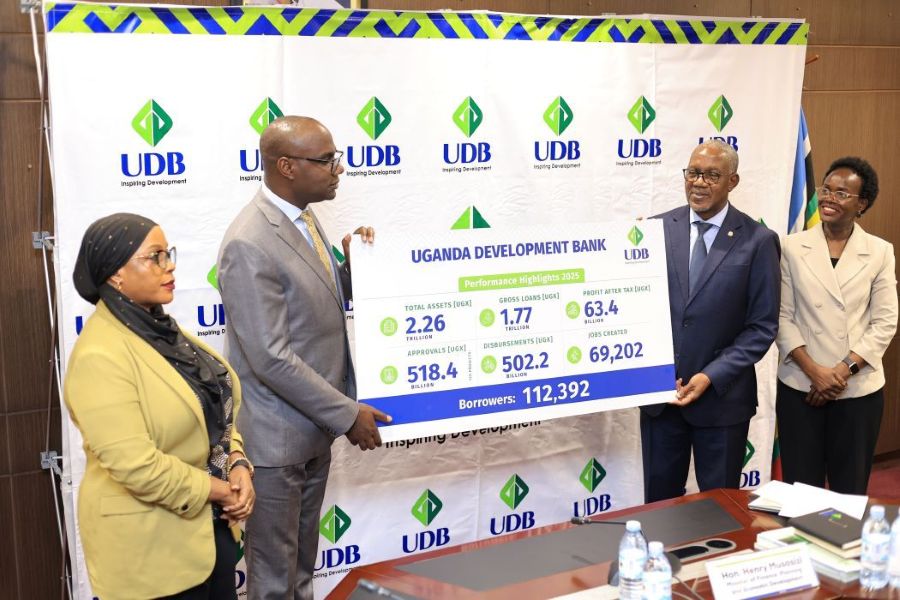 L-R_ State Minister for Investment and Privatization, Hon. Amina Mukalazi; Finance Minister, Hon. Henry Musasizi with UDB Board Chairman, Godfrey Kihuguru and UDB MD Dr. Patricia Ojangole during the AGM
- The Bank disbursed UGX 502.2 billion to facilitate private sector growth in Uganda
- Total assets grew by 27pc to UGX 2.26 trillion
- Net loans and advances rose by 6.6pc to UGX 1.63 trillion
- Bank-supported enterprises created and maintained a total of 69,202 jobs, a rise of 24.6pc
UDB board approves UGX63bn recapitalisation after posting a 9.7pc rise in 2025 profit and disbursing UGX502.2bn to Uganda’s private sector.
Uganda Development Bank (UDB) is set to strengthen its lending capacity after its Board approved a UGX63 billion recapitalisation from the lender’s 2025 earnings, and 165pc increase in share capital to UGX5 trillion.
The decision followed a year of strong financial performance in which the national development finance institution posted a profit after tax of UGX63.4 billion for the year ended December 2025, a 9.7pc increase over 2024.
The results were presented at UDB’s Annual General Meeting held at the Ministry of Finance, Planning and Economic Development on Thursday.
The recapitalisation is expected to give the bank greater capacity to finance large-scale investments in sectors considered critical to Uganda’s economic transformation.
UDB Managing Director Dr Patricia Ojangole said the lender’s performance demonstrated the role of development finance in supporting investments that may not be adequately served by conventional commercial lending.
“Development finance delivers its greatest value when it unlocks opportunities that commercial markets alone cannot provide,” Ojangole said.
She said UDB’s investments were intended to strengthen productive enterprises, create jobs, expand value addition and improve incomes.
The bank’s total assets grew by 27pc to UGX2.26 trillion in 2025, from UGX1.78 trillion a year earlier, while total equity rose 24.8Pc to Shs1.89 trillion.
Net loans and advances increased by about 7pc to UGX1.63 trillion, reflecting continued expansion of UDB’s financing to productive sectors.
Ojangole attributed the performance to Uganda’s economic expansion, prudent management and the bank’s increased focus on agro-industrialisation, which now accounts for about 65pc of its loan book.
The bank’s loan-loss ratio stood at 6.7pc, which management said remained within its risk appetite and regulatory limits.
UGX502 billion disbursed
UDB approved UGX518.4 billion in new financing for 120 projects during the year and disbursed UGX502.2 billion, a 29pc increase from 2024.
Nearly two-thirds of its financing went to agriculture, agro-industrialisation and manufacturing, sectors identified as critical to raising productivity, expanding value addition and reducing reliance on imported manufactured goods.
The bank’s active customer base increased to 689 enterprises operating across 105 districts.
The financing translated into a significant reported economic impact. Enterprises supported by UDB created and sustained 69,202 jobs during the year, a 24.6pc increase and one of the strongest annual employment impacts recorded by the bank.
The enterprises generated production worth UGX6.26 trillion and profits exceeding UGX1.16 trillion.
Their tax contributions rose by 22.5pc to UGX387 billion, while foreign exchange earnings increased from the equivalent of UGX1.11 trillion to UGX1.84 trillion.
Finance Minister Henry Musasizi said the Government’s priority was now to make development finance cheaper and more accessible to businesses.
He said the target was to bring UDB’s lending rate down from the current 12pc to single digits, while shortening loan approval times and expanding the range of eligible borrowers, including small and medium enterprises.
The Government also intends to mobilise additional resources for the bank, including external borrowing backed by Government guarantees.
“Our aim is to have a strong bank that is able to provide cheap credit to investors in big projects in manufacturing, agro-industrialisation, hotels and tourism, among others,” Musasizi said.
The Minister commended UDB for translating Government capital into investments that are expanding industry, supporting value addition and strengthening the private sector in line with the National Development Plan IV and the Ten-Fold Growth Strategy.
The bank also strengthened its funding base through partnerships with bilateral and multilateral development institutions and launched the Reshaping Industry for Sustainable Economy (RISE) initiative to turn development challenges into investment-ready projects.
UDB’s performance comes against a favourable macroeconomic backdrop, with Uganda’s economy growing by 6.3pc in 2025 while inflation declined to 3.3pc.
The bank also retained strong external recognition, including an A+ rating from the Association of African Development Finance Institutions and a AA+ (Uga) national rating from Fitch Ratings, described as the highest available on Uganda’s national scale.
Related Posts
 UNBS Seizes 17,770 Litres of Illicit Alcohol as Kenya Deaths Raise Regional Concern
 Relief as UAE Eases Ebola-era Entry Curbs on Ugandans, Reopening Key Aviation Corridor
 13 Feared Killed as Tracep Aviation L-410 Crashes in DRC
 IATA Warns Cargo Screening Alone Cannot Contain Undeclared Dangerous Goods Risk
 Rwenzori Marathon: A Case of What’s Possible in Diversifying Uganda’s Tourism Offering
 Entebbe-Based Jet Fresh Cargo Takes Ugandan Air Freight into Global Awards Contest
Get business news delivered to you everyday
Latest News

UNBS Seizes 17,770 Litres of Illicit Alcohol as Kenya Deaths Raise Regional Concern

Why Unlocking Africa’s Next Mining Powerhouse Requires Strong Financial Partnerships

Relief as UAE Eases Ebola-era Entry Curbs on Ugandans, Reopening Key Aviation Corridor

Equity Turns Schools into Climate Restoration Hubs as Lender Launches 200,000-tree Uganda drive

13 Feared Killed as Tracep Aviation L-410 Crashes in DRC

IATA Warns Cargo Screening Alone Cannot Contain Undeclared Dangerous Goods Risk

Rwenzori Marathon: A Case of What’s Possible in Diversifying Uganda’s Tourism Offering

Afreximbank Issues USD29m Guarantee to Expand EAC Customs Bond

Uganda puts UGX1.4tn Treasury Bonds on Auction

DHL Launches Direct Bahrain-Johannesburg Freighter Service