

Equity Turns Schools into Climate Restoration Hubs as Lender Launches 200,000-tree Uganda drive
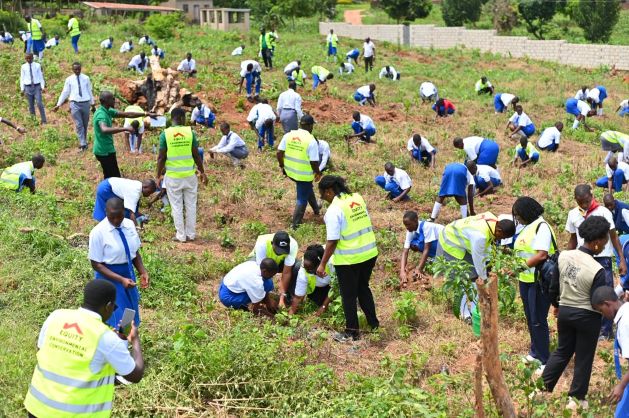
Equity Bank Uganda has launched a school-based tree programme targeting 200,000 trees across Uganda by December 2027.
Equity Bank Uganda is taking its environmental campaign into schools, targeting the planting, protection and nurturing of 200,000 trees across the country by December 2027 under a new Green Schools Programme.
The programme, launched on September 25 at Nakanyonyi Secondary School in Mukono District in partnership with My Tree Initiative Uganda, puts schools at the centre of a wider effort to combine environmental restoration with climate education.
The launch saw students and partners plant 3,500 trees at the school, marking the start of the first phase of the programme, which will cover 25 schools in 10 districts by the end of 2026.
A further 150,000 trees are planned for 2027, with the programme expected to incorporate school orchards and longer-term tree-care activities rather than focusing solely on planting.
That distinction stands out in a country where tree-planting campaigns have often faced the challenge of ensuring that seedlings survive beyond launch events.
Gift Shoko, Managing Director of Equity Bank Uganda, said the programme was intended to give students a direct role in environmental conservation.
“This is more than a tree-planting initiative. It is a commitment to the future of our environment, our communities and, most importantly, the young people who will inherit the Uganda we build today,” Shoko said.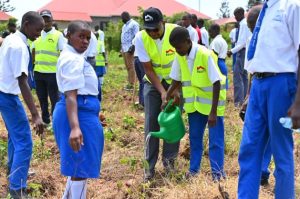
He said the bank’s approach was to move beyond planting to protecting and nurturing trees to maturity. “Economic transformation and environmental sustainability must go hand in hand,” Shoko said.
The programme builds on an earlier partnership between the bank and My Tree Initiative, which resulted in 1,500 trees being planted at Kyasanku Hill College in Mpigi District.
Enjer Ashiraf, Executive Director of My Tree Initiative, said the partnership was intended to make environmental action a practical experience for students.
The initiative comes against a backdrop of sustained pressure on Uganda’s natural forests from agricultural expansion, settlement and other land-use pressures. Equity said the country’s forest cover had fallen from about 24pc several decades ago to below 9pc.
Rtd. Gen. Katumba Wamala, Minister for Public Service and patron of My Tree Initiative, called for greater private-sector participation in environmental restoration.
“This programme is about restoring our environment,” Katumba said, linking environmental degradation to increasingly extreme weather conditions.
The Green Schools Programme forms part of Equity Group’s wider Africa Recovery and Resilience Plan, which has a regional target of planting 35 million trees across East Africa.
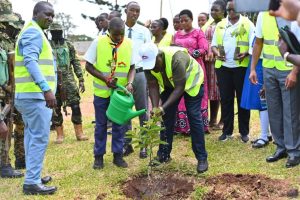
Gen. Katumba Wamala, the Minister for Public Service plants a tree
In Uganda, the bank said it has supported the planting of more than 60,000 trees over the past five years, alongside more than UGX34 billion in climate financing and support to more than 800 green enterprises.
The school-based model potentially gives the tree campaign another dimension with schools serving simultaneously as planting sites, demonstration farms and centres for environmental education, allowing students to track the survival and growth of trees they help establish.
Related Posts
 Entebbe-Based Jet Fresh Cargo Takes Ugandan Air Freight into Global Awards Contest
 DHL Launches Direct Bahrain-Johannesburg Freighter Service
 Equity Wraps up Uganda Leg of Regional Trade Mission as Value Addition Drive Gains Traction
 Independence Marathon Turns to Blood Storage Gap in Maternal Health Drive
 Fine Spinners Injects Fresh USD5m Into Technology as Uganda Textile Maker Targets African, European Markets
 Equity Trade Mission Puts Uganda’s Manufacturing Capacity to Regional Test
Get business news delivered to you everyday
Latest News

Equity Turns Schools into Climate Restoration Hubs as Lender Launches 200,000-tree Uganda drive

13 Feared Killed as Tracep Aviation L-410 Crashes in DRC

IATA Warns Cargo Screening Alone Cannot Contain Undeclared Dangerous Goods Risk

Rwenzori Marathon: A Case of What’s Possible in Diversifying Uganda’s Tourism Offering

Entebbe-Based Jet Fresh Cargo Takes Ugandan Air Freight into Global Awards Contest

Afreximbank Issues USD29m Guarantee to Expand EAC Customs Bond

Uganda puts UGX1.4tn Treasury Bonds on Auction

DHL Launches Direct Bahrain-Johannesburg Freighter Service

Uganda Set for First National ESG Conference as Sustainable Finance Gains Ground

Equity Wraps up Uganda Leg of Regional Trade Mission as Value Addition Drive Gains Traction