

ICEA LION, dfcu Team-up to turn Vehicle Finance into a Business Growth Tool
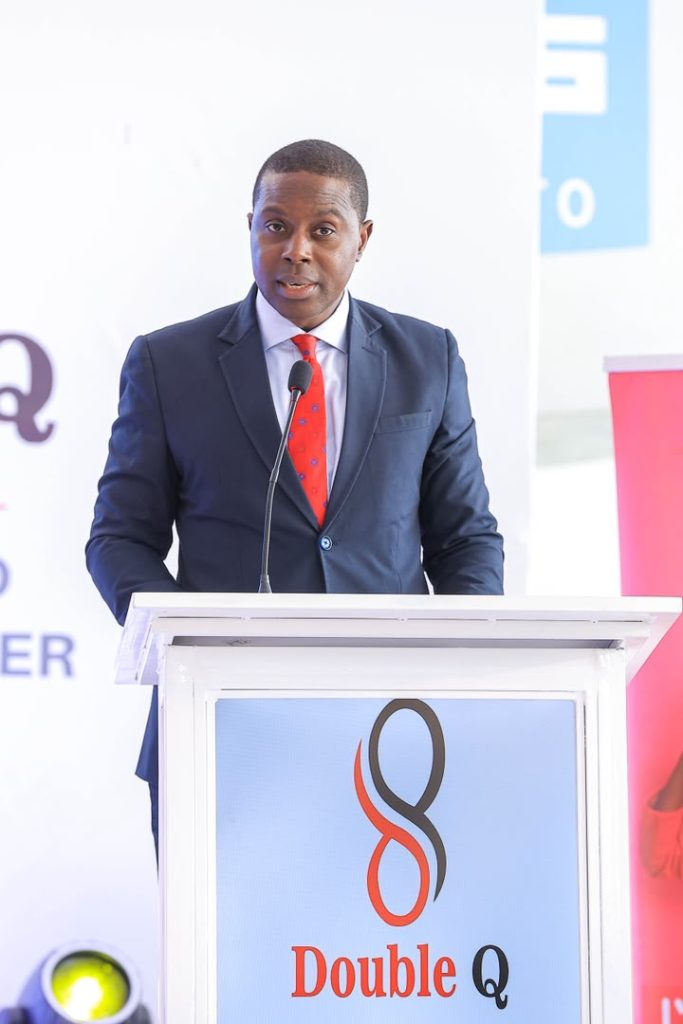 Ambrose Kibuuka ICEA LION CEO speaking during the launch
ICEA LION, dfcu Bank and Double Q are combining asset finance and insurance to help Ugandan businesses acquire productive vehicles and equipment without exhausting working capital.
For Ugandan businesses, acquiring a vehicle or productive equipment is often less about whether the asset is needed than whether the business can absorb the upfront cost without starving its operations of working capital.
A new partnership between ICEA LION General Insurance, dfcu Bank and Double Q Company Limited is seeking to address that constraint by bringing asset financing, vehicle acquisition and insurance into a single proposition.
Launched at the Double Q showroom in Bugolobi on August 12, the partnership offers financing of up to 90pc for eligible commercial vehicles and equipment, while selected passenger and electric vehicles can qualify for financing of up to 100pc, subject to dfcu Bank’s assessment.
The business proposition is significant because it treats a financed vehicle not simply as a purchase, but as a productive asset whose ability to generate revenue must be protected.
For a logistics company, for instance, a truck is part of the revenue-generating infrastructure of the business. For a contractor, construction equipment is a production asset, while for a small enterprise a pickup can determine how efficiently it reaches customers and moves goods.
ICEA LION says that financing such assets without adequately protecting them leaves businesses exposed to a potentially costly interruption.
“The customer should not have to think about financing and insurance as two separate conversations,” said Anita Mugabekazi, Head of Sales at ICEA LION General Insurance. “Once they acquire the asset, they should have a solution that enables them to secure and protect it throughout its ownership.”
Ambrose Kibuuka, Chief Executive Officer of ICEA LION General Insurance, said the partnership reflects a broader shift towards treating asset acquisition and risk management as interconnected business decisions.
“Today is not simply about adding another vehicle financing product. It is about making it easier for Ugandans to acquire assets, protect those assets and use them to create value,” Kibuuka said.
The logic is particularly relevant in a financed-asset economy. A business that commits to monthly repayments remains liable for the financing even when an accident, theft or other insured event disrupts the asset’s ability to operate.
“A vehicle that is financed but not adequately protected represents an unmanaged risk,” Kibuuka said, arguing that insurance should be regarded as part of the investment rather than an afterthought.
For dfcu Bank, the financing side of the partnership is positioned as a way of helping businesses preserve working capital while acquiring assets capable of expanding their productive capacity.
Gloria Ssuna Namutebi, Head of Vehicle and Asset Finance at dfcu Bank, said asset finance should be viewed as a growth instrument rather than merely a credit product.
“Asset finance is not simply a loan product; it is a growth tool,” Namutebi said. “It allows a logistics company to add a truck, a contractor to acquire equipment or an entrepreneur to purchase a reliable vehicle without draining the cash needed to keep the business running.”
That distinction is important for small and growing enterprises, where available cash is often required simultaneously for salaries, inventory, supplier payments and other operating expenses.
The partnership therefore seeks to shift part of the cost of expansion from an upfront cash requirement into structured financing, allowing businesses to acquire productive assets while retaining liquidity for day-to-day operations.
It also introduces a green-mobility dimension. Selected electric and hybrid passenger vehicles are eligible for financing under the arrangement, potentially lowering the entry barrier for businesses and individuals considering newer vehicle technologies.
The assets covered include the GWM Tank 500, GWM P300 SX pickup, HAVAL H6 GT Plug-in Hybrid Electric Vehicle, SINOTRUK commercial trucks, XCMG construction and mining equipment and Heli electric forklifts.
For Double Q, the showroom component provides the physical asset pipeline, while dfcu supplies the financing and ICEA LION provides the risk protection.
That combination creates a three-part business proposition: access to capital, access to productive assets and protection of the investment.
The model also reflects a wider question facing Uganda’s businesses as they seek to expand: how to increase productive capacity without putting excessive pressure on working capital.
For an entrepreneur buying a truck, forklift, construction machine or business vehicle, the economic value lies not in owning the asset but in keeping it productive.
That makes the insurance component more than a compliance requirement. It becomes part of protecting the cash flow and debt-servicing capacity that the asset is expected to generate.
The partnership’s broader proposition is consequently that asset finance works best when acquisition, financing and risk protection are considered as one investment decision.
For businesses able to qualify, the result could be a lower upfront capital burden while giving them greater certainty that the asset underpinning their expansion remains protected.
Related Posts
 Uganda Coffee Roasters Tap Richard Rugaya as Executive Director, with Focus on Commercial Growth
 Equity Bank Reports UGX37.6 Billion in Green Loans as Uganda Seeks to Scale Climate Investment
 Why Africa’s Institutions Must Turn Knowledge and Investment into Farmer Prosperity
 Forbes ranks MTN Group third globally on best telecom employer list
 Stanbic experts offer investment insights to navigate current market uncertainty
 Africa Carbon Markets Urged to Turn Potential into Investment and Delivery
Get business news delivered to you everyday
Latest News

Uganda Coffee Roasters Tap Richard Rugaya as Executive Director, with Focus on Commercial Growth

Equity Bank Reports UGX37.6 Billion in Green Loans as Uganda Seeks to Scale Climate Investment

Why Africa’s Institutions Must Turn Knowledge and Investment into Farmer Prosperity

Forbes ranks MTN Group third globally on best telecom employer list

Stanbic experts offer investment insights to navigate current market uncertainty

Bank of Uganda hikes base rate from 9.75% to 12% amidst global tensions

Corporate Buyers Could Help Unlock SAF Market Worth Millions of Tonnes by 2030

Airbus sees USD420bn Global Aviation Services Boom: Can Africa Capture its Share?

Nile Breweries Celebrates 75 Years of Growing with Uganda

Nawangwe Urges Architects to Document Uganda’s Built Heritage