

Nawangwe Urges Architects to Document Uganda’s Built Heritage

Makerere University Vice Chancellor Barnabas Nawangwe has urged architects to document Uganda’s built heritage, warning that the loss of historic buildings and misrepresentation of African architectural achievements threaten the continent’s cultural record.
Makerere University Vice Chancellor Professor Barnabas Nawangwe has urged Uganda’s architects to document and preserve the country’s built-heritage, warning that the loss of historic structures and inadequate historical records risk erasing Africa’s contribution to global architecture.
Speaking as keynote speaker at the Uganda Society of Architects (USA) Annual Symposium on October 2, Nawangwe said African architectural achievements had often been overlooked or misrepresented, leaving the continent’s history vulnerable to interpretations that diminish its contribution to civilisation.
The symposium marked 60 years of professional fellowship and 30 years of regulated architectural practice in Uganda.
Nawangwe cited the Great Mosque of Djenné in Mali, the Pyramids of Giza in Egypt, the Kasubi Royal Tombs and the ruins of Bigo bya Mugenyi in central Uganda as examples of African architectural achievement whose histories need to be properly documented, attributed and preserved.
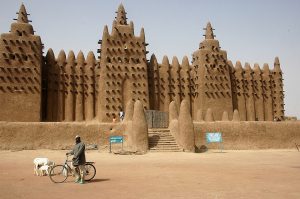
The Great Mud Mosque of Djenne in Mali. Built in 1200, it is one of the outstanding monuments to African architecture
“Africa’s architectural heritage must be documented by Africans themselves. If we leave the narrative to others, we risk losing control of our own history and allowing misrepresentations to persist,” he said.
He criticised historical interpretations that have sought to detach major African monuments from the people and societies that produced them, citing debates over the origins of the Egyptian pyramids as an example of how Africa’s architectural legacy has been contested.
Nawangwe also referred to historical damage to the Great Sphinx of Giza, arguing that attempts to alter or reinterpret African monuments have sometimes reflected wider efforts to obscure their origins. He cited the Sphinx as an example, saying that its nose had been deliberately knocked off by the Germans because its African features contradicted narratives that sought to separate ancient Egypt’s monumental architecture from black African civilisation.
He said such acts reflected broader efforts to obscure the African origins of some of the continent’s most significant architectural achievements.
He challenged the view, which he attributed to some Western scholars, that significant African architecture was largely confined to North Africa, with Ethiopia marking its southern limit.
The ruins of Great Zimbabwe, Uganda’s royal tombs and other surviving sites across the continent, he said, demonstrate a much wider architectural tradition.
Part of the problem, Nawangwe argued, is that the historical record is uneven. In much of sub-Saharan Africa, builders relied on wood, grass and other locally available materials, many of which were less likely to survive centuries of exposure than stone structures.
“The fact that some of these buildings have disappeared does not mean that the architectural traditions did not exist,” he said, calling for greater research into the materials, construction methods and cultural influences that shaped African settlements.
 He singled out the Kasubi Royal Tombs, a UNESCO World Heritage Site, as an important example of Uganda’s architectural ingenuity. The complex demonstrates how traditional materials and building techniques were used to create structures of considerable cultural, historical and architectural significance.
Nawangwe also presented a historical perspective on Uganda’s architectural development, tracing its traditions from the precolonial period through colonial rule to contemporary practice, including the development of formal architectural training at Kyambogo Technical College.
He raised the possibility of historical connections between communities across the continent, including the movement of peoples and the exchange of building techniques. Such theories, he suggested, warranted further investigation, although they require archaeological and historical evidence before firm conclusions can be drawn.
Beyond historical preservation, Nawangwe urged architects to play a stronger role in shaping Uganda’s urban development, particularly as cities expand and demand for housing and commercial property increases.
Architects, he said, operate at the intersection of design, engineering and public health, making their contribution essential to the creation of safe, functional and sustainable living spaces.
He called on the profession to establish a stronger presence in urban centres outside Kampala so that more communities can access professional architectural services.
The expansion of architectural services, he argued, should go hand in hand with efforts to protect historic buildings from demolition or inappropriate redevelopment.
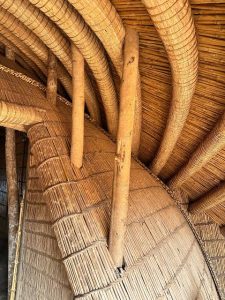
A close-up view of the Kasubi Royal Tombs shows the intricate beams that make up the superstructure
Nawangwe cited the National Theatre in Kampala as a building whose architectural and cultural significance extends beyond its immediate use. The structure continues to attract interest from international scholars and visitors studying Uganda’s built environment.
Using the Roman Pantheon as an example, Nawangwe argued that architectural heritage retains cultural, educational and economic value long after the generations that built it have passed. He described the Pantheon as one of Europe’s most visited structures, making the case that historic buildings should be viewed not as relics of the past but as assets that continue to serve contemporary society.
He urged Ugandan architects, developers and urban authorities to recognise that preserving historic buildings can sustain cultural identity, attract scholarly interest and enrich the built environment for future generations.
He expressed concern over past proposals to demolish the existing theatre and replace it with another development, saying decisions involving buildings of national significance should take their heritage value into account.
He also criticised what he described as the frequent disregard for architectural advice by property developers and municipal authorities, warning that the consequences were visible in the loss of distinctive buildings and the deterioration of urban planning.
For Nawangwe, documenting architectural heritage is not simply an academic exercise but also a practical requirement for managing urban growth, preserving cultural identity and ensuring that development does not destroy the physical evidence of Uganda’s past.
As the profession reflects on six decades of organised fellowship and three decades of regulated practice, he urged architects to combine technical expertise with a stronger public voice in decisions affecting the built environment.
Protecting Uganda’s architectural legacy, he said, requires both a better understanding of what earlier generations built and a commitment to ensuring that contemporary development does not erase it.
Related Posts
 Stanbic installs solar power system at Mbale School for the Deaf
 NWSC Seeks Grundfos Partnership to Manufacture Pumps, Spare Parts in Uganda
 Uganda to Host 2027 Global Water Congress as NWSC Targets Better Services
 Lt Gen Frederick Alexander Okecho: The Gallant Soldier Who Knew When to be Still
 Uganda’s Oil Refinery Still Makes Sense in a USD500 Billion Economy
 Equity Bank Uganda Honours 80 Customers for Loyalty, Business Growth
Get business news delivered to you everyday
Latest News

Nawangwe Urges Architects to Document Uganda’s Built Heritage

Stanbic installs solar power system at Mbale School for the Deaf

NWSC Seeks Grundfos Partnership to Manufacture Pumps, Spare Parts in Uganda

Airbus-Kratos Valkyrie Unmanned Combat Aircraft Completes First Flight Ahead of 2029 Combat Target

Uganda to Host 2027 Global Water Congress as NWSC Targets Better Services

Lt Gen Frederick Alexander Okecho: The Gallant Soldier Who Knew When to be Still

Uganda’s Oil Refinery Still Makes Sense in a USD500 Billion Economy

African Leopards Have Lost 41pc of Their Historical Range as New Study Finds Population May be as Low as 80,000

African Aviation Leaders Demand Action on Costs, Safety and Connectivity

Stanbic Business Forum told Uganda’s Schools Need to Outlive Their Founders