

Equity Bank Reports UGX37.6 Billion in Green Loans as Uganda Seeks to Scale Climate Investment
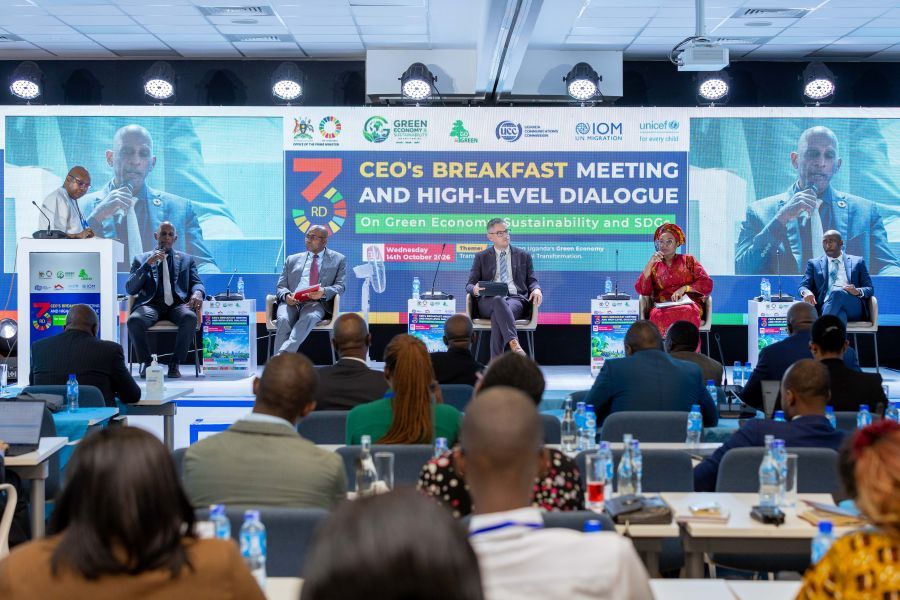 Equity Bank Uganda MD Gift Shoko sits with other panellists during the panel session at the 3rd CEOs’ Breakfast Meeting to Advance Financing for Uganda’s Green Growth
Equity Bank Uganda says it has disbursed UGX37.6 billion in green loans and supported more than 157,000 clean-energy product sales, highlighting the financing challenge facing Uganda’s green economy transition.
Equity Bank Uganda has disbursed UGX37.6 billion in green loans and supported the sale of more than 157,000 clean-energy products, as financial institutions face growing pressure to turn Uganda’s green economy ambitions into commercially viable investments.
The figures, presented by Managing Director Gift Shoko at the third CEOs’ Breakfast Meeting and High-Level Dialogue on Green Economy, SDGs and Sustainability in Mbuya on Wednesday, highlight the role of financial institutions in financing climate resilience, clean energy and sustainable enterprise.
Shoko said the bank had also channelled UGX4.75 billion into green finance through a partnership with the Uganda Energy Credit Capitalisation Company (UECCC), while working with 18 clean-energy implementing partners. Its environmental initiatives have also contributed to the planting of 96,638 trees over the past three years.
The dialogue, held at the UNICEF Conference Centre under the theme Accelerating Uganda’s Green Economy Transition Through Digital Transformation, brought together government officials, private-sector leaders, development partners and civil society representatives to discuss ways of mobilising capital for climate-resilient growth.
The figures point to a broader challenge moving Uganda’s green transition beyond climate commitments and pilot projects to financing models that can attract investment at scale while delivering measurable economic and environmental benefits.
Green finance opportunities discussed at the meeting included renewable energy, clean cooking, climate-smart agriculture, water and sanitation, and sustainable businesses. Participants also highlighted the potential of digital technology to improve energy management, extend access to clean-energy solutions and strengthen agricultural resilience.
Shoko also cited a recent USD200 million agreement by Equity Group to support smallholder farmers and micro and small enterprises through smart agriculture and related interventions. Uganda is expected to access approximately USD50 million under the arrangement, subject to the programme’s implementation and allocation arrangements.
The funding could provide additional support to agricultural enterprises and smaller businesses, although its wider economic impact will depend on how effectively financing reaches viable projects and translates into improved productivity, incomes and resilience.
Speaker of Parliament Jacob Oboth-Oboth was the keynote speaker and guest of honour. Other participants included representatives of UNICEF, the World Bank, Heifer International, the Office of the Prime Minister, the Uganda Communications Commission, the International Organization for Migration and other public- and private-sector institutions.
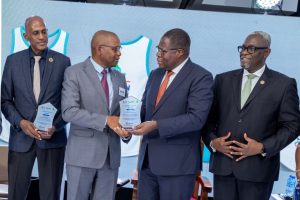
Equity Bank Uganda MD Gift Shoko is given a token of appreciation as a partner by Speaker of Parliament Hon Jacob Oboth-Oboth at the 3rd CEOs’ Breakfast Meeting to Advance Financing for
From green commitments to investable projects
A central issue in the discussions was how to reconcile the urgency of climate action with the need for bankable projects capable of attracting commercial financing.
Uganda faces growing risks from rising temperatures and increasingly unpredictable rainfall, with implications for agricultural production, household livelihoods and business continuity. Participants called for greater investment in renewable energy, wetland protection and the restoration of degraded land, alongside stronger policies to support sustainable investment.
For lenders, the challenge is to develop financing structures that make environmentally beneficial projects commercially viable without excluding businesses and communities that lack conventional collateral or established credit histories.
The discussions also highlighted the importance of public-private partnerships in mobilising capital, developing supportive regulations and extending successful interventions beyond individual organisations.
Shoko argued that sustainability should be treated as an economic priority rather than a discretionary expense.
“The question is no longer whether Uganda can afford to invest in sustainability. The question is whether we can afford not to,” he said.
He added that coordinated action by government, private businesses, development partners and financial institutions would be necessary to move the country towards a more sustainable economic model.
Trees, youth and inclusive finance
Equity Bank Uganda is also using school-based tree planting to extend its environmental programmes beyond lending.
Through its Equity Green Schools Programme, the bank aims to plant 200,000 trees by 2027, combining environmental restoration with efforts to involve young people in long-term conservation.
The programme targets 50,000 trees across 25 schools in 10 districts by the end of 2026, with further planting planned through school orchards in 2027.
Activities have included planting approximately 3,500 trees at Nakanyonyi Secondary School in Mukono during the programme’s launch, 1,500 at Kyasanku Hill College in Mpigi and 1,000 at St Julian Secondary School in Wakiso. At Busoga College Mwiri, more than 43,000 indigenous trees have been planted across the school’s hill slopes.
The initiative reflects a longer-term approach to environmental stewardship, although the durability of its impact will depend on the survival and maintenance of the trees rather than planting numbers alone.
The meeting also addressed the relationship between sustainability and social inclusion, with participants discussing targeted support for women, including those over 40, and young people, alongside employee wellness and organisational resilience.
Equity Bank Uganda said it was expanding financial literacy and capacity-building initiatives under the Young Africa Works framework. The bank reported that more than 100,000 young people had received training, alongside efforts to improve access to appropriate financing.
The wider challenge, participants said, is to translate such interventions into durable opportunities for employment, enterprise growth and household income.
As Shoko put it, the task is to mobilise finance, expand access to sustainable solutions and build partnerships capable of accelerating the transition.
Related Posts
 Uganda Coffee Roasters Tap Richard Rugaya as Executive Director, with Focus on Commercial Growth
 Nile Breweries Celebrates 75 Years of Growing with Uganda
 Stanbic installs solar power system at Mbale School for the Deaf
 Airbus-Kratos Valkyrie Unmanned Combat Aircraft Completes First Flight Ahead of 2029 Combat Target
 Uganda to Host 2027 Global Water Congress as NWSC Targets Better Services
 Equity Bank Uganda Honours 80 Customers for Loyalty, Business Growth
Get business news delivered to you everyday
Latest News

Uganda Coffee Roasters Tap Richard Rugaya as Executive Director, with Focus on Commercial Growth

Equity Bank Reports UGX37.6 Billion in Green Loans as Uganda Seeks to Scale Climate Investment

Why Africa’s Institutions Must Turn Knowledge and Investment into Farmer Prosperity

Forbes ranks MTN Group third globally on best telecom employer list

Stanbic experts offer investment insights to navigate current market uncertainty

Africa Carbon Markets Urged to Turn Potential into Investment and Delivery

Bank of Uganda hikes base rate from 9.75% to 12% amidst global tensions

Corporate Buyers Could Help Unlock SAF Market Worth Millions of Tonnes by 2030

Airbus sees USD420bn Global Aviation Services Boom: Can Africa Capture its Share?

Nile Breweries Celebrates 75 Years of Growing with Uganda