

Kalangala’s Oil Palm Economy Expands as Lenders Deepen Farmers’ Access to Finance

Two decades after oil palm production began, organised farmers in Kalangala are using savings, credit and formal banking to expand plantations and diversify household incomes.
For David Balironda Mukasa, the transformation of Kalangala’s oil palm economy can be measured not only in hectares under cultivation, but also in the changing relationship between farmers and financial institutions.
Mukasa, who has been involved in the leadership of the Kalangala Oil Palm Growers Trust (KOPGT) for more than two decades, remembers an island community where access to formal financial services was limited and household incomes were low.
Today, farmers receive regular payments for their produce, save through organised financial institutions and use credit to invest in agriculture and other businesses.
“Stanbic came to Kalangala when our people were poor, barely had shoes on their feet and there was little financial literacy,” Mukasa says.
“Our people struggled to meet basic needs, including educating their children, but today, with the support of partners like Stanbic Bank Uganda, farmers have greatly transformed.”
Stanbic Bank was the first commercial bank to establish a branch in Kalangala and has remained involved in the island’s agricultural economy as the oil palm industry has developed.
The relationship illustrates a broader shift in Kalangala, where the growth of commercial agriculture has been accompanied by the expansion of formal financial services.
Kalangala District, made up of 84 islands, was once characterised by limited economic activity and weak connections to formal markets.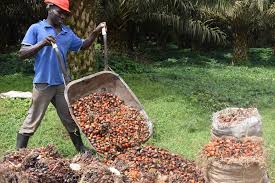
The situation began to change with the introduction of the Kalangala oil palm project in 2002, a partnership involving the Government of Uganda, the International Fund for Agricultural Development (IFAD), the World Bank and private-sector investors, including Wilmar International through Oil Palm Uganda Limited (OPUL) and Bidco Uganda Limited (BUL).
OPUL established plantations and developed an out-grower system through which local farmers could cultivate oil palm and supply fresh fruit bunches to its mill at Bwendero on Bugala Island.
The project organised more than 2,500 out-growers through the Kalangala Oil Palm Growers Trust, creating a local production base around an industry that also supports processing and manufacturing activities.
Commercial production began in 2006, and payments to farmers have since generated substantial financial flows through the formal banking system.
According to Stanbic, between UGX60 billion and UGX70 billion is transacted annually through the bank on behalf of oil palm farmers. Farmers also receive annual dividends from their shareholding in OPUL, with between UGX7 billion and UGX10 billion processed through the bank.
The figures point to an agricultural economy that has moved well beyond subsistence production.
For farmers, however, the significance of the banking relationship extends beyond receiving payments.
The emergence of organised farmer groups and savings cooperatives has provided another channel through which farmers can access capital.
Stanbic has developed a financing model centred on Savings and Credit Cooperative Organisations (SACCOs), allowing groups of farmers to mobilise savings and borrow collectively.
Melissa Nyakwera, Stanbic’s Head of Commercial Banking, says the bank provides unsecured loans of up to UGX4 billion to qualifying registered SACCOs.
The bank has also introduced unsecured financing for individual farmers in selected agricultural value chains, including palm oil, coffee, dairy, sugarcane and cocoa, with eligible farmers able to access up to UGX200 million.
The model is designed to address a familiar problem in agricultural finance: farmers often require capital to expand production before they receive income from their crops.
In Kalangala, the experience of the Ssese Oil Palm Growers SACCO illustrates how collective finance can increase the scale of borrowing.
Milly Nambatya, the SACCO’s manager, says the organisation initially borrowed UGX35 million but has since grown its borrowing capacity to as much as UGX2 billion.
Membership has also increased from 30 to more than 1,000, with women and young people making up a significant proportion.
“The SACCO financing model has enabled us to expand our operations and respond to the needs of our members,” Nambatya says.
For farmers, pooling savings and borrowing collectively can provide access to capital that would be harder to secure individually, while imposing greater financial discipline on borrowers.
A second phase
Kalangala’s oil palm economy is now entering another phase.
The Government is expanding the project into the district’s second county following the repayment of a UGX52 billion government loan by farmers involved in the first phase.
The recovered funds are expected to support the next stage of development, with preparatory work including land opening, farmer registration and institutional strengthening already underway.
The new phase is expected to cover about 2,600 hectares and benefit approximately 1,000 farmers.
For the expansion to succeed, however, the financial infrastructure that has developed around the first phase will need to expand with it.
Fred Badda, Resident District Commissioner and Chairperson of the Kalangala Palm Oil Growers Trust, says access to banking services will remain important as the project moves into new areas.
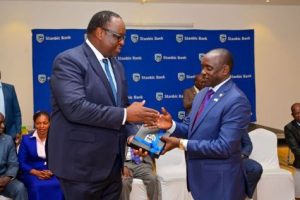
Fred Badda (R), the Resident District Commissioner and current Chairperson of the Kalangala Palm Oil Growers Trust receives a gift from Mumba Kalifungwa the Chief Executive Stanbic Bank Uganda.JPG
He has called on Stanbic to consider expanding its presence into Kyamuswa County, where the new phase will be implemented, to support farmer payments, agricultural financing and related services.
Beyond oil palm
The evolution of Kalangala’s financial ecosystem is also changing the way farmers use agricultural income.
Rather than relying exclusively on oil palm, farmers are increasingly able to invest in other businesses and income-generating activities, supported by access to savings and credit.
This diversification matters because agricultural incomes remain exposed to production cycles, commodity prices and other risks.
Stanbic says its support in Kalangala is therefore increasingly extending beyond transactions and lending to financial literacy, governance and enterprise development.
Through its Stanbic Business Incubator, the bank plans to strengthen the financial management and governance capabilities of farmers and their cooperatives.
Mumba Kalifungwa, Chief Executive of Stanbic Bank Uganda, says the approach is part of the bank’s broader Positive Impact Agenda, launched in 2025, through which it aims to mobilise up to UGX1 trillion by 2028 towards inclusive economic growth.
The agenda covers financial inclusion, enterprise development and job creation, infrastructure investment, climate resilience and corporate social investment.
Mark Ocitti Ongom, Chief Executive of Stanbic Uganda Holdings, says the bank’s engagement with farmers is also intended to give it a better understanding of the financing and business-management challenges facing agricultural communities.
For Kalangala, the next challenge is therefore not simply expanding oil palm acreage. It is ensuring that the financial systems surrounding the crop are strong enough to support farmers as their businesses become larger and more complex.
The island’s experience shows how organised agriculture, formal finance and private investment can combine to create a rural economy with stronger links to markets and capital.
For farmers such as Mukasa, the change is ultimately measured at household level in terms of the ability to save, borrow, invest and build businesses around an agricultural enterprise that was once barely connected to the formal economy.
That may be the more enduring transformation taking place beneath Kalangala’s growing canopy of oil palms.
Related Posts
 COMESA Flags WBeauty Shampoo Recall in Three Member States
 AFRAA sees Government Action, Partnerships as Key to Unlocking African Airlines’ Potential amid Surging Demand
 COMESA Competition Agency reopens Tender for Lilongwe HQ Complex
 TAAG Joins Westbrook Racing as Race Partner for Luanda E1 Grand Prix
 IFAD, Equity Launch USD200m Mechanism to Take Climate Finance to East Africa’s Farmers
 Air Tanzania Moscow Suspension Highlights rising Geopolitical Risks for African Airlines
Get business news delivered to you everyday
Latest News

COMESA Flags WBeauty Shampoo Recall in Three Member States

Kalangala’s Oil Palm Economy Expands as Lenders Deepen Farmers’ Access to Finance

AFRAA sees Government Action, Partnerships as Key to Unlocking African Airlines’ Potential amid Surging Demand

COMESA Competition Agency reopens Tender for Lilongwe HQ Complex

TAAG Joins Westbrook Racing as Race Partner for Luanda E1 Grand Prix

IFAD, Equity Launch USD200m Mechanism to Take Climate Finance to East Africa’s Farmers

Uganda Airlines Separates CEO and Accountable Manager Roles in Major Leadership Reset

Boeing Holds Bullish Africa Aviation Outlook as Fleet Set to More than Double by 2045

Inside Dr Silver Mugisha and NWSC’s Long Game to Keep Kampala’s Taps Running into the Future

Oil Money’s First Test Will be Uganda’s Ability to Stop it Leaking Through Flawed Procurement