

AFRAA sees Government Action, Partnerships as Key to Unlocking African Airlines’ Potential amid Surging Demand
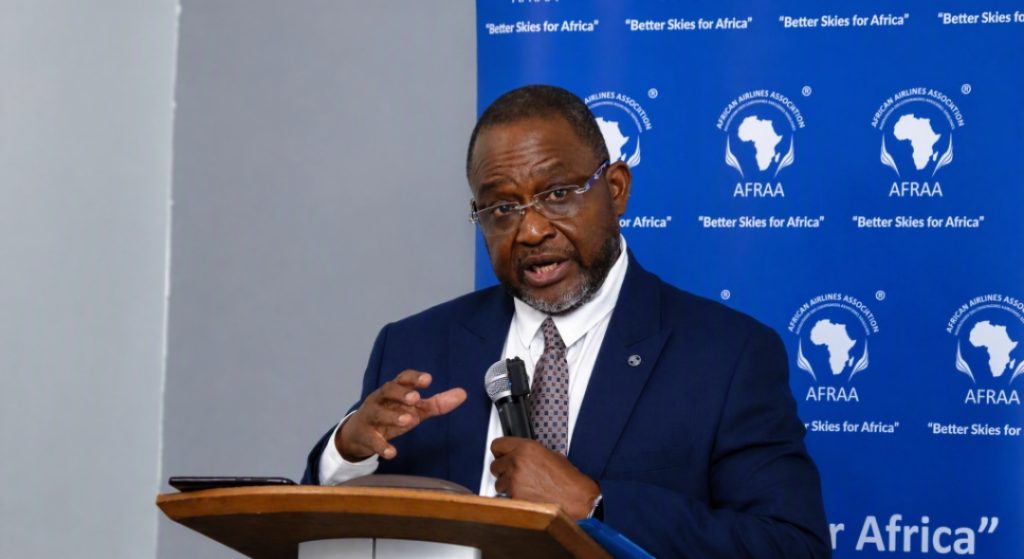
African carriers face margins of just 0.2pc in 2026 even as passenger traffic grows 21.5pc, highlighting the gap between rising demand and the continent’s weak airline economics
Africa’s aviation market is expanding rapidly, but airlines are struggling to convert rising passenger demand into sustainable returns, prompting the African Airlines Association (AFRAA) to call for stronger government action on taxes, infrastructure, financing and market liberalisation.
Speaking at a media roundtable held on the sidelines of the Aviation Africa Summit in Nairobi on September 10, AFRAA Secretary General Abderahmane Berthé said Africa’s aviation industry was confronting a fundamental contradiction: passenger demand is rising sharply while airlines continue to operate on some of the thinnest margins globally.
Passenger traffic in Africa is projected to reach 137.3 million in 2026, representing a 21.5pc increase over 2025. Yet African carriers are expected to achieve an average margin of only 0.2pc, according to AFRAA, leaving the industry highly exposed to fuel-price volatility, geopolitical disruption and other external shocks.
The structural weakness is particularly significant given Africa’s demographic and economic potential. The continent’s population is estimated at 1.58 billion in 2026, with a median age of 19, while its economies are growing at about 4.3pc annually. Yet air travel penetration remains at only about 7pc of the population, among the lowest levels globally.
For AFRAA, this represents both a challenge and a major opportunity—but one that cannot be unlocked by airlines alone.
Taxes, fees and charges account for an estimated 35–40pc of African airfares, compared with about 20pc globally. At the same time, governments were holding an estimated USD774 million in airline funds that remained blocked as of March 2026.
The association says the release of such funds, together with a reduction in the cost burden imposed on air travel, would provide immediate relief to airlines operating in already difficult markets.
Africa also receives only about 2pc of global aircraft deliveries, compared with 35.6pc for Asia-Pacific and 24pc for Europe. The continent faces an estimated USD25–30 billion requirement for airport and air-navigation infrastructure over the next decade, making access to affordable long-term financing increasingly critical.
“African aviation is ready to deliver on its promise to connect our economies, move our trade, and carry the growth that this continent’s youth and enterprise are already generating. But readiness is not the same as capacity,” Berthé said.
“Our airlines are being asked to carry that promise on some of the thinnest margins in the world, while absorbing costs, blocked funds and shocks that carriers elsewhere simply do not face.”
Geopolitical disruption is adding another layer of pressure. Conflict-driven airspace closures in parts of the Sahel and North Africa are forcing airlines to take longer routes, increasing fuel consumption and operating costs.
AFRAA is therefore pushing for a coordinated response involving governments, regional institutions, development finance institutions and the airlines themselves.
The association’s six-point response includes developing financing mechanisms for aircraft acquisition in partnership with Afreximbank, the African Development Bank and the African Union Commission, ahead of the July 2027 AU Summit.
It is also seeking to advance the African Airlines Cooperation Framework to address the continent’s long-haul capacity deficit. African airlines currently account for only 37.6pc of intercontinental capacity, leaving a substantial share of the market to non-African carriers.
AFRAA is further urging governments to move beyond commitments under the Single African Air Transport Market (SAATM) and implement the market liberalisation measures on the ground.
“We are calling on governments to release what is owed, to lower the tax burden on air travel, and to convert the liberalisation they have already signed up to into practice on the ground,” Berthé said.
The association is also advocating greater investment in aviation safety, airspace efficiency and local maintenance capacity.
There has been progress on safety. AFRAA says its capacity-building work with the Flight Safety Foundation contributed to a 35pc improvement in Africa’s accident rate in 2025, which fell to 7.86 accidents per million flights from 12.13 in 2024.
Its Free Route Airspace programme, which allows aircraft to fly more direct routes instead of following fixed airway structures, has already generated estimated annual fuel savings of 5,000 tonnes in West and Central Africa. AFRAA now plans to extend the initiative into Eastern and Southern Africa.
Maintenance remains another major leakage of value from the continent. African airlines currently spend an estimated USD1.8 billion annually on overseas aircraft maintenance, according to AFRAA.
Building stronger local maintenance, repair and overhaul (MRO) capacity, the association argues, would not only reduce airline costs but retain more aviation expenditure within African economies.
The underlying message from AFRAA is that Africa’s aviation challenge is no longer simply a question of whether there is sufficient demand.
The demand is increasingly evident. The harder question is whether governments and institutions can create the financial, regulatory and infrastructure conditions that allow African airlines to capture more of that growth.
“With that support matched at scale, African airlines can do what they do best: drive the growth, resilience and connectivity our continent needs,” Berthé said.
Related Posts
 COMESA Flags WBeauty Shampoo Recall in Three Member States
 Kalangala’s Oil Palm Economy Expands as Lenders Deepen Farmers’ Access to Finance
 COMESA Competition Agency reopens Tender for Lilongwe HQ Complex
 Air Tanzania Moscow Suspension Highlights rising Geopolitical Risks for African Airlines
 Uganda Airlines Separates CEO and Accountable Manager Roles in Major Leadership Reset
 Boeing Holds Bullish Africa Aviation Outlook as Fleet Set to More than Double by 2045
Get business news delivered to you everyday
Latest News

COMESA Flags WBeauty Shampoo Recall in Three Member States

Kalangala’s Oil Palm Economy Expands as Lenders Deepen Farmers’ Access to Finance

AFRAA sees Government Action, Partnerships as Key to Unlocking African Airlines’ Potential amid Surging Demand

COMESA Competition Agency reopens Tender for Lilongwe HQ Complex

TAAG Joins Westbrook Racing as Race Partner for Luanda E1 Grand Prix

IFAD, Equity Launch USD200m Mechanism to Take Climate Finance to East Africa’s Farmers

Air Tanzania Moscow Suspension Highlights rising Geopolitical Risks for African Airlines

Uganda Airlines Separates CEO and Accountable Manager Roles in Major Leadership Reset

Inside Dr Silver Mugisha and NWSC’s Long Game to Keep Kampala’s Taps Running into the Future

Oil Money’s First Test Will be Uganda’s Ability to Stop it Leaking Through Flawed Procurement