

Equity Trade Mission Targets Capital, Markets to Unlock Uganda’s Investment Potential
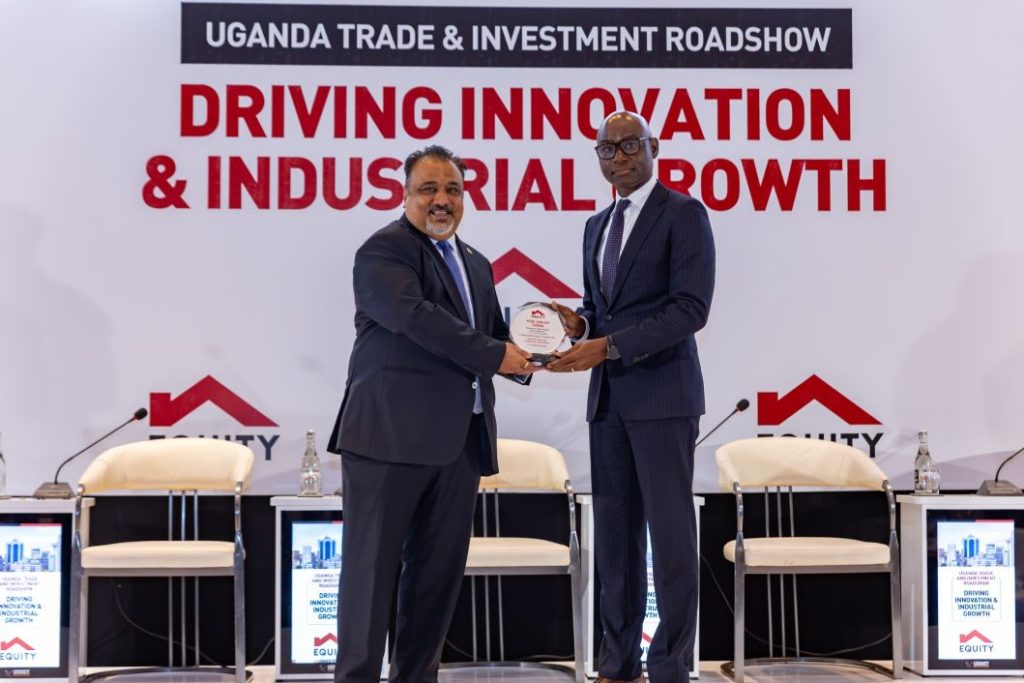 Equity Bank Executive Director Claver Serumaga(L), hands over a personalized plaque to the Minister of Trade, Industry and Cooperatives Hon. Sanjay Tanna appreciating the Ministry for its contribut_edited
More than 150 business leaders, investors and policymakers from 10 countries are in Kampala seeking commercial partnerships across agriculture, manufacturing, mining, coffee and technology.
Uganda’s investment challenge is increasingly less about identifying opportunities than connecting businesses with the capital, markets, technology and partnerships needed to turn those opportunities into scalable enterprises, participants at Equity Group’s 2026 Uganda Trade and Investment Roadshow have heard.
More than 150 business leaders, investors, policymakers and private-sector players from 10 countries have converged in Kampala for the trade mission, which is seeking to facilitate cross-border business, investment and trade links between Ugandan enterprises and regional and international partners.
The Uganda leg, which opened at the Marriott Hotel Kampala on Monday, brings together businesses and policymakers to explore opportunities in agriculture, manufacturing, mining, trade, technology and the coffee value chain.
The emphasis on commercial connections comes as Uganda seeks to increase the value generated from its natural resources and agricultural production rather than relying predominantly on exports of raw materials.
Opening the mission, Minister for Trade, Industry and Cooperatives Sanjay Tanna said the Government was accelerating efforts in value addition, manufacturing, innovation and skills development to translate Uganda’s economic potential into jobs and higher incomes.
He identified agro-processing, minerals, pharmaceuticals, textiles, leather, construction materials and ICT among areas with significant potential for investment and value addition.
Tanna said Uganda’s youthful population, natural resources, strategic location and access to growing regional markets provide a foundation for further economic expansion, but urged investors and businesses to focus on developing productive capacity within the country.
The call is particularly relevant to agriculture and minerals, where Uganda has substantial production but continues to face the challenge of moving higher up the value chain.
The minister also challenged Equity Bank to take its support for small businesses beyond major urban centres and deepen its grassroots approach in rural Uganda.
“Equity Bank built its foundation by lifting micro-enterprises in Kenya; we invite them to replicate that same grassroots model in rural Uganda to build the capacity of our local traders,” Tanna said.
He called for greater support to micro, small and medium enterprises through financial literacy, improved bookkeeping, access to finance and market opportunities.
For Government, he said, collaboration with financial institutions would be important in reducing investment barriers and the cost of capital while creating conditions in which businesses can expand and generate employment.
From finance to business connections
Equity Bank Uganda Executive Director Claver Serumaga said the bank’s role in the investment ecosystem extends beyond providing credit.
“Uganda does not lack opportunity; what we need is to connect that opportunity to the right capital, markets, technology and partnerships,” Serumaga said.
That approach is central to the trade mission, which is designed to move participating businesses from general discussions about investment opportunities towards commercial partnerships, transactions and market linkages.
For a financial institution, such a role potentially creates value on both sides of the financing equation. Helping businesses identify markets and partners can improve their ability to grow, while creating a stronger pipeline of commercially viable enterprises requiring financial services.
Equity Group Associate Director of Trade Relations Mahvish Malik said the group’s trade missions are intended to move companies beyond discussions about potential markets to direct engagement with prospective business partners.
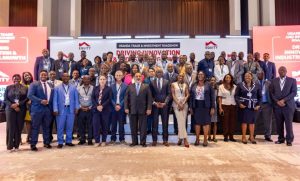
Minister of Trade, Industry and Cooperatives Hon. Sanjay Tanna and Equity Bank Executive Director Claver Serumaga in the middle along with delegates at Equity Bank Trade and Investment Roadshow 202
The programme combines business-to-business engagements, government interactions, sector visits and market-linkage activities aimed at facilitating investment, sourcing, partnerships and access to new markets.
Coffee takes centre stage
One of the key components of the Uganda mission is a roundtable on the coffee value chain, bringing together major international industry players including Neumann Kaffee Gruppe and Volcafe, alongside Ugandan businesses and other participants in the sector.
The focus on coffee comes as Uganda seeks to capture more value from one of its most important export commodities by strengthening processing, market access and linkages between producers and international buyers.
Beyond the roundtable, delegates are scheduled to undertake visits to businesses and productive-sector facilities, including Zigoti Coffee Farm, JNL Industries and Roofings Uganda Limited.
The visits are intended to give participating investors and business leaders a direct view of Uganda’s productive capacity and the commercial opportunities available across different sectors.
The programme also includes discussions on Uganda’s investment environment, trade policy and industrial development.
The business forum brought together Georgina Mugerwa, Assistant Commissioner for Multilateral Trade; Dr Cosmas Mwikirize, Head of Industrial Value Chains Innovation; and private-sector leader Ronnie Mulongo for discussions on investment opportunities and the broader business environment.
Regional integration through business
The roadshow is part of Equity Group’s wider push to use its regional footprint to facilitate intra-African trade and investment.
Rather than treating cross-border trade solely as a matter of moving goods between markets, the model seeks to connect businesses to finance, technology, suppliers, buyers and strategic partners across national borders.
That approach is increasingly important as African businesses confront fragmented markets, limited access to long-term capital and high costs associated with establishing relationships in unfamiliar markets.
For Uganda, the opportunity lies in converting its agricultural, mineral and manufacturing base into businesses capable of competing across the East African and wider African markets.
The Uganda leg runs until September 16, after which the delegation will proceed to Kigali, Rwanda, for the next phase of the programme.
The broader objective is to strengthen the commercial networks through which African businesses can access capital, markets and technology—potentially making regional integration more tangible at the enterprise level.
Related Posts
 COMESA Flags WBeauty Shampoo Recall in Three Member States
 Kalangala’s Oil Palm Economy Expands as Lenders Deepen Farmers’ Access to Finance
 AFRAA sees Government Action, Partnerships as Key to Unlocking African Airlines’ Potential amid Surging Demand
 COMESA Competition Agency reopens Tender for Lilongwe HQ Complex
 TAAG Joins Westbrook Racing as Race Partner for Luanda E1 Grand Prix
 IFAD, Equity Launch USD200m Mechanism to Take Climate Finance to East Africa’s Farmers
Get business news delivered to you everyday
Latest News

Equity Trade Mission Targets Capital, Markets to Unlock Uganda’s Investment Potential

COMESA Flags WBeauty Shampoo Recall in Three Member States

Kalangala’s Oil Palm Economy Expands as Lenders Deepen Farmers’ Access to Finance

AFRAA sees Government Action, Partnerships as Key to Unlocking African Airlines’ Potential amid Surging Demand

COMESA Competition Agency reopens Tender for Lilongwe HQ Complex

TAAG Joins Westbrook Racing as Race Partner for Luanda E1 Grand Prix

Air Tanzania Moscow Suspension Highlights rising Geopolitical Risks for African Airlines

Uganda Airlines Separates CEO and Accountable Manager Roles in Major Leadership Reset

Boeing Holds Bullish Africa Aviation Outlook as Fleet Set to More than Double by 2045

Inside Dr Silver Mugisha and NWSC’s Long Game to Keep Kampala’s Taps Running into the Future