

Equity Bank Targets Uganda’s Artisanal Miners as Financing Gap Limits Mining Growth
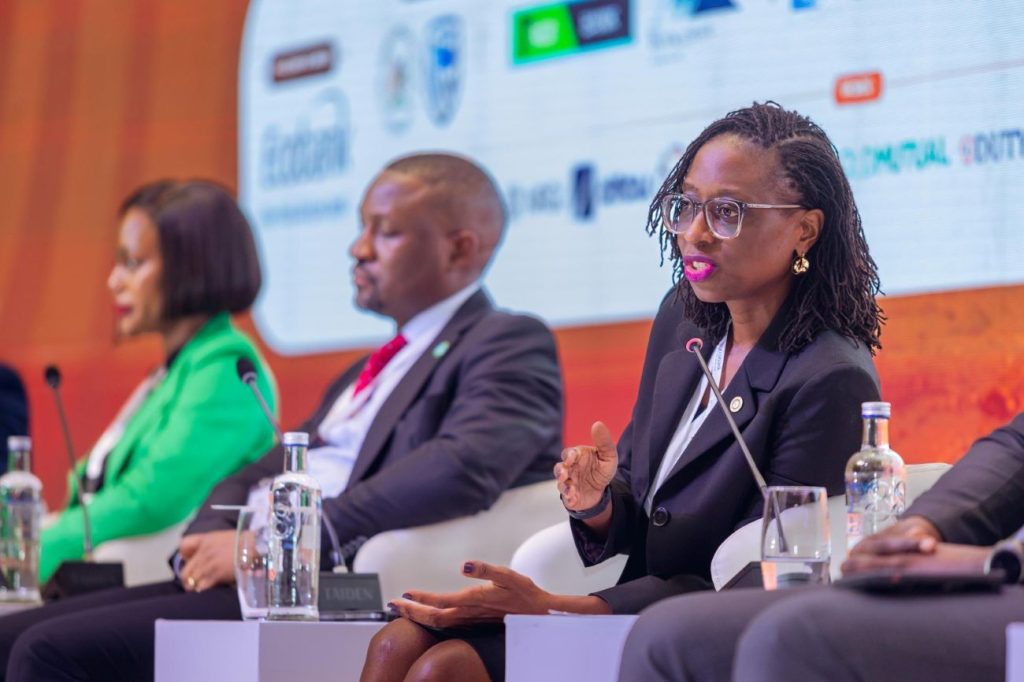 Ms Christine Mukasa Mugerwa, Senior Sector Head, Energy, Mining and Extractives at Equity Bank Uganda during the panel discussion session.
Equity Bank is targeting Uganda’s largely informal artisanal mining sector, where limited access to finance and equipment remains a major barrier to productivity, safety and value addition.
Uganda’s ambition to raise mining’s contribution to the economy from about 2% to 10% of GDP will depend not only on attracting large-scale investors, but also on bringing the country’s largely informal artisanal and small-scale miners into the formal financial system.
That is the challenge Equity Bank Uganda is seeking to address, as the bank steps up its focus on financing and financial inclusion across the mining and extractive sector.
The issue was highlighted at the 15th Annual Mineral Wealth Conference and Expo, held at Speke Resort Munyonyo from September 29 to 30, where more than 1,500 delegates discussed the future of Uganda’s mining industry under the theme, “Beneath the Surface: Unlocking Africa’s Next Mining Powerhouse.”
Christine Mukasa Mugerwa, Senior Sector Head for Energy, Mining and Extractives at Equity Bank Uganda, said about 80% of Uganda’s miners are artisanal operators, many working with rudimentary equipment and outside conventional financial systems.
“Eighty per cent of Uganda’s miners are artisanal workers using basic sticks and basins, facing major barriers to traditional financing because they move with the mines and lack formal paperwork,” Mugerwa said.
The financing challenge is rooted partly in the nature of artisanal mining itself. Operators can move between mining sites, lack fixed business addresses and often have limited formal documentation or conventional financial records, making it difficult to satisfy standard lending requirements.
The result is a significant gap between the financial needs of small-scale miners and the products available through formal banking channels.
Equity Bank says it is seeking to bridge that gap through partnerships with miner associations, off-takers and refineries, combined with financial literacy and asset-financing programmes.
The bank is also exploring financing for equipment such as mini-excavators, which could help miners move away from labour-intensive and potentially unsafe extraction methods while improving productivity.
The broader objective is to connect financing more closely to the mining value chain, rather than treating miners simply as individual borrowers.
Through partnerships with off-takers and refineries, including Wagagai, the bank says it wants to strengthen the link between production, markets and payment flows, potentially giving small-scale miners greater visibility and predictability over revenues from their output.
That is particularly important in a sector where dependence on informal intermediaries can leave small-scale producers with limited bargaining power and restricted access to investment capital.
The financing question is also tied to Uganda’s wider ambitions for the minerals sector.
Jonard Asiimwe, State Minister for Science, Technology and Innovation, said the country needs to move beyond exporting minerals in their raw form and develop domestic processing capacity.
“Exporting our minerals in their raw form is like exporting our future prosperity,” Asiimwe said, arguing that better geological information, value-chain mapping and local processing are necessary if Uganda is to retain more economic value from its mineral resources.
The argument points to a wider weakness in Africa’s mineral economies: possessing mineral deposits does not automatically translate into industrial development. The greater economic prize lies in moving from extraction into processing, manufacturing and associated services.
Uganda has identified 58 minerals and is seeking greater investment in exploration, extraction and beneficiation. But achieving the government’s target of increasing mining’s contribution to GDP to 10% will require capital at multiple levels of the industry, from major projects to small operators supplying the primary market.
Humphrey Asiimwe, CEO of the Uganda Chamber of Energy and Minerals, said the conference was intended to highlight the country’s mineral potential and investment opportunities, including the development of operations such as the Wagagai Gold Mine.
For artisanal and small-scale miners, however, the immediate challenge is less about attracting international capital than obtaining the equipment, working capital and financial services needed to participate more effectively in the formal economy.
Equity Bank’s intervention therefore reflects a broader shift in thinking about financial inclusion in extractive industries. Bringing small operators into formal banking can provide more than access to loans; it can create financial records, improve payment transparency and potentially make miners more bankable over time.
The bank says its wider approach forms part of Equity Group’s Africa Recovery and Resilience Plan, which identifies natural resources and extractives as potential drivers of industrialisation and economic transformation.
For Uganda, the test will be whether increased investment in mining translates into more domestic value addition, better working conditions and stronger local supply chains.
That will require more than large mining projects. It will also require a financial system capable of reaching the informal and small-scale operators who make up much of the country’s mining workforce.
If Uganda is to turn its mineral resources into a larger economic sector, closing that financing gap could prove as important as discovering new deposits.
Related Posts
 UDB Commissions Titivated Headquarter Tower as Development Lender Scales up Transformation Role
 Equity Bank Urges Diaspora Ugandans to Turn Remittances into Investments
 Exim Bank Uganda Backs Yangtze Industry Expansion into Manufacturing
 United’s Johannesburg-New York Nonstop Service Hits Five-Year Milestone
 Airbus A350F Freighter Takes Flight as Cargo Market Shifts Toward Newer, More Efficient Aircraft
 Equity Turns Schools into Climate Restoration Hubs as Lender Launches 200,000-tree Uganda drive
Get business news delivered to you everyday
Latest News

UDB Commissions Titivated Headquarter Tower as Development Lender Scales up Transformation Role

Equity Bank Urges Diaspora Ugandans to Turn Remittances into Investments

Uganda Private Sector Sustains Demand Despite Rising Costs

Aviation says Safety’s Next Gains Will Depend on People, Technology and Standards

Equity Bank Targets Uganda’s Artisanal Miners as Financing Gap Limits Mining Growth

Airlink Expands Cape Town Network with New Lanseria and Mauritius Links

Africa Faces Gunboat Diplomacy Without the Gunboats

Exim Bank Uganda Backs Yangtze Industry Expansion into Manufacturing

United’s Johannesburg-New York Nonstop Service Hits Five-Year Milestone

African Airlines Outpace Global Market as August Passenger Demand Rises 6.7pc