

Aviation says Safety’s Next Gains Will Depend on People, Technology and Standards
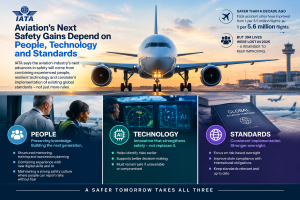
IATA says aviation’s next safety gains will depend on combining experienced people, resilient technology and consistent implementation of global standards rather than simply creating more rules.
The next major gains in aviation safety will depend less on creating new rules than on combining experienced people, resilient technology and consistent enforcement of existing global standards, the International Air Transport Association (IATA) has said.
Opening the IATA World Safety and Operations Conference in Istanbul on October 6, IATA Director of Safety Mark Searle said the industry had made significant safety gains but could not afford to become complacent.
Fatal accident rates have improved from one accident per 3.5 million flights a decade ago to one per 5.6 million flights today. But 394 people were still killed in aviation accidents in 2025, underscoring the consequences of weaknesses in the system.
“The next advance in safety will come from people, technology, and standards working together better as one resilient system,” Searle said.
For IATA, one of the emerging challenges is managing the transition between generations of aviation professionals while retaining operational knowledge built up over decades.
The association is calling for more structured mentoring, training and succession planning to ensure that experience is not lost as older professionals leave the industry.
That knowledge will increasingly need to be combined with the digital capabilities of a younger workforce, particularly as airlines and regulators adopt artificial intelligence and other data-driven technologies.
But IATA’s position is that technological sophistication should not be mistaken for safety resilience.
Searle said new technology should be assessed against three basic questions: whether it improves understanding of emerging risks, whether it supports better decision-making, and whether an operation can remain safe if the technology becomes unavailable or is compromised.
The warning is particularly relevant as aviation faces growing interference with global navigation satellite systems (GNSS), which can disrupt navigation and other aircraft systems.
Technology can help identify risks earlier, but its failure or degradation must not leave aviation without an effective fallback.
That means maintaining redundancy, procedures, training and human judgement alongside increasingly automated systems.
“Technology alone is never enough,” Searle said, pointing to GNSS interference as an example of why aviation systems must be designed to remain safe when technology is unavailable, degraded or produces misleading information.
IATA is also challenging the assumption that the industry’s safety problem is primarily a shortage of international standards.
The association argues that many of the most significant weaknesses now arise from inconsistent implementation and oversight of standards that already exist.
The performance of airlines participating in IATA’s IOSA safety audit programme demonstrates, in the association’s view, the value of common standards when they are backed by effective oversight.
The next improvement therefore requires governments, regulators and operators to concentrate on applying existing requirements consistently rather than continually adding new layers of regulation.
IATA has identified stronger implementation and oversight, improved compliance by states with international obligations and regular modernisation of standards as priorities.
It has particularly highlighted conflict-zone risk information and accident reporting as areas where stronger state compliance is needed.
For regulators operating with limited resources, IATA says oversight should also be increasingly risk-based, directing attention towards areas where safety risks are greatest rather than treating every requirement equally.
The approach has implications beyond major aviation markets. As air traffic expands in emerging markets, the effectiveness of safety regulation will depend not simply on whether countries have adopted international standards, but on whether they have the institutional capacity, trained personnel and technical systems to implement and monitor them.
The same principle applies to accident investigation, operational reporting and the management of emerging risks.
IATA’s message is that aviation safety is becoming less about finding a single technological or regulatory solution and more about ensuring that the different parts of the safety system reinforce each other.
A highly automated aircraft still requires competent people. Sophisticated navigation technology requires procedures for when it fails. And international standards have limited value if implementation and oversight vary significantly between jurisdictions. As aviation becomes more technologically complex, maintaining that resilience could prove as important as developing the next generation of safety technology.
Related Posts
 Equity Bank Targets Uganda’s Artisanal Miners as Financing Gap Limits Mining Growth
 Airlink Expands Cape Town Network with New Lanseria and Mauritius Links
 Africa Faces Gunboat Diplomacy Without the Gunboats
 United’s Johannesburg-New York Nonstop Service Hits Five-Year Milestone
 Uganda Parliament Calls for Faster Social Protection Reforms for Older Persons
 Uganda Targets Higher Milk Yields From Indigenous Ankole Cow Without Exotic Crossbreeding
Get business news delivered to you everyday
Latest News

UDB Commissions Titivated Headquarter Tower as Development Lender Scales up Transformation Role

Equity Bank Urges Diaspora Ugandans to Turn Remittances into Investments

Uganda Private Sector Sustains Demand Despite Rising Costs

Aviation says Safety’s Next Gains Will Depend on People, Technology and Standards

Equity Bank Targets Uganda’s Artisanal Miners as Financing Gap Limits Mining Growth

Airlink Expands Cape Town Network with New Lanseria and Mauritius Links

Africa Faces Gunboat Diplomacy Without the Gunboats

Exim Bank Uganda Backs Yangtze Industry Expansion into Manufacturing

United’s Johannesburg-New York Nonstop Service Hits Five-Year Milestone

African Airlines Outpace Global Market as August Passenger Demand Rises 6.7pc