

Africa Faces Gunboat Diplomacy Without the Gunboats
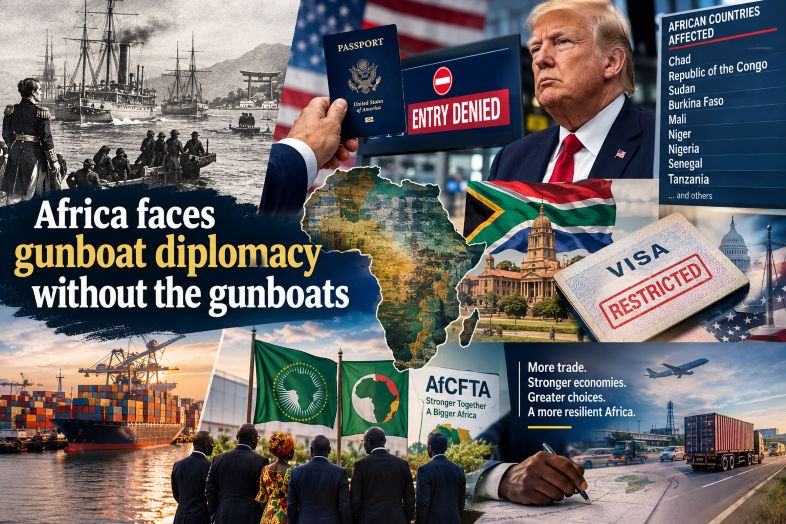
Africa is confronting a new form of gunboat diplomacy, where visas, tariffs and market access can be used as instruments of political pressure.
 By Bertie Jacobs
“Speak softly and carry a big stick; you will go far.” That was one of the mantras of Theodore ‘Teddy’ Roosevelt, the 26th president of the United States. It meant diplomacy backed by force. As US imperial ambitions expanded, the message was clear: negotiations carried more weight when the other party knew what refusal might cost.
But there is another ‘diplomatic’ practice from a few decades before Teddy, one associated with the British Royal Navy in the nineteenth century and demonstrated by American Commodore Matthew Perry’s arrival in Japan with warships in 1853. Perry came to secure access. His ships made the consequences of resistance unmistakable.
For Africa, the vessels have changed. The question of who gets to dictate the terms remains.
US president Donald Trump is not renowned for speaking softly. His administration’s restrictions on entry to the United States have affected countries across the continent. Washington’s June 2025 proclamation imposed full entry restrictions on nationals of seven African countries, including Chad, the Republic of the Congo and Sudan. A December expansion added further African countries, including Burkina Faso, Mali and Niger, while imposing partial restrictions on others, including Nigeria, Senegal and Tanzania. These measures contain exceptions, but their continental reach is clear.
Washington presents these broader restrictions as responses to security concerns, inadequate screening and visa overstays. They differ from sanctions aimed at particular officials over disputed government policies. Yet both demonstrate the power that comes with controlling access.
Who may enter? On whose terms? And what must a government change to keep the door open?
South Africa offers a revealing case study. On 15 September, Secretary of State Marco Rubio announced visa restrictions targeting people involved in policies Washington says enable uncompensated land seizures, racial discrimination or the incitement of violence against minority groups. No individuals were named.
Prof. Piet Croucamp, political analyst from the North-West University (NWU), says the ambiguity makes the restrictions an instrument of political leverage.
“The most striking thing about the statement is how vague it is. It names no individuals and relies on a provision that gives US Secretary of State Marco Rubio wide discretion to bar people whose entry is deemed harmful to US foreign policy interests. That leaves Washington room to target anyone from legislators to bureaucrats and other officials. Julius Malema may be a principal target.”
That is his assessment of the South African dispute. Its implications deserve attention beyond Pretoria.
“In practice, the visa restrictions are less a precise legal instrument than a flexible political stick that can be used selectively. They mark another step in the Trump administration’s deterioration of relations with South Africa.”
A flexible stick is useful precisely because those facing it cannot be certain where it will land next.
For African governments, the concern is therefore bigger than whether a minister can board a flight to Washington. It is whether access to a powerful country becomes conditional on accepting its interpretation of domestic policy, its diplomatic priorities and its preferred partnerships.
South Africa’s dispute illustrates how quickly these questions overlap. Washington has also criticised Pretoria’s genocide case against Israel at the International Court of Justice. A disagreement over domestic legislation consequently sits alongside a confrontation over foreign policy.
None of this places African governments beyond criticism. Sovereignty does not excuse corruption, repression or policies that fail their own citizens. Nor does a government become principled merely by opposing Washington.
Croucamp makes that distinction when assessing Pretoria.
“There is a fair argument that South Africa’s foreign policy is driven less by consistent human rights principles than by ideology and the ANC’s historical relationships. It is a complicated picture.”
It is. But acknowledging a government’s inconsistencies does not give another government an unlimited mandate to determine its choices.
The nineteenth-century gunboat carried power because its guns did not necessarily have to be fired. Its presence demonstrated what could happen if demands were ignored. Visas, tariffs, financial restrictions and access to markets can carry a similar threat.
These instruments differ in purpose and effect. A visa restriction on an official is not equivalent to a tariff affecting an entire industry. That difference is precisely why escalation matters.
Croucamp’s warning concerns South Africa, but the underlying vulnerability is familiar wherever livelihoods depend on decisions made in distant capitals.
“The larger risk is that targeting individuals through visa restrictions makes it easier to escalate to trade measures. Changes to AGOA access or tariffs would hurt far more South Africans than a visa ban. That wider relationship matters more than the visa restrictions alone.”
When pressure moves from officials to economic relationships, the people paying the price may have had little influence over the dispute. Workers, exporters and their families become exposed to a confrontation conducted in the language of national interests.
Africa’s answer cannot end with indignation. Nor can it depend on exchanging reliance on Washington for reliance on another powerful capital.
Greater room to make independent choices requires stronger economies, more trading partners and more trade within Africa. The African Continental Free Trade Area aims to create a single market for goods and services and deepen the continent’s economic integration. Making that ambition work would also strengthen Africa’s ability to negotiate.
That requires functioning infrastructure, credible institutions and governments willing to remove obstacles between African businesses. Sovereignty needs practical foundations. A country with few economic alternatives has less room to resist pressure, however forcefully its leaders speak.
Africa is a continent of different states, interests and vulnerabilities. A common response need not mean agreement on every dispute. It should mean recognising the danger of allowing external powers to negotiate with each country from a position of overwhelming dependence.
The gunboats have not disappeared from international politics. But they are no longer required at every harbour. Sometimes a visa restriction delivers the warning. Sometimes access to a market supplies the ammunition.
South Africa is facing that warning now. The rest of Africa should be paying attention to the bigger sticks still within Washington’s reach.
Bertie Jacobs is an award-winning journalist who has been published extensively in a variety of national media publications. He is an alumnus of the North-West University where he completed his honours degree in journalism. He enjoys writing about current affairs, everything sociological, human-interest stories and sport. Bertie is a history and popular culture fanatic and spends most of his free time indulging in one of these pursuits…or traveling.
Related Posts
 United’s Johannesburg-New York Nonstop Service Hits Five-Year Milestone
 Uganda Parliament Calls for Faster Social Protection Reforms for Older Persons
 Uganda Targets Higher Milk Yields From Indigenous Ankole Cow Without Exotic Crossbreeding
 Airbus A350F Freighter Takes Flight as Cargo Market Shifts Toward Newer, More Efficient Aircraft
 Uganda Architects to Celebrate 60 Years as Profession Confronts a Technology-driven Future
 Africa Moves to Implement ‘Correct the Map’ Resolution as Equal Earth Cartographers Pledge Support
Get business news delivered to you everyday
Latest News

Africa Faces Gunboat Diplomacy Without the Gunboats

Exim Bank Uganda Backs Yangtze Industry Expansion into Manufacturing

United’s Johannesburg-New York Nonstop Service Hits Five-Year Milestone

African Airlines Outpace Global Market as August Passenger Demand Rises 6.7pc

Uganda Parliament Calls for Faster Social Protection Reforms for Older Persons

Uganda Targets Higher Milk Yields From Indigenous Ankole Cow Without Exotic Crossbreeding

Airbus A350F Freighter Takes Flight as Cargo Market Shifts Toward Newer, More Efficient Aircraft

Uganda Architects to Celebrate 60 Years as Profession Confronts a Technology-driven Future

Oyo Nyimba: The King Who Made Tooro Feel Close to the World

In Karamoja, an 80-day Sorghum Variety Offers a Different Response to Drought