

In Karamoja, an 80-day Sorghum Variety Offers a Different Response to Drought
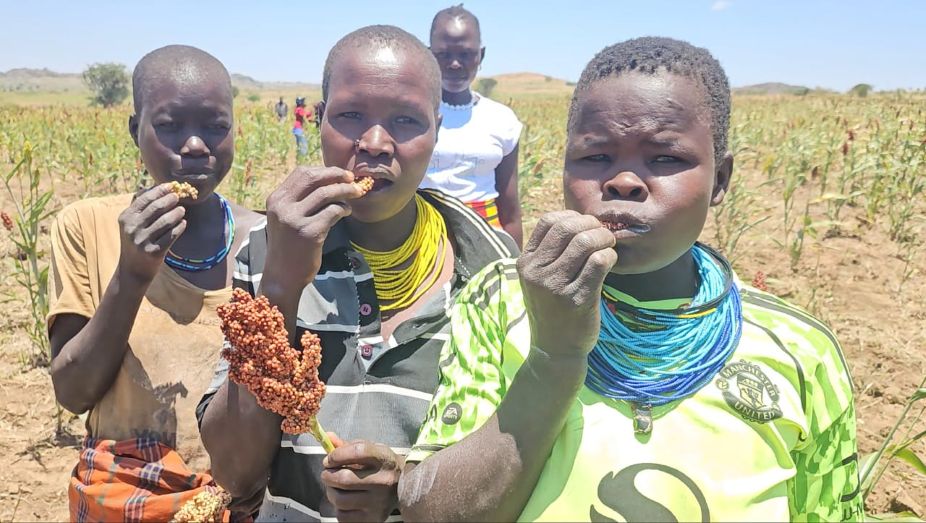
A drought-tolerant NARO sorghum variety that matures in about 80 days is showing promise in Karamoja, offering farmers a shorter production cycle as prolonged dry conditions deepen food insecurity.
In Karamoja, where prolonged drought is pushing households deeper into food insecurity, a five-acre sorghum field in Katile Sub County is being used to test a proposition that could become increasingly important for farming in Uganda’s drylands. When the climate changes, shortening the time between planting and harvest may matter as much as increasing yields.
The crop on the demonstration plot is NARO Sorghum 2, or NAROSORG2, an early-maturing variety developed by the National Agricultural Research Organisation (NARO) for harsh growing conditions. Under Karamoja’s conditions, the variety takes about 80 days to mature, according to NARO researchers.
That characteristic is particularly important in a region where farmers can no longer assume that a rainy season will provide enough time for conventional crops to complete their growth cycle.
At the Katile field day, NARO researchers said NAROSORG2 had continued to perform despite the difficult weather, offering farmers a practical demonstration rather than simply a laboratory claim about drought tolerance.
“It is early maturing, it is drought tolerant, it can withstand extreme drought and still give you some good degree of yield,” said Dr Walter Odongo, Director of Research at NARO’s Nabuin Zonal Agricultural Research and Development Institute.
Another attribute that makes the variety just as important for Karamoja is that birds do not readily feed on it.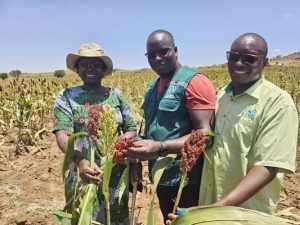
Sorghum farmers in the subregion have long faced losses from predatory birds, making a variety that combines drought tolerance with resistance to bird damage potentially more useful than one that addresses drought alone.
“The third strong attribute about this sorghum variety, and which excites the farmers most, is that this variety of Sorghum is not eaten by birds,” Odongo said.
Farming against a shorter climate window
The significance of NAROSORG2 lies less in its ability to eliminate drought risk than in its potential to reduce farmers’ exposure to it. A crop that reaches maturity in roughly 80 days gives farmers a shorter production cycle in which rainfall has to remain adequate. In a semi-arid environment, that can be the difference between harvesting a crop and losing an entire season.
This is also why NARO has taken the technology beyond a single demonstration plot. Dr Ijara Anthony Raphael, a Senior Research Officer at NARO, says parish-level demonstration gardens had been established across Karamoja’s six districts. The gardens, ranging from five to 10 acres, allow farmers to observe different technologies, planting times and crop-management practices under local conditions.
The strategy reflects a shift from treating drought primarily as an emergency to treating it as a production constraint requiring adaptation.
“Karamoja is challenged by hitting droughts,” Ijara says. “Our minds are triggered at getting technologies which can ensure food security and income for the Karamoja people.”
The demonstrations are also intended to create a pathway for seed multiplication. Rather than leaving improved varieties confined to research stations or demonstration plots, NARO wants farmers to acquire planting material and progressively expand cultivation within their communities.
Dr Damalie Akwango, coordinator of the Uganda Climate-Smart Agriculture Transformation Project at NARO, said the project is supporting seed multiplication for sorghum and cassava while promoting early-maturing varieties.
“Under the project, we are promoting early maturing varieties to try to reduce food insecurity in this region and also improve their household income,” she said.
The challenge now is to determine whether the performance observed on demonstration farms can translate into sustained production at household level.
For that to happen, farmers need reliable access to quality seed, extension advice and markets, while the economics of producing sorghum must make sense for households operating under difficult conditions.
The Katile demonstration has given farmers visible evidence that a crop can still produce under the conditions they are actually experiencing, something that drought-hit communities often lack.
Extension worker Miriam Akitwi says farmers had been involved from land preparation through to crop management and harvest.
“They are appreciating NARO SORG 2 as a rare variety.”
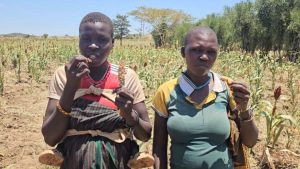 Local farmer Apui John Baptist says the difference between NAROSORG2 and varieties traditionally grown in the area was already apparent, particularly in its ability to withstand the intense sunshine and mature more quickly.
For Kaabong District LCV Chairman Lotyang Albert Loris, the potential significance extends beyond one harvest.
“There is no doubt that our people are suffering. They have no food. And it is not because of laziness, but the weather conditions can be so harsh,” he says.
He believes that the crop’s short maturity period could create opportunities for farmers to fit additional production into a year.
“Looking at the fast maturity of this crop, people would even be able to introduce a second harvest season in a year.”
Karamoja’s prolonged drought has exposed the limits of farming systems built around predictable rainfall. While a drought-tolerant, early-maturing crop cannot solve the region’s wider food-security problem on its own, experts believe it can reduce one of the most immediate risks facing farmers – investing in a crop that runs out of time before the rains do.
Related Posts
 UNBS Seizes 17,770 Litres of Illicit Alcohol as Kenya Deaths Raise Regional Concern
 Relief as UAE Eases Ebola-era Entry Curbs on Ugandans, Reopening Key Aviation Corridor
 13 Feared Killed as Tracep Aviation L-410 Crashes in DRC
 IATA Warns Cargo Screening Alone Cannot Contain Undeclared Dangerous Goods Risk
 Rwenzori Marathon: A Case of What’s Possible in Diversifying Uganda’s Tourism Offering
 Entebbe-Based Jet Fresh Cargo Takes Ugandan Air Freight into Global Awards Contest
Get business news delivered to you everyday
Latest News

In Karamoja, an 80-day Sorghum Variety Offers a Different Response to Drought

UNBS Seizes 17,770 Litres of Illicit Alcohol as Kenya Deaths Raise Regional Concern

Why Unlocking Africa’s Next Mining Powerhouse Requires Strong Financial Partnerships

Relief as UAE Eases Ebola-era Entry Curbs on Ugandans, Reopening Key Aviation Corridor

Equity Turns Schools into Climate Restoration Hubs as Lender Launches 200,000-tree Uganda drive

13 Feared Killed as Tracep Aviation L-410 Crashes in DRC

IATA Warns Cargo Screening Alone Cannot Contain Undeclared Dangerous Goods Risk

Rwenzori Marathon: A Case of What’s Possible in Diversifying Uganda’s Tourism Offering

Afreximbank Issues USD29m Guarantee to Expand EAC Customs Bond

Uganda puts UGX1.4tn Treasury Bonds on Auction