

China’s GPMI Interface Leapfrogs HDMI, USB With 192Gbps Speeds and 480W Power

China’s GPMI interface combines video, data and power in one cable, targeting up to 192Gbps speeds and 480W delivery as it challenges HDMI and USB.
China is advancing a new cable interface designed to consolidate video, audio, data transmission and power delivery into a single connection, challenging established technologies such as HDMI, USB and DisplayPort as manufacturers seek simpler, higher-capacity ways to connect electronic devices.
The General Purpose Media Interface (GPMI), developed by an alliance of Chinese technology companies, supports advertised bandwidth of up to 192 gigabits per second (Gbps) and power delivery of up to 480 watts (W), specifications intended to accommodate demanding applications such as 8K ultra-high-definition video.
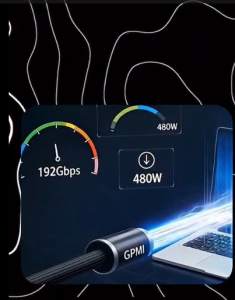 The technology is being promoted by the Shenzhen 8K UHD Video Industry Cooperation Alliance, a consortium involving more than 50 companies, including electronics manufacturers and technology suppliers. Its stated objective is to address the limitations of existing interfaces by combining several connectivity functions in one cable.
GPMI could reduce the number of cables and separate power connections required by televisions, computers, monitors and audiovisual equipment. It also supports bidirectional data transmission and device control, potentially allowing connected equipment to exchange information rather than simply transmit content in one direction.
Two versions target different devices
GPMI has two principal connector configurations, with different performance capabilities.
The Type-B version offers the headline specifications of 192Gbps bandwidth and 480W power delivery. It uses a dedicated connector and is designed for applications requiring higher data throughput and power capacity.
The Type-C version uses the USB-C connector format and is specified to deliver up to 96Gbps of bandwidth and 240W of power. Its design could make it more suitable for devices such as laptops, monitors and other equipment built around compact connections.
However, sharing the USB-C connector format does not automatically make every existing USB-C port compatible with GPMI. Devices must support the relevant technology for its full capabilities to be available.
The higher-capacity Type-B configuration is designed to support 8K video at up to 120 frames per second, according to HiSilicon, the Chinese chip developer promoting the technology. The Type-C version is specified for 8K at 60 frames per second or 4K at 120 frames per second.
GPMI also incorporates networking and control capabilities, including support for connecting multiple devices in a chain. This could simplify installations involving displays, computers, audiovisual equipment and other connected devices.
A challenge to established standards
The technology enters a market in which HDMI remains widely used for connecting televisions, monitors and entertainment equipment, while USB-C, USB4 and Thunderbolt serve a growing range of data, display and power applications.
GPMI’s proposed advantage is the combination of these functions rather than simply higher transmission speeds. A sufficiently powerful, compatible connection could carry high-resolution video, exchange data and supply electricity without requiring several separate cables.
That proposition could appeal to manufacturers of smart televisions, commercial displays, gaming systems and professional audiovisual equipment, particularly where cable management and power requirements complicate installation.
There is also a geopolitical question over whether Western technology companies will embrace a connectivity standard developed in China, at a time when control over technology standards, semiconductor supply chains and digital infrastructure has become an increasingly important element of economic competition. Even if GPMI delivers on its technical promises, adoption beyond China will depend partly on whether global electronics manufacturers see commercial advantages in supporting a standard they did not develop and do not control.
Compatibility with existing equipment, licensing arrangements, intellectual property protections and confidence in long-term governance could influence that decision. Yet the commercial logic cuts both ways. If GPMI offers demonstrable performance or cost advantages, manufacturers may find it difficult to ignore, regardless of where the technology originated.
But technical specifications alone will not determine whether GPMI becomes a global standard. Its prospects will depend on manufacturers incorporating compatible ports into products, the availability of supporting chips and cables, pricing, and whether device makers outside China choose to adopt it.
Compatibility will also be important. Consumers and businesses have invested heavily in equipment built around existing interfaces, meaning any transition would have to offer clear practical benefits to justify replacing established connections or adding adapters.
GPMI is therefore better understood as an emerging challenger than an immediate replacement for HDMI and USB. Its performance claims indicate the direction of China’s ambitions in electronic connectivity, but widespread adoption remains a separate test.
For the broader technology industry, the development highlights a continuing effort to simplify the connections between devices while increasing the bandwidth and power available through a single interface. Whether GPMI can turn that proposition into a widely adopted alternative will depend on how quickly its technical capabilities translate into commercially available products.
Related Posts
 SITA Acquisition of Collins Airport Solutions Signals Moves to Consolidate Aviation Technology
 Airbus sees USD420bn Global Aviation Services Boom: Can Africa Capture its Share?
 IATA says Aviation Safety’s Next Gains Will Depend on People, Technology and Standards
 Uganda Architects to Celebrate 60 Years as Profession Confronts a Technology-driven Future
 28 Ethiopian Students Graduate from Ethiopian Airlines-Boeing STEM Programme
 Kigali to Host Carbon Markets Africa Summit as Climate Finance Opportunity Grows
Get business news delivered to you everyday
Latest News

China’s GPMI Interface Leapfrogs HDMI, USB With 192Gbps Speeds and 480W Power

Stanbic Seeks Northern Uganda Business Feedback as It Marks 35 Years in Country

Uganda Emerges as Africa’s Largest Organic Farming Country as Exports Reach USD225 Million

SITA Acquisition of Collins Airport Solutions Signals Moves to Consolidate Aviation Technology

Uganda Coffee Roasters Tap Richard Rugaya as Executive Director, with Focus on Commercial Growth

Equity Bank Reports UGX37.6 Billion in Green Loans as Uganda Seeks to Scale Climate Investment

Why Africa’s Institutions Must Turn Knowledge and Investment into Farmer Prosperity

Forbes ranks MTN Group third globally on best telecom employer list

Stanbic experts offer investment insights to navigate current market uncertainty

Africa Carbon Markets Urged to Turn Potential into Investment and Delivery