

Uganda Emerges as Africa’s Largest Organic Farming Country as Exports Reach USD225 Million
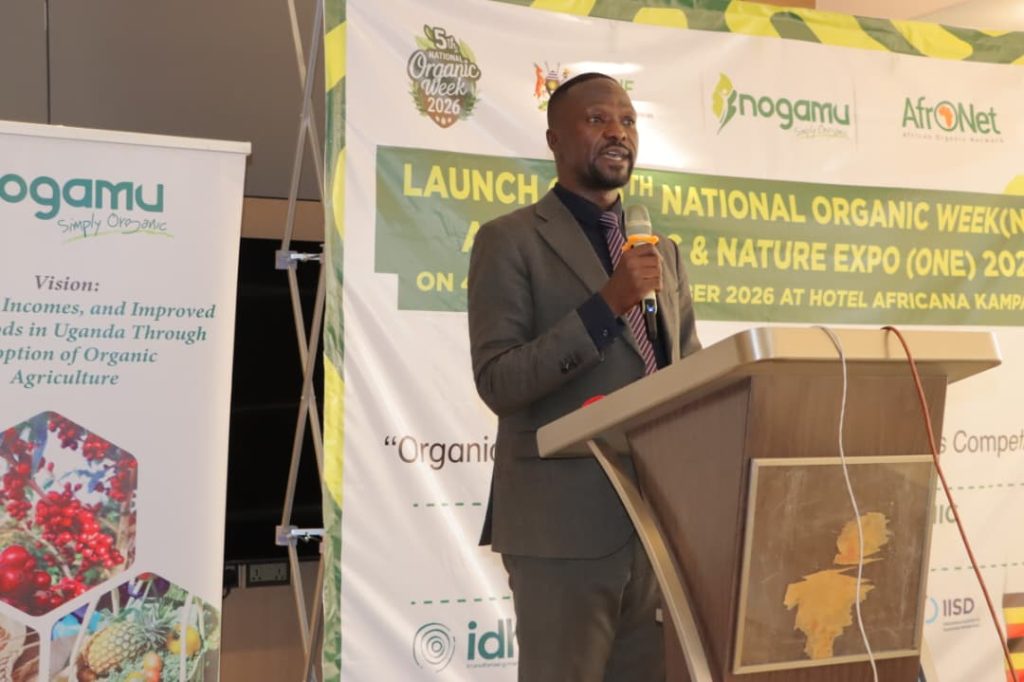 NOGAMU Chief Executive Chariton Namuwoza announcing the 5th National Organic Week and Africa’s First Organic and Nature Expo
Uganda’s organic agriculture sector recorded USD225.7 million in exports in 2025, with 744,288 certified farmers cultivating 930,360 hectares, strengthening the country’s position as Africa’s largest organic farming producer
Uganda’s organic agriculture sector has expanded rapidly, with certified farmers increasing to 744,288 and exports reaching an estimated USD225.7 million in 2025, according to new figures released by the National Organic Agricultural Movement of Uganda (NOGAMU).
The figures place Uganda as Africa’s largest country by area under certified organic farmland and among the world’s leading organic agriculture producers, strengthening its position in a market increasingly shaped by demand for sustainably produced food and agricultural products.
Speaking at the October 16 launch of the First Africa Organic and Nature Expo (ONE) and the Fifth National Organic Week (NOW), slated for November 4-7, NOGAMU chief executive Chariton Namuwoza said the sector had undergone significant changes over the past 25 years, including increased investment in processing, export value addition and locally manufactured agricultural inputs.
He said disruptions to global supply chains following Russia’s invasion of Ukraine, compounded by geopolitical tensions in the Middle East, had increased the cost and difficulty of importing conventional fertilisers, encouraging domestic investment in alternatives.
“Today, Uganda is home to some of Africa’s biggest producers of organic fertilisers,” Namuwoza said, adding that more than 11 manufacturers now produce organic fertilisers, biopesticides, fungicides and animal probiotics.
The expansion offers an opportunity to reduce dependence on imported agricultural inputs while building domestic capacity in a sector vulnerable to international price and supply shocks.
NOGAMU’s consolidated Uganda Organic Agriculture Sector Statistics 2026, compiled with the Knowledge-based Ecosystem for Building Resilience in Agriculture (KeBERA), show that the number of certified organic farmers rose from 211,584 in 2018 to 744,288 in 2025. The annual growth rate averaged 19.7pc over the period.
Certified organic farmland covered an estimated 930,360 hectares in 2025, while the number of certified operators increased from 65 in 2018 to 439.
Organic exports also grew steadily, from USD123.3 million in 2018 to USD225.7 million in 2025, with products reaching markets in the European Union, the United States, Japan and the wider region.
Uganda’s organic export portfolio comprises 95 distinct products, including coffee, fruit pulp and oilseeds, with 403 product variants recorded across 11 categories. The sector has 137 processors, providing a foundation for further value addition and higher export earnings.
However, the figures also point to room for growth in certified supply, particularly in high-volume crops such as coffee, where expanding the proportion produced and processed under recognised organic standards could help increase export revenues.
Namuwoza said organic agriculture could improve incomes for the estimated 70pc to 80pc of Africans who depend on agriculture, provided producers can access higher-value markets and capture more of the value generated along the supply chain.
The new statistics draw on surveys of organic farmers in 12 selected districts across Uganda’s four regions and the mapping of 493 active sector actors across 58 districts. The data are expected to inform the development of Uganda’s National Organic Agriculture Bill, providing policymakers and investors with a consolidated evidence base for the sector.
NOGAMU, in partnership with the Ministry of Agriculture, Animal Industry and Fisheries, the African Organic Network (AfrONet) and other stakeholders, will host the Africa Organic and Nature Expo alongside National Organic Week from November 4 to 7 at Hotel Africana in Kampala.
Held under the theme “Organic and Regenerative Innovations: Africa’s Competitive Edge,” the event is expected to attract more than 2,000 producers, processors, exporters, buyers, investors, financiers, policymakers and development partners from across Africa.
The four-day programme will include an organic and regenerative agriculture conference, business-to-business meetings, a dedicated regenerative coffee day and visits to farms, processing facilities and producer cooperatives.
The organisers say the event is intended to strengthen regional trade, connect producers with buyers and financiers, and promote practical approaches to soil health, agroforestry, organic certification and renewable energy.
Related Posts
 Uganda Coffee Roasters Tap Richard Rugaya as Executive Director, with Focus on Commercial Growth
 Why Africa’s Institutions Must Turn Knowledge and Investment into Farmer Prosperity
 Forbes ranks MTN Group third globally on best telecom employer list
 Stanbic experts offer investment insights to navigate current market uncertainty
 Africa Carbon Markets Urged to Turn Potential into Investment and Delivery
 Corporate Buyers Could Help Unlock SAF Market Worth Millions of Tonnes by 2030
Get business news delivered to you everyday
Latest News

Uganda Emerges as Africa’s Largest Organic Farming Country as Exports Reach USD225 Million

SITA Acquisition of Collins Airport Solutions Signals Moves to Consolidate Aviation Technology

Uganda Coffee Roasters Tap Richard Rugaya as Executive Director, with Focus on Commercial Growth

Equity Bank Reports UGX37.6 Billion in Green Loans as Uganda Seeks to Scale Climate Investment

Why Africa’s Institutions Must Turn Knowledge and Investment into Farmer Prosperity

Forbes ranks MTN Group third globally on best telecom employer list

Stanbic experts offer investment insights to navigate current market uncertainty

Africa Carbon Markets Urged to Turn Potential into Investment and Delivery

Bank of Uganda hikes base rate from 9.75% to 12% amidst global tensions

Airbus sees USD420bn Global Aviation Services Boom: Can Africa Capture its Share?