

Uganda Seeks to Calm Coffee, Cocoa Markets as Global Prices Fluctuate on Positive Sentiment
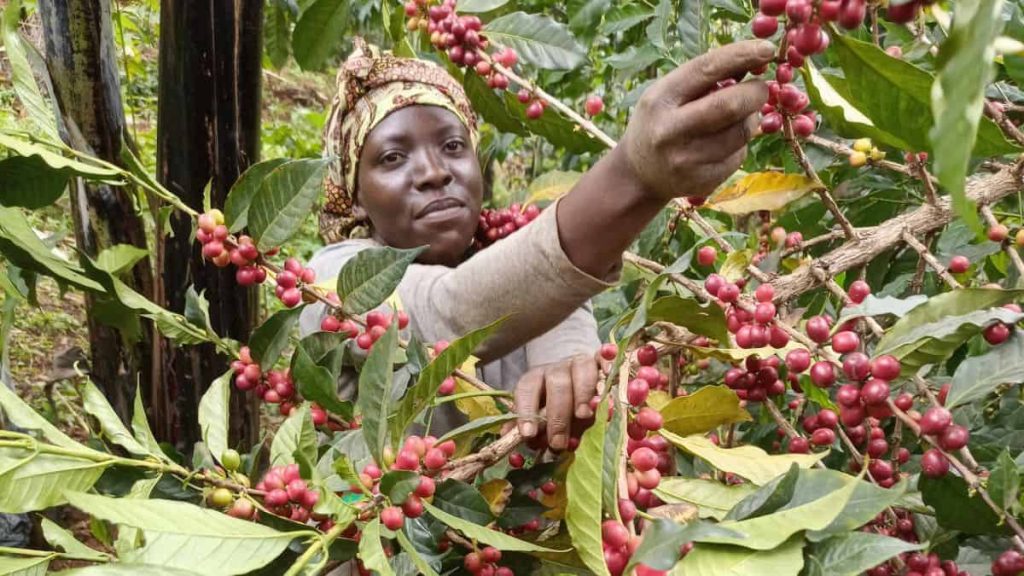 Photo credit: Solidaridad Network
Uganda reassures coffee and cocoa farmers as global price volatility, drought and declining coffee exports put pressure on agricultural incomes.
The government has sought to reassure coffee and cocoa farmers and traders that recent price declines reflect shifting global supply expectations rather than weakening demand, while acknowledging that drought and declining export volumes are adding pressure to Uganda’s coffee value chain.
In a statement issued on September 20, Agriculture Minister Frank K. Tumwebaze said international commodity markets were undergoing a period of adjustment, with increased coffee availability from Brazil and Vietnam and higher cocoa supply expectations contributing to recent price volatility.
“Current price fluctuation should not be interpreted as a disappearance of demand for coffee or cocoa,” Tumwebaze said, attributing the changes largely to expectations around global supply and inventories.
The minister’s intervention comes as Uganda’s coffee industry faces a combination of international price movements and domestic production challenges, including prolonged drought and unusually high temperatures in several growing regions.
According to the Ministry’s comparison of farm-gate prices, commercial-quality Robusta FAQ declined by approximately 14.5pc year-on-year during the first half of September.
Robusta FAQ prices fell from an average range of UGX13,500–14,000 per kilogramme in September 2025 to UGX11,500–12,000 during the first half of September 2026.
Robusta Kiboko prices also declined from UGX6,000–7,000 per kilogramme to UGX5,000–6,000 over the same comparison period.
Arabica coffee, however, recorded a different trend. The Ministry reported Arabica parchment prices at approximately UGX15,500–16,000 per kilogramme in the first half of September 2026, compared with UGX14,000–15,000 in September 2025.
Drugar prices increased from UGX13,500–14,000 per kilogramme to UGX14,000–14,500.
Tumwebaze identified increased availability from Brazil and rising exports from Vietnam as factors behind pressure on international coffee prices. He cited market reports indicating that Arabica had fallen to approximately USD3.03 per pound by September 3, while Robusta stood at around USD3,426 per tonne.
The minister said the developments were part of a wider international market adjustment rather than a Uganda-specific collapse in demand.
Drought compounds domestic supply pressures
While global supply expectations are influencing prices, Uganda’s production conditions have also deteriorated in some coffee-growing areas.
Tumwebaze said prolonged drought and unusually high temperatures in parts of Greater Masaka, Kyotera, Sembabule, Luwero and other regions had affected coffee flowering, cherry development, bean filling and processing out-turn.
The adverse weather conditions are estimated to have reduced out-turn by approximately 10% below normal averages in affected areas, according to the statement.
The effects have extended into Uganda’s export performance. The country exported 846,376 bags of 60 kilogrammes in July 2026, down from 997,105 bags in July 2025, representing a 15pc decline in volume.
Export earnings fell from USD250.7 million to USD204.1 million, a reduction of approximately 18.6pc.
The combination of reduced production and changing market conditions has also made traders more selective in their purchasing decisions.
Tumwebaze said properly harvested, well-dried and good-quality coffee could attract substantially higher prices than immature, poorly dried or mixed coffee.
That distinction is increasingly important for farmers seeking to protect their returns in a market where quality and processing determine the price received.
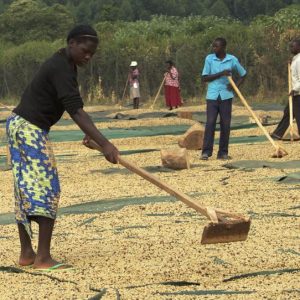
Drying coffee beans at Kaweri Coffee
Cocoa follows global supply correction
Cocoa markets have also experienced significant fluctuations, with the Ministry linking recent declines to expectations of increased near-term supplies and higher shipments.
The statement cited a 5.9pc fall in London and New York cocoa prices in a single session on September 3, following a one-year high. On September 18, December New York cocoa reportedly fell by approximately 7.1pc in one day to a seven-week low.
The Ministry attributed part of the correction to increased cocoa production in Ivory Coast, where the June 2025–June 2026 harvest had increased by 30pc, alongside higher shipments during the current international marketing year.
Tumwebaze said global cocoa demand remained substantial, with processors and chocolate manufacturers continuing to require reliable supplies. However, weather and production risks remain important influences on the market.
The government expects coffee and cocoa prices to remain sensitive to developments in major producing regions over the coming six months.
Brazil’s coffee harvest and Vietnam’s Robusta exports are expected to remain significant influences on the Robusta market, while weather disruptions or lower-than-expected production could tighten global supplies and support prices.
Tumwebaze said it was reasonable to expect some price recovery and greater stability over the next six months, although the statement did not provide a quantified forecast.
The Ministry says its priority is to restore and protect production following the drought. The government plans to continue monitoring domestic and international prices, strengthen coffee productivity, rehabilitate and establish coffee gardens, and support farmers’ resilience to climate shocks.
The minister also urged farmers not to harvest immature coffee or compromise quality, encouraging them to move from raw Kiboko into better-processed and graded coffee to improve returns.
The government is distributing fertilisers and other productivity-enhancing inputs in key producing regions under a Presidential Directive. The initiative is intended to improve access to inputs, restore soil fertility and increase crop productivity.
Irrigation is also being strengthened through an inter-ministerial approach involving the Ministry of Agriculture, Animal Industry and Fisheries, the Ministry of Water and Environment, and other relevant government agencies.
Tumwebaze said Uganda would scale up irrigation schemes and promote smaller, farmer-managed irrigation systems.
Support under the Climate Smart Agricultural Transformation Project is expected to include improved planting materials, appropriate technologies, water management and knowledge to help farmers adapt to changing climatic conditions.
The minister sought to distinguish falling farm-gate prices from actual losses, arguing that profitability depends on production costs, productivity per acre, coffee quality, post-harvest handling and the form in which the product is sold.
According to the Ministry, farmers who improve productivity and undertake basic value addition can break even when FAQ prices reach UGX7,000 per kilogramme, although those affected by severe drought may experience considerable financial losses.
Uganda, Tumwebaze said, remains an important coffee producer and exporter, with continued international demand for its Robusta and Arabica varieties.
The Ministry is expected to announce further strategic interventions in the short and medium term to support farmers and other participants in the coffee and cocoa value chains.
Related Posts
 Uganda Green Entrepreneurs Set for Paris Visit as Stanbic-France Partnership Graduates 106
 Equity Bank Explores Value-Chain Financing to Support Zigoti Coffee Expansion
 Kalangala’s Oil Palm Economy Expands as Lenders Deepen Farmers’ Access to Finance
 El Niño Puts More Than 162 Million Children at Risk Across Africa as UNICEF warns of worsening drought, flooding and extreme heat hazard
 Equity, Madi-West Nile Diocese Move to Unlock Church Assets for Regional Growth
 28 Ethiopian Students Graduate from Ethiopian Airlines-Boeing STEM Programme
Get business news delivered to you everyday
Latest News

Uganda Seeks to Calm Coffee, Cocoa Markets as Global Prices Fluctuate on Positive Sentiment

Uganda Green Entrepreneurs Set for Paris Visit as Stanbic-France Partnership Graduates 106

Entebbe Airport Passenger Traffic Recovers in August but Remains Below 2025 Levels

Nile Breweries, Next Media Renew Road Safety Push with Focus on Boda Boda Riders

Equity Bank Explores Value-Chain Financing to Support Zigoti Coffee Expansion

Uganda Breaks Ground on USD310m Kampala Fuel Terminal, Targets September 2028 Completion

Uganda Will Not Close Its 2.4-Million-Unit Housing Deficit with Ribbon-Cuttings in Kira

Nairobi’s 2029 World Athletics Win Draws Doping Scrutiny in UK Media

Airbus Moves to Close Africa’s Aircraft Maintenance Skills Gap

Africa’s Electric Mobility Opportunity Will be Built Beyond the Vehicle