
Equity, Madi-West Nile Diocese Move to Unlock Church Assets for Regional Growth
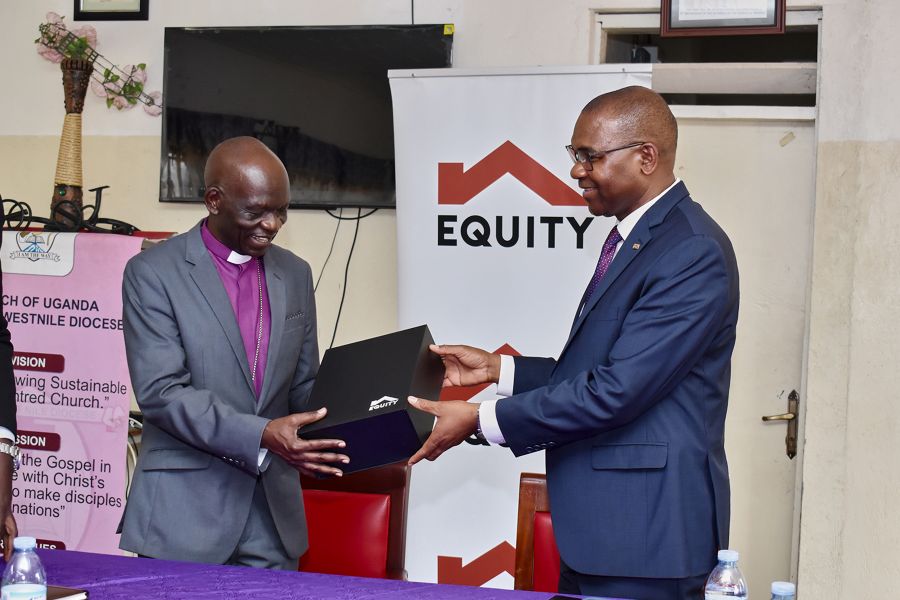 Rt Rev Charles Collins Andaku, the Arch Bishop of the Madi West Diocese receives a gift hamper from Gift Shoko, the Managing Director at Equity Bank after a strategic meeting
Madi-West Nile Diocese and Equity Bank Uganda are moving to formalise a partnership to unlock church-owned land, schools and health facilities for investment in agriculture, enterprise, education, healthcare and other development projects across West Nile.
The Madi-West Nile Diocese of the Church of Uganda is looking beyond conventional banking to turn its land, institutions and community networks into engines of sustainable economic development across the West Nile region.
The diocese and Equity Bank Uganda are working towards a formal partnership that would provide a framework for developing church assets in agriculture, education, healthcare, energy, environmental conservation and enterprise development.
The proposed partnership, to be formalised through a Memorandum of Understanding (MoU), marks an evolution in a relationship that has traditionally centred on banking services but has increasingly expanded into financing, financial literacy and community development.
For the diocese, which operates across 12 districts and 13 archdeaconries, the scale of its institutional footprint provides a significant platform for economic activity. It has 150 parishes, 685 churches and 221 active clergy, alongside schools, health facilities and substantial land holdings.
The opportunity now is to make those assets more productive without losing their underlying social and religious purpose.
Equity Bank Managing Director Gift Shoko said the bank’s role would be to bring financial and technical expertise to projects capable of making church institutions more economically sustainable.
“Our purpose as a Bank is to transform lives, give dignity and expand opportunities for wealth creation,” Shoko said.
He said the partnership could help church institutions, schools and land become “self-sustaining, financially independent entities”.
That approach shifts the relationship from one based primarily on the provision of banking services to one centred on capital mobilisation and asset development.
Among the opportunities under consideration are commercial agriculture and forestry projects on church land, as well as financing for the renovation and expansion of schools and health facilities.
The partnership would also have a grassroots financial inclusion component, targeting savings groups in communities that include refugees and their host populations. Financial literacy and appropriate financing products would be used to strengthen the capacity of these groups to save, invest and grow enterprises.
Geoffrey Nasser, the diocesan secretary, said Equity’s engagement with the diocese had already moved beyond conventional corporate banking.
The Diocesan Secretary Geoffrey Nasser secretary of the Madi West Diocese receives a gift hamper from Catherine Psomgen, the Director for Public Sector Social Investments at Equity Bank after a strategic engagement
The bank has supported clergy and church workers, while also providing financing and financial literacy initiatives targeting graduates, youth and community groups.
“Equity Bank’s support extends far beyond corporate banking into the very heart of our community,” Nasser said.
The relationship has also produced a significant physical asset for the diocese. Equity Bank has provided about UGX4 billion towards construction of the Jubilee Administrative Building, conceived as part of the diocese’s 50th anniversary celebrations.
Bishop Rt Rev Dr Charles Collins Andaku said the building was intended to provide the diocese with a permanent administrative home.
The proposed wider partnership could now build on that investment by creating a more systematic approach to financing and developing diocesan assets.
This is particularly significant in a region where land, institutional infrastructure and community networks represent potentially valuable economic resources, but where access to long-term capital and technical expertise can constrain their development.
For Equity, the arrangement also provides an avenue to deepen financial inclusion and enterprise development among communities that already interact with the church through its extensive institutional network.
The partnership comes amid a broader shift among faith-based organisations towards developing sustainable revenue streams to support their social missions.
For Madi-West Nile Diocese, the central proposition is that productive assets should help finance the institutions and services through which the church serves its communities.
If successfully structured, the relationship with Equity could therefore turn church land and institutions into a more deliberate development portfolio—generating income, creating jobs and supporting education, healthcare and community initiatives while strengthening the diocese’s financial independence.
Related Posts
 Why Africa’s Institutions Must Turn Knowledge and Investment into Farmer Prosperity
 Stanbic experts offer investment insights to navigate current market uncertainty
 Africa Carbon Markets Urged to Turn Potential into Investment and Delivery
 Corporate Buyers Could Help Unlock SAF Market Worth Millions of Tonnes by 2030
 Airbus sees USD420bn Global Aviation Services Boom: Can Africa Capture its Share?
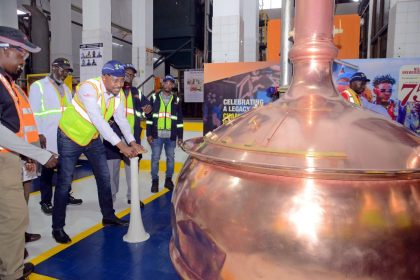 Nile Breweries Celebrates 75 Years of Growing with Uganda
Get business news delivered to you everyday
Latest News

Why Africa’s Institutions Must Turn Knowledge and Investment into Farmer Prosperity

Forbes ranks MTN Group third globally on best telecom employer list

Stanbic experts offer investment insights to navigate current market uncertainty

Africa Carbon Markets Urged to Turn Potential into Investment and Delivery

Bank of Uganda hikes base rate from 9.75% to 12% amidst global tensions

Corporate Buyers Could Help Unlock SAF Market Worth Millions of Tonnes by 2030

Airbus sees USD420bn Global Aviation Services Boom: Can Africa Capture its Share?

Nawangwe Urges Architects to Document Uganda’s Built Heritage

Stanbic installs solar power system at Mbale School for the Deaf

NWSC Seeks Grundfos Partnership to Manufacture Pumps, Spare Parts in Uganda