

Uganda Breaks Ground on USD310m Kampala Fuel Terminal, Targets September 2028 Completion
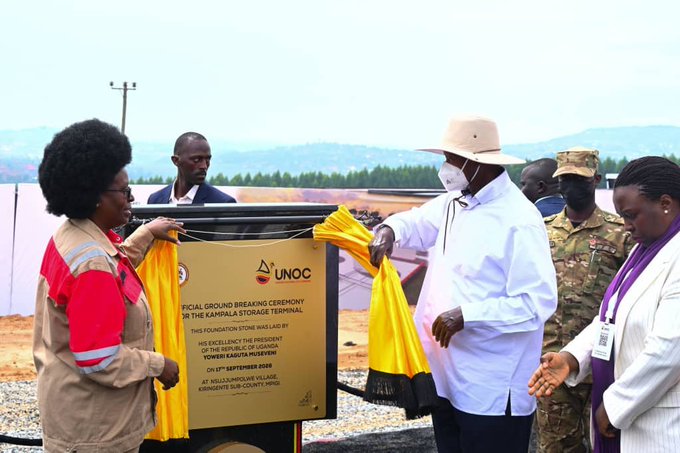
Uganda has broken the ground on a USD310 million fuel storage terminal with 320 million-litre capacity, targeting September 2028 completion.
President Yoweri Kaguta Museveni today presided over the groundbreaking for Uganda’s Kampala Storage Terminal (KST) in Namwabula, Mpigi District, launching construction of a USD310 million facility designed to hold up to 320 million litres of refined petroleum products.
The terminal, being developed by the Uganda National Oil Company (UNOC), is expected to be completed in September 2028, following 24 months of construction under an Engineering, Procurement and Construction (EPC) contract.
The project adds a major storage and distribution component to Uganda’s developing petroleum value chain as the country advances towards domestic oil production, refining and regional petroleum trade.
Speaking at the groundbreaking ceremony, President Museveni welcomed cooperation among East African countries in developing the region’s petroleum sector, linking Uganda’s storage ambitions to broader regional energy security.
“I am happy that Her Excellency Samia Suluhu has sent a delegation, so we are working together with East Africa to develop our petroleum,” Museveni said, referring to the Tanzanian President’s delegation at the ceremony.
The President further said Uganda would participate in the development of a larger refinery in Tanga, Tanzania, as part of regional efforts to strengthen petroleum security.
Storage capacity and regional distribution
The KST will provide additional capacity for Uganda to maintain petroleum reserves, receive imported products and support the distribution of fuel to domestic and regional markets.
Uganda currently consumes approximately 240 million litres of petroleum products each month, including petrol, diesel, jet fuel and kerosene. The new facility is intended to strengthen the country’s ability to manage supply disruptions, improve storage resilience and support the operations of oil marketing companies.
The terminal will complement UNOC’s existing 30-million-litre Jinja Storage Terminal and private-sector storage facilities. Its planned functions include Government strategic reserves, commercial storage and handling services for oil marketing companies, and the distribution of petroleum products.
Located on approximately 300 acres at Namwabula Estate, the facility is expected to serve Kampala, the Central Region and other parts of Uganda, while supporting the country’s ambitions to become a regional petroleum distribution hub.
UNOC Board Chairman Mathias Katamba described the terminal as a major milestone in Uganda’s petroleum sector, saying it would contribute to positioning the country as a regional hub for petroleum products.
Katamba said UNOC was ready to commence implementation of the project after securing the necessary Government and building permits from relevant local authorities, as well as a petroleum facility construction permit from the Ministry of Energy and Mineral Development.
Linking storage to domestic refining
The Kampala Storage Terminal is being developed as part of a wider infrastructure system that will connect imported and locally refined petroleum products.
The terminal is expected to link with the planned refinery in Hoima through a proposed 211-kilometre multi-products pipeline. It will also incorporate the future Mpigi Remote Refinery Terminal (MRRT), designed to receive, store and dispatch petroleum products produced locally.
Once the refinery, pipeline, MRRT and KST are operational, Uganda will have an interconnected system for receiving, storing and distributing petroleum products, reducing the separation between crude oil production, refining and downstream supply infrastructure.
The project is aligned with the Government’s commitments under the Fourth National Development Plan (NDP IV), which seeks to increase national storage capacity for refined petroleum products from 99.1 million litres in financial year 2023/24 to 150 million litres by 2029/30.
The planned expansion of the Jinja Storage Terminal and the preparation of regional strategic storage facilities are also part of the Government’s petroleum infrastructure agenda.
Museveni raises environmental concerns
While launching the project, President Museveni cautioned against encroachment on wetlands and other water bodies, emphasising the need to protect the environment as Uganda expands its industrial infrastructure.
He also raised concerns about the proximity of a garbage dumping site to the planned petroleum storage facility, describing the situation as dangerous and calling for the site to be relocated.
“We must find alternative means of dealing with waste. One of the ways is through incineration, which is also a source of electricity,” Museveni said.
The remarks introduce an environmental and public safety dimension to the development of a large petroleum storage facility, particularly concerning waste management and the protection of surrounding land and water resources.
The KST groundbreaking comes two weeks after President Museveni announced the name Pearl Sweet for Uganda’s crude oil, as the country prepares for first oil and advances plans for domestic refining.
Related Posts
 Uganda Will Not Close Its 2.4-Million-Unit Housing Deficit with Ribbon-Cuttings in Kira
 Nairobi’s 2029 World Athletics Win Draws Doping Scrutiny in UK Media
 Airbus Moves to Close Africa’s Aircraft Maintenance Skills Gap
 Africa’s Electric Mobility Opportunity Will be Built Beyond the Vehicle
 COMESA Flags WBeauty Shampoo Recall in Three Member States
 Kalangala’s Oil Palm Economy Expands as Lenders Deepen Farmers’ Access to Finance
Get business news delivered to you everyday
Latest News

Uganda Breaks Ground on USD310m Kampala Fuel Terminal, Targets September 2028 Completion

Uganda Will Not Close Its 2.4-Million-Unit Housing Deficit with Ribbon-Cuttings in Kira

Nairobi’s 2029 World Athletics Win Draws Doping Scrutiny in UK Media

Airbus Moves to Close Africa’s Aircraft Maintenance Skills Gap

Africa’s Electric Mobility Opportunity Will be Built Beyond the Vehicle

Equity Trade Mission Targets Capital, Markets to Unlock Uganda’s Investment Potential

COMESA Flags WBeauty Shampoo Recall in Three Member States

AFRAA sees Government Action, Partnerships as Key to Unlocking African Airlines’ Potential amid Surging Demand

COMESA Competition Agency reopens Tender for Lilongwe HQ Complex

TAAG Joins Westbrook Racing as Race Partner for Luanda E1 Grand Prix