

Equity Bank launches tree planting drive in Bugisu subregion
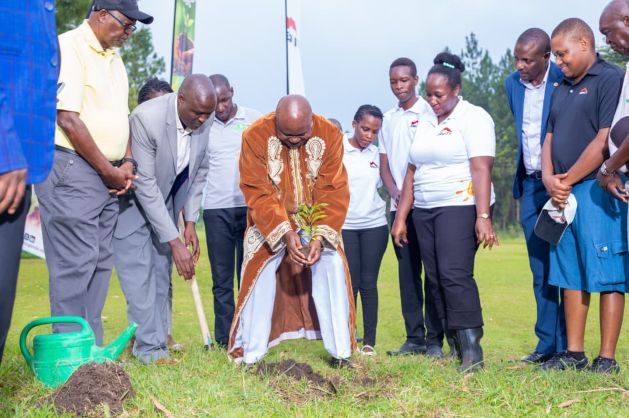
Bank commits UGX60 million to plant 60,000 trees by end of 2026
Lender Equity Bank Uganda has joined forces with the Umukuka wa Bugisu, the cultural leader of the Bamasaba, and Gro Foundation to launch a large-scale tree planting initiative aimed at restoring degraded ecosystems and promoting environmental sustainability across the Bugisu subregion.
The project, officially launched on Saturday during celebrations marking the Umukuka’s second anniversary as head of the Bugisu Kingdom, targets the planting of 60,000 trees by the end of 2026. Equity Bank has committed UGX60 million to finance the program, while Gro Foundation, a nonprofit specializing in reforestation, will provide technical expertise to ensure that indigenous tree species are planted, nurtured, and monitored for long-term survival.
Covering eight acres around the main dumping site in Mbale City, the project will establish green buffers that act as natural carbon sinks — helping to reduce emissions, stabilise soils, and protect communities from climate-related risks. The effort also seeks to prevent disasters like the Kitezi landfill collapse in Kampala, underscoring the urgent need for sustainable waste management solutions in growing urban centers.
Speaking at the launch, Virginia Ssemakula, Equity Bank’s Manager for Energy, Environment and Climate Change, said the initiative reflects the bank’s broader commitment to sustainability.
“At Equity, we believe our responsibility extends beyond traditional banking,” she said. “We are investing in healthier communities and a more sustainable future — growing not only financial prosperity but also environmental resilience.”
Lydia Apeduno, Mbale City Council’s Composite Manager, noted that the tree belt around the landfill will serve a dual purpose of cutting emissions and preventing encroachment.
“Dumping sites often emit gases such as carbon dioxide. These trees will help absorb carbon while creating a natural boundary that safeguards the area,” she explained.
Beyond the landfill, the tree planting program aims to support agricultural transformation and community livelihoods across Bugisu. The trees will improve soil fertility, conserve water, and strengthen farm resilience against the recurring mudslides that have long plagued the region. They will also provide farmers with food, fodder, and additional income streams.
Laban Musiguzi from Gro Foundation emphasized the broader ecological and economic benefits of the initiative.
“Integrating trees into farming systems helps control soil erosion, manage pests and diseases, and foster more diverse and productive ecosystems,” he said. “This is not just about planting trees, but about planting hope — securing the environment and protecting the climate for generations to come.”
The Bugisu project forms part of the bank’s Environmental, Social and Governance (ESG) strategy, which embeds sustainability into all operations. Nationwide, Equity Bank targets planting 35 million trees by 2026, positioning it among the leading financial institutions driving climate action in Uganda.
Related Posts
 Equity Wraps up Uganda Leg of Regional Trade Mission as Value Addition Drive Gains Traction
 Independence Marathon Turns to Blood Storage Gap in Maternal Health Drive
 Fine Spinners Injects Fresh USD5m Into Technology as Uganda Textile Maker Targets African, European Markets
 Equity Trade Mission Puts Uganda’s Manufacturing Capacity to Regional Test
 Uganda Green Entrepreneurs Set for Paris Visit as Stanbic-France Partnership Graduates 106
 Entebbe Airport Passenger Traffic Recovers in August but Remains Below 2025 Levels
Get business news delivered to you everyday
Latest News

Equity Wraps up Uganda Leg of Regional Trade Mission as Value Addition Drive Gains Traction

JPMorgan Abandons Oil Price Baseline as Iran Conflict Deepens Market Uncertainty

Frankfurt Airport Malaria Outbreak Raises Questions Over Aviation-Related Health Risks

What Maps Communicate: UN Resolution Challenges World Maps that Make Africa Look Smaller

Independence Marathon Turns to Blood Storage Gap in Maternal Health Drive

Fine Spinners Injects Fresh USD5m Into Technology as Uganda Textile Maker Targets African, European Markets

Equity Trade Mission Puts Uganda’s Manufacturing Capacity to Regional Test

Uganda Seeks to Calm Coffee, Cocoa Markets as Global Prices Fluctuate on Positive Sentiment

Uganda Green Entrepreneurs Set for Paris Visit as Stanbic-France Partnership Graduates 106

Nile Breweries, Next Media Renew Road Safety Push with Focus on Boda Boda Riders