

ECOTRUST targets 16.5 million Ugandans as it marks 27 years of conservation finance
ECOTRUST has launched its 27th anniversary celebrations, highlighting nearly three decades of pioneering conservation finance, carbon market innovation and community-led restoration efforts that now support over 54,000 households across Uganda.
Environmental conservation organisation Environmental Conservation Trust of Uganda (ECOTRUST) has launched celebrations to mark 27 years of conservation financing and community-led environmental restoration, highlighting its growing role in climate resilience and sustainable livelihoods across Uganda.
The anniversary celebrations were officially launched Tuesday at the Golden Tulip Canaan Kampala, bringing together development partners, conservation stakeholders, board members and international partners to reflect on the organisation’s journey since its establishment in 1999.
Speaking during the event, ECOTRUST Executive Director Pauline Nantongo Kalunda described the institution’s evolution as a story of resilience, innovation and transformation within Uganda’s conservation sector.
“Twenty-seven years is a significant milestone for any institution, especially in a sector where many organisations struggle to survive beyond their early years,” Nantongo said.
“Our work has always focused on ensuring that conservation is not only environmentally important, but also economically meaningful for local communities,” she added.
Founded following the transformation of a former environmental grants management unit supported by United States Agency for International Development (USAID), ECOTRUST was established to conserve biological diversity while improving social welfare through sustainable environmental management.
Over the years, the organisation has developed into one of Uganda’s leading conservation finance institutions, creating models that channel financial resources into conservation initiatives implemented by rural communities.
Central to that transformation has been ECOTRUST’s flagship Trees for Global Benefits programme, launched in 2003 and widely regarded as one of Africa’s earliest cooperative carbon offsetting schemes.
The programme links Ugandan smallholder farmers to voluntary carbon markets while supporting land restoration and alternative income generation.
According to Nantongo, the organisation’s strategy has been to make conservation commercially viable for ordinary households.
“We want farmers to grow trees because it makes economic sense for them, not simply because they are saving the environment,” she noted.
“When environmental services such as carbon storage, watershed protection and climate regulation are properly valued, conservation becomes a profitable and sustainable land-use option.”
Through its landscape restoration model, ECOTRUST supports enterprises ranging from timber production, coffee and cocoa growing to fruit farming, fish farming, honey production and medicinal plant extraction, while also helping communities access carbon credits and biodiversity financing.
What began in the Queen Elizabeth conservation landscape has since expanded into the Rwenzori Mountains, Mount Elgon, Murchison Falls, Northern Uganda and the Mpologoma landscape.
Today, the organisation says it works with more than 54,000 households and supports restoration and management of over 70,000 hectares across five major landscapes.
ECOTRUST also revealed that it has significantly reduced dependence on traditional donor funding, with about 80 percent of its financing now generated through private philanthropy, conservation service agreements and its Endowment Fund, compared to 20 percent from conventional donor support.
ECOTRUST Board Chairperson Isaac Kapalaga said the organisation’s expansion into regions such as Northern Uganda demonstrates the growing demand for community-centred conservation models despite operational challenges.
“Our commitment remains focused on reaching more communities and ensuring that conservation delivers real social and economic value to ordinary Ugandans,” Kapalaga said.
The launch event concluded with stakeholders signing the ECOTRUST Impact Report, symbolising nearly three decades of conservation finance and environmental restoration efforts.
The organisation now plans to scale its programmes further, targeting improved livelihoods and climate resilience for more than 16.5 million people across 33 districts over the next five years, while restoring at least 60,000 additional hectares of degraded land.
Related Posts
 Independence Marathon Turns to Blood Storage Gap in Maternal Health Drive
 Fine Spinners Injects Fresh USD5m Into Technology as Uganda Textile Maker Targets African, European Markets
 Equity Trade Mission Puts Uganda’s Manufacturing Capacity to Regional Test
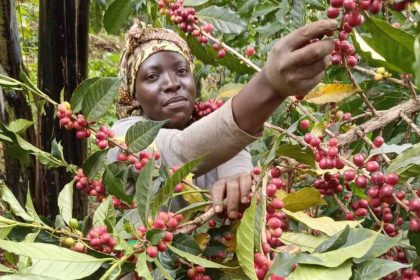 Uganda Seeks to Calm Coffee, Cocoa Markets as Global Prices Fluctuate on Positive Sentiment
 Uganda Green Entrepreneurs Set for Paris Visit as Stanbic-France Partnership Graduates 106
 Entebbe Airport Passenger Traffic Recovers in August but Remains Below 2025 Levels
Get business news delivered to you everyday
Latest News

Independence Marathon Turns to Blood Storage Gap in Maternal Health Drive

Fine Spinners Injects Fresh USD5m Into Technology as Uganda Textile Maker Targets African, European Markets

Equity Trade Mission Puts Uganda’s Manufacturing Capacity to Regional Test

Uganda Seeks to Calm Coffee, Cocoa Markets as Global Prices Fluctuate on Positive Sentiment

Uganda Green Entrepreneurs Set for Paris Visit as Stanbic-France Partnership Graduates 106

Nile Breweries, Next Media Renew Road Safety Push with Focus on Boda Boda Riders

Equity Bank Explores Value-Chain Financing to Support Zigoti Coffee Expansion

Uganda Breaks Ground on USD310m Kampala Fuel Terminal, Targets September 2028 Completion

Uganda Will Not Close Its 2.4-Million-Unit Housing Deficit with Ribbon-Cuttings in Kira

Nairobi’s 2029 World Athletics Win Draws Doping Scrutiny in UK Media