

United Bets on Economy Comfort as Airlines Race to Redefine Premium Travel
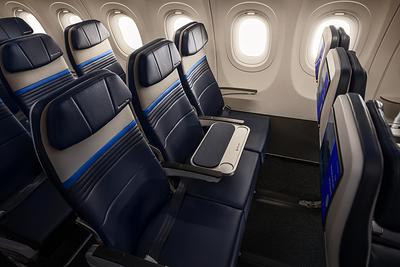
United Airlines is redesigning economy travel with new Airbus A321XLR cabins featuring permanently open middle seats and shared tables in Economy Plus. The move reflects a wider airline strategy to generate new revenue by offering greater comfort on long-haul narrowbody flights without requiring passengers to upgrade to premium cabins.
United Airlines is extending the battle for premium passengers beyond business class, unveiling a new Economy Plus seating concept that offers travellers something airlines have rarely provided in economy cabins: more personal space without paying for a premium cabin.
The U.S. carrier announced that all 50 of its new Airbus A321XLR aircraft will feature a dedicated Economy Plus row where the middle seat is permanently removed and replaced with a shared table, creating additional elbow room for passengers seated at the window and aisle.
The product, which goes on sale later this year ahead of the aircraft’s commercial introduction, underscores a broader shift in airline strategy as carriers seek new ways to increase revenue while responding to changing passenger expectations on longer narrowbody flights.
The innovation comes only weeks after United unveiled its United Relax Row, an economy seating concept on selected Boeing 787 and Boeing 777 aircraft that converts an entire row into a lie-flat surface, scheduled to enter service in early 2027.
“We’re investing nose-to-tail across our fleet and giving customers choice and value in every cabin,” said Andrew Nocella, United’s Executive Vice President and Chief Commercial Officer.
Unlike traditional economy seating, the new arrangement leaves the middle seat permanently vacant, replacing it with a fixed table finished in a leather-like material complete with integrated cup holders.
Passengers will also retain the additional three inches of legroom already offered in Economy Plus, effectively creating a hybrid product positioned between standard economy and premium economy.
Industry analysts say the concept reflects a growing recognition that comfort has become an increasingly important differentiator as airlines deploy narrowbody aircraft such as the Airbus A321XLR on transatlantic and other medium-haul international routes lasting six to nine hours.
Rather than relying solely on business-class upgrades, airlines are increasingly introducing intermediate products designed to appeal to leisure travellers and cost-conscious business passengers willing to pay modest premiums for additional comfort.
The A321XLR Changes Airline Economics
United’s latest innovation also highlights the strategic importance of the Airbus A321XLR, one of the aviation industry’s most closely watched aircraft.
The long-range narrowbody enables airlines to operate thinner international routes that would be uneconomical with larger widebody aircraft while offering passengers a cabin experience approaching that of long-haul jets.
United’s configuration includes 32 premium seats—double the number found on the Boeing 757s the aircraft will replace—including all-aisle-access Polaris business suites with privacy doors.
Every passenger, regardless of cabin, will have access to 4K OLED entertainment screens with Bluetooth connectivity, larger overhead bins and redesigned cabin interiors.
The airline expects to begin domestic A321XLR operations later this year before launching international services in early 2027.
A Broader Industry Trend
United’s move reflects an industry-wide shift towards product segmentation, where airlines increasingly monetise comfort rather than simply adding more seats.
As aircraft technology allows airlines to fly longer routes with single-aisle jets, passenger expectations are evolving, particularly on journeys lasting several hours.
The introduction of products such as the Economy Plus open-seat concept and the Relax Row suggests airlines now see significant commercial opportunities in creating new categories between standard economy and premium cabins.
For passengers, the result could be more choice—and potentially greater comfort—without the price tag associated with business class.
Related Posts
 Uganda Coffee Roasters Tap Richard Rugaya as Executive Director, with Focus on Commercial Growth
 Why Africa’s Institutions Must Turn Knowledge and Investment into Farmer Prosperity
 Forbes ranks MTN Group third globally on best telecom employer list
 Stanbic experts offer investment insights to navigate current market uncertainty
 Africa Carbon Markets Urged to Turn Potential into Investment and Delivery
 Corporate Buyers Could Help Unlock SAF Market Worth Millions of Tonnes by 2030
Get business news delivered to you everyday
Latest News

SITA Acquisition of Collins Airport Solutions Signals Moves to Consolidate Aviation Technology

Uganda Coffee Roasters Tap Richard Rugaya as Executive Director, with Focus on Commercial Growth

Equity Bank Reports UGX37.6 Billion in Green Loans as Uganda Seeks to Scale Climate Investment

Why Africa’s Institutions Must Turn Knowledge and Investment into Farmer Prosperity

Forbes ranks MTN Group third globally on best telecom employer list

Stanbic experts offer investment insights to navigate current market uncertainty

Africa Carbon Markets Urged to Turn Potential into Investment and Delivery

Bank of Uganda hikes base rate from 9.75% to 12% amidst global tensions

Airbus sees USD420bn Global Aviation Services Boom: Can Africa Capture its Share?

Nile Breweries Celebrates 75 Years of Growing with Uganda