

Africa leads global iGaming fraud as Kenya, Uganda record declining trends
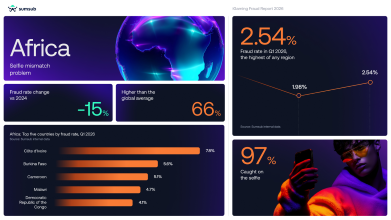
Africa has become the world’s leading iGaming fraud hotspot, with fraud rates 66 percent above the global average, while new research shows identity theft and AI-powered scams are replacing traditional document forgery across the continent. Kenya and Uganda have recorded improving trends, although fraud risks remain elevated.
Africa has overtaken every other region in the world as the leading hotspot for iGaming fraud, with fraud rates now standing 66 percent above the global average, underscoring the growing cybersecurity and identity verification challenges facing one of the world’s fastest-growing online gaming markets.
The findings are contained in the Sumsub iGaming Fraud Report 2026, which analysed more than three million fraud attempts and millions of identity verification checks conducted between 2024 and the first quarter of 2026.
According to the report, Africa’s iGaming fraud rate reached 2.54 percent in the first quarter of 2026, significantly exceeding fraud levels recorded in Europe, Latin America, North America and the Asia-Pacific region. After easing during 2025, fraudulent activity rebounded sharply this year, making Africa the largest contributor to the global rise in online gaming fraud.
For East Africa, however, the picture is mixed.
While Kenya and Uganda registered declining fraud trends towards the end of 2025, suggesting that anti-fraud measures may be gaining traction, fraud levels remain relatively high. Malawi emerged as one of Africa’s highest-risk markets, recording a fraud rate of 4.7 percent, the fourth highest on the continent.
The regional differences indicate that fraud risks are evolving differently across African markets, requiring operators to tailor fraud prevention strategies to local conditions rather than relying on continent-wide approaches.
Globally, the report found that fraud rates increased by nearly 18 percent year-on-year, while suspicious financial transactions surged more than fourfold. The average value of suspicious transactions also climbed to more than USD6,500, reflecting the growing sophistication and financial scale of organised fraud networks.
“Africa’s rapid digital adoption, growing online gaming sector and expanding access to financial services have created enormous opportunities for operators, but they have also attracted increasingly sophisticated fraud actors,” says Jarryd Jensen, Regional Director for Southern Africa at Sumsub.
Perhaps the report’s most significant finding is the changing nature of identity fraud across Africa.
Unlike Europe, where forged identity documents remain a major threat, 97 percent of fraud detected on the continent is intercepted during facial biometric, or liveness, verification. This indicates that fraudsters are increasingly using genuine stolen identities rather than counterfeit documents to open gaming accounts.
The trend points to a growing reliance on identity theft, with criminals exploiting personal information obtained through data breaches, phishing attacks and other illicit channels before attempting to bypass digital verification systems.
The report also highlights the increasing role of artificial intelligence in enabling fraud at scale.
According to Sumsub’s iGaming Product Evangelist Kris Galloway, fraudsters are increasingly deploying AI-generated faces, manipulated identity documents, synthetic identities and automated application processes to overwhelm verification systems.
“AI dramatically lowers the cost and effort required to commit fraud at scale, and professional fraud groups are already taking advantage of it,” he said.
Among African countries, Côte d’Ivoire recorded the continent’s highest fraud rate at 7.8 percent, followed by Burkina Faso, Cameroon, Malawi and the Democratic Republic of Congo. South Africa recorded one of the sharpest deteriorations, with fraud levels more than tripling during the second half of 2025.
The report further found that fraudulent activity across Africa is most likely to occur between 2 p.m. and 8 p.m. (GMT+2), a pattern that differs from fraud cycles observed in Europe, Asia and North America.
Sumsub argues that traditional Know Your Customer (KYC) compliance is no longer sufficient to protect operators.
Instead, gaming companies are being urged to adopt integrated fraud management systems combining biometric identity verification, behavioural analytics, device intelligence and continuous transaction monitoring throughout the customer lifecycle.
As Africa’s digital economy expands and online gaming continues to attract millions of new users, the report suggests that trust, cybersecurity and identity protection are rapidly becoming competitive advantages as much as regulatory obligations.
For East African operators, particularly in Kenya and Uganda, the improving fraud trend offers cautious optimism, but the persistence of elevated fraud levels indicates that investment in advanced fraud detection technologies will remain essential as digital gaming markets continue to mature.
Related Posts
 Uganda Coffee Roasters Tap Richard Rugaya as Executive Director, with Focus on Commercial Growth
 Why Africa’s Institutions Must Turn Knowledge and Investment into Farmer Prosperity
 Forbes ranks MTN Group third globally on best telecom employer list
 Stanbic experts offer investment insights to navigate current market uncertainty
 Africa Carbon Markets Urged to Turn Potential into Investment and Delivery
 Corporate Buyers Could Help Unlock SAF Market Worth Millions of Tonnes by 2030
Get business news delivered to you everyday
Latest News

Uganda Coffee Roasters Tap Richard Rugaya as Executive Director, with Focus on Commercial Growth

Equity Bank Reports UGX37.6 Billion in Green Loans as Uganda Seeks to Scale Climate Investment

Why Africa’s Institutions Must Turn Knowledge and Investment into Farmer Prosperity

Forbes ranks MTN Group third globally on best telecom employer list

Stanbic experts offer investment insights to navigate current market uncertainty

Africa Carbon Markets Urged to Turn Potential into Investment and Delivery

Bank of Uganda hikes base rate from 9.75% to 12% amidst global tensions

Airbus sees USD420bn Global Aviation Services Boom: Can Africa Capture its Share?

Nile Breweries Celebrates 75 Years of Growing with Uganda

Nawangwe Urges Architects to Document Uganda’s Built Heritage