

Boeing, ThinkYoung Expand STEM Pipeline as Africa’s Aviation Skills Race Intensifies
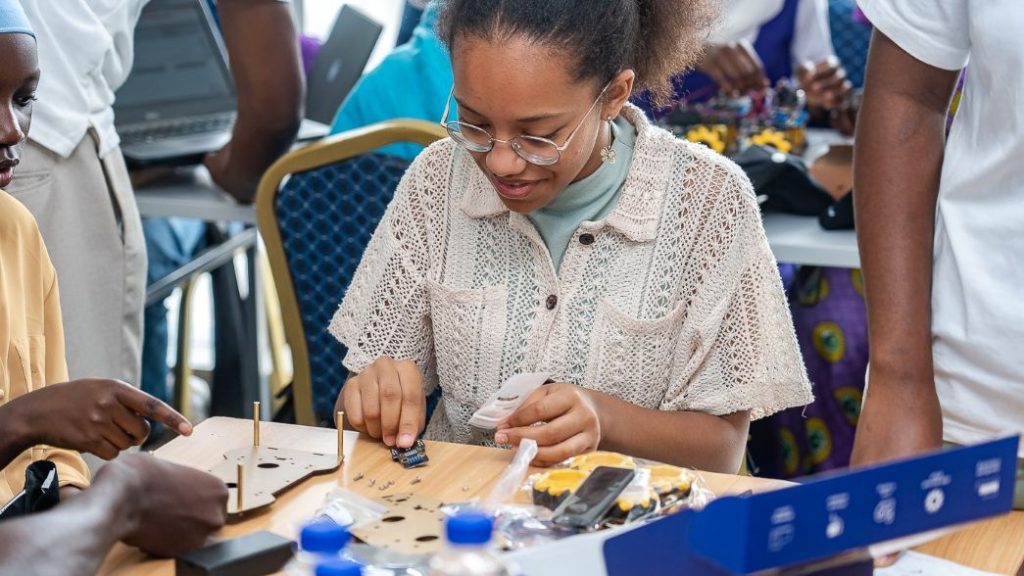 A student working on a robotics challenge at the STEM School in Dakar, Senegal .
Boeing and ThinkYoung have expanded their STEM education programme to Senegal, highlighting the growing importance of developing Africa’s future aviation and technology workforce as countries invest in digital economies and air transport infrastructure.
As African countries accelerate investments in aviation infrastructure and digital economies, attention is increasingly shifting from aircraft and airports to the workforce needed to sustain them.
That transition is driving greater investment in science, technology, engineering and mathematics (STEM) education, with global aerospace companies partnering with education organisations to build the continent’s future aviation talent pipeline.
The latest initiative comes in Senegal, where ThinkYoung, in partnership with Boeing, has launched its ThinkYoung STEM School, introducing young learners to digital technologies and careers in aviation, engineering and emerging technologies.
The three-day programme, held in Dakar from June 23–25, brought together 49 students aged between 12 and 18 years, including 30 girls, in what organisers describe as an effort to prepare young Africans for careers in rapidly evolving technology-driven industries.
Delivered alongside Steamtastic, the Senegal Drone Academy and D-Hub, the curriculum combines practical learning in coding, aviation, drone technology, artificial intelligence, robotics and the metaverse, while also developing problem-solving, teamwork and critical thinking skills.
The expansion comes at a time when many African economies are confronting a growing mismatch between rising demand for technical skills and the supply of qualified professionals capable of supporting industrialisation, digital transformation and aviation growth.
For the aviation industry in particular, the challenge extends beyond pilots and engineers to software developers, drone specialists, maintenance technicians and data professionals needed to support increasingly digital aircraft and airport operations.
According to Henok Teferra Shawl, Boeing Africa Managing Director, Senegal’s aviation ambitions make investment in future talent as important as investment in physical infrastructure.
“With the development of Blaise Diagne International Airport and Air Sénégal’s commitment to renew its fleet with nine Boeing 737 MAX aircraft, Senegal has an opportunity to become one of West Africa’s major gateways to global markets,” he said.
“That growth will create high-value jobs across aviation, logistics and related industries. The ThinkYoung STEM School helps raise awareness of these career opportunities while equipping young people with future-ready skills.”
The programme aligns with Senegal’s broader national strategy to strengthen STEM education through specialised science and technology streams in secondary schools, expanded digital skills training and practical extracurricular learning.
For Boeing, the initiative also reflects a long-term industry strategy increasingly focused on workforce development alongside aircraft sales.
Aircraft deliveries alone cannot sustain aviation growth if countries lack engineers, technicians, software specialists and maintenance professionals to operate increasingly sophisticated fleets.
ThinkYoung founder Andrea Gerosa said the programme has now trained nearly 2,000 young people across Africa, West Asia and Europe, helping expose students to careers that may otherwise appear inaccessible.
“As technology and innovation reshape economies, it is essential to equip young people with the skills to think critically, solve complex problems and adapt to change,” Gerosa said.
“By investing in STEM education today, we are helping build stronger futures for young people and the industries that will depend on them tomorrow.”
Over the past decade, the Boeing-ThinkYoung partnership has reached more than 950 young people in Africa, with approximately 60 percent of participants being girls and young women, reflecting a deliberate effort to improve gender representation in STEM and aviation careers.
The programme also signals a wider shift taking place across the continent, where governments, educational institutions and private industry are increasingly recognising that Africa’s competitiveness will depend not only on infrastructure investment but also on developing the skilled workforce capable of powering innovation-led economic growth.
For African economies pursuing industrialisation, digital transformation and expanded air connectivity, the race to build airports is increasingly becoming a race to build talent.
Related Posts
 Uganda Coffee Roasters Tap Richard Rugaya as Executive Director, with Focus on Commercial Growth
 Equity Bank Reports UGX37.6 Billion in Green Loans as Uganda Seeks to Scale Climate Investment
 Nile Breweries Celebrates 75 Years of Growing with Uganda
 Stanbic installs solar power system at Mbale School for the Deaf
 Airbus-Kratos Valkyrie Unmanned Combat Aircraft Completes First Flight Ahead of 2029 Combat Target
 Uganda to Host 2027 Global Water Congress as NWSC Targets Better Services
Get business news delivered to you everyday
Latest News

Uganda Coffee Roasters Tap Richard Rugaya as Executive Director, with Focus on Commercial Growth

Equity Bank Reports UGX37.6 Billion in Green Loans as Uganda Seeks to Scale Climate Investment

Why Africa’s Institutions Must Turn Knowledge and Investment into Farmer Prosperity

Forbes ranks MTN Group third globally on best telecom employer list

Stanbic experts offer investment insights to navigate current market uncertainty

Africa Carbon Markets Urged to Turn Potential into Investment and Delivery

Bank of Uganda hikes base rate from 9.75% to 12% amidst global tensions

Corporate Buyers Could Help Unlock SAF Market Worth Millions of Tonnes by 2030

Airbus sees USD420bn Global Aviation Services Boom: Can Africa Capture its Share?

Nile Breweries Celebrates 75 Years of Growing with Uganda