

Nile Breweries Extends Retailer Skills Programme to Masaka
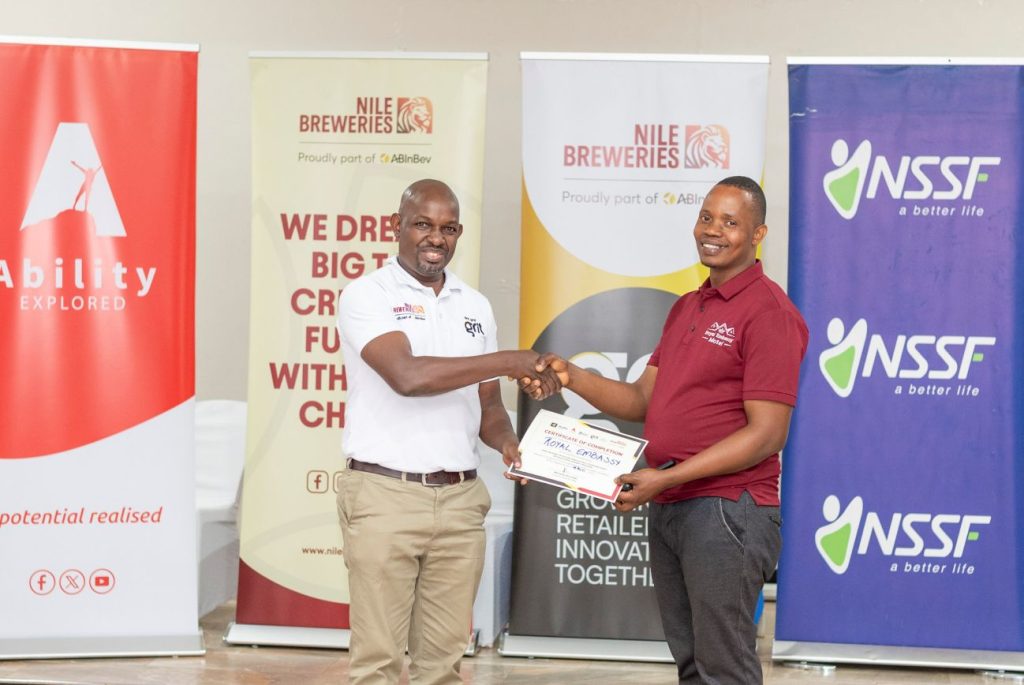 Emmanuel Njuki, Head of Legal & Corporate Affairs, Nile Breweries Limited, hands over a certificate to one of the retailers during the training.
Training focuses on financial management, digital payments and business planning as SME capacity-building initiative expands beyond Kampala and Gulu.
Nile Breweries Limited (NBL) has trained 230 retailers in Masaka District under its Growing Retailers Innovatively Together (GRIT) programme, the latest phase of a nationwide initiative aimed at strengthening business management skills among small enterprises.
The participants, drawn from bars, retail shops and distribution outlets across the district, received training in financial management, stock control, sales and marketing, digital payments, responsible retailing and long-term business planning.
The programme also emphasised practical business disciplines such as separating business and personal finances, maintaining financial records, managing cash flow and planning for growth.
Masaka becomes the third major beneficiary of the initiative after Kampala and Gulu, with NBL targeting more than 1,500 retailers across Uganda through the programme.
Speaking during the training, Nile Breweries Head of Legal and Corporate Affairs Emmanuel Njuki said the initiative recognises the important role retailers play in both the company’s distribution network and the wider economy.
“Retailers are at the heart of our business and a critical part of Uganda’s local economy. When retailers are stronger, the entire value chain is stronger,” Njuki said.
Beyond business training, the programme introduced participants to financial inclusion tools through partnerships with the National Social Security Fund (NSSF) and MTN Mobile Money.
Retailers received guidance on NSSF’s SmartLife Flexi voluntary savings product, which is designed for workers in the informal and semi-formal sectors, while also learning how to integrate digital payment systems into their businesses to improve transaction security and record-keeping.
According to NBL, linking entrepreneurs to savings products and digital financial services is intended to help small businesses improve resilience and formalise some of their operations.
One of the participants, Steven Sekamatte, proprietor of Vegas Depot and Pub in Mutukula, said the training had provided practical lessons he plans to implement in his business.
He said the sessions improved his understanding of record-keeping, stock management, separating personal and business finances, and the role of digital payments and regular saving in supporting business growth.
Uganda’s small and medium-sized enterprises remain a critical pillar of the economy. According to the Uganda Bureau of Statistics, SMEs account for about 90% of businesses in the country, employ more than 2.5 million people and contribute roughly 20% of gross domestic product.
Private-sector programmes such as GRIT have increasingly focused on improving business skills among informal enterprises, many of which face challenges related to financial management, limited access to formal savings products and low adoption of digital business tools.
For beverage manufacturers and other consumer goods companies, strengthening the capacity of retail partners is also seen as a way of improving efficiency across distribution networks while supporting the growth of small businesses that form part of their supply chains.
Related Posts
 Frankfurt Airport Malaria Outbreak Raises Questions Over Aviation-Related Health Risks
 What Maps Communicate: UN Resolution Challenges World Maps that Make Africa Look Smaller
 Independence Marathon Turns to Blood Storage Gap in Maternal Health Drive
 Fine Spinners Injects Fresh USD5m Into Technology as Uganda Textile Maker Targets African, European Markets
 Equity Trade Mission Puts Uganda’s Manufacturing Capacity to Regional Test
 Uganda Seeks to Calm Coffee, Cocoa Markets as Global Prices Fluctuate on Positive Sentiment
Get business news delivered to you everyday
Latest News

JPMorgan Abandons Oil Price Baseline as Iran Conflict Deepens Market Uncertainty

Frankfurt Airport Malaria Outbreak Raises Questions Over Aviation-Related Health Risks

What Maps Communicate: UN Resolution Challenges World Maps that Make Africa Look Smaller

Independence Marathon Turns to Blood Storage Gap in Maternal Health Drive

Fine Spinners Injects Fresh USD5m Into Technology as Uganda Textile Maker Targets African, European Markets

Equity Trade Mission Puts Uganda’s Manufacturing Capacity to Regional Test

Uganda Green Entrepreneurs Set for Paris Visit as Stanbic-France Partnership Graduates 106

Entebbe Airport Passenger Traffic Recovers in August but Remains Below 2025 Levels

Nile Breweries, Next Media Renew Road Safety Push with Focus on Boda Boda Riders

Equity Bank Explores Value-Chain Financing to Support Zigoti Coffee Expansion