

Equity’s USD50m bet on Microhaem turns Uganda’s Medical Import bill into Opportunity
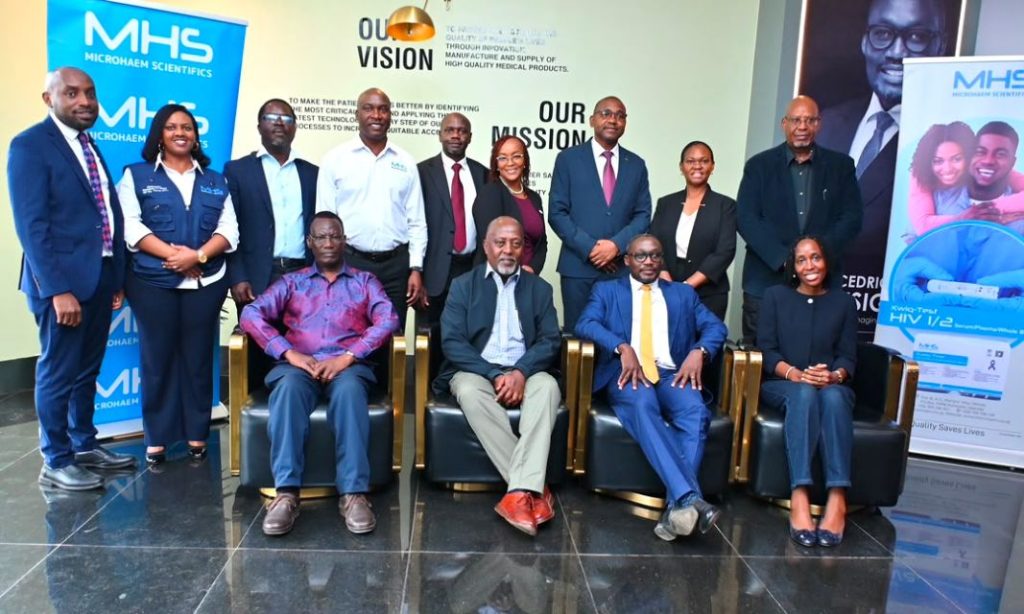
Equity Bank’s USD50m financing is helping Microhaem expand medical manufacturing, strengthening Uganda’s push to reduce reliance on imports.
Equity Bank Uganda’s more than USD50 million financing of Microhaem Scientifics is helping to build one of Uganda’s more ambitious bets on domestic medical manufacturing, as the company moves to expand production of diagnostic products at Namanve Industrial Park.
The scale of the investment came into sharper focus on August 7 when Equity Bank Uganda Board Chair Henry Rugamba, Managing Director Gift Shoko and senior executives toured Microhaem’s existing production facility in Ntinda and its 20-acre Phase II development at Namanve.
The engagement was an opportunity for the lender to assess a manufacturing project that has moved beyond the conventional small-scale industrial enterprise and into an area with implications for Uganda’s health security, foreign-exchange requirements and industrialisation ambitions.
Microhaem, founded by Ugandan scientist Dr Cedric Akwesigye, has spent about 14 years developing and manufacturing in-vitro diagnostic products for the African market. Its product portfolio includes malaria, HIV and sickle-cell diagnostic tests, alongside molecular reagents.
The company’s central proposition is that some medical products routinely imported into African markets can be manufactured closer to where they are consumed, reducing exposure to international supply disruptions while creating local industrial capability.
That proposition has become more significant as African countries seek to reduce dependence on imported medicines and medical supplies. The Covid-19 pandemic exposed the vulnerability of countries that rely heavily on international supply chains for essential health products, while transport disruptions and foreign-exchange shortages have continued to complicate imports.
Microhaem’s existing Ntinda facility supplies national programmes and private-sector healthcare providers. The company is now building a substantially larger manufacturing complex at Namanve, designed to increase production capacity and broaden its manufacturing base.
The Phase II project includes a four-level manufacturing block measuring about 40 metres by 160 metres, dedicated utility systems, research and development facilities and a plastics plant for syringes and other consumables. The development is also expected to support expansion beyond diagnostics into pharmaceutical manufacturing.
Civil works on the main manufacturing block are expected to be completed by December 2026, after which the facility will undergo Good Manufacturing Practice fit-out and validation. The company expects the first validated products from the new complex in about 18 months.
The expansion illustrates the kind of longer-term industrial financing required to move Ugandan manufacturing beyond relatively simple processing into more technically demanding production.
Equity said it has committed more than USD50 million in financing to Microhaem over time, supporting the company’s expansion of production capacity, quality systems and infrastructure.
“This is African capability in action,” Rugamba said during the visit. “Microhaem is not waiting for solutions to be shipped from elsewhere; it is building them here.”
The financing forms part of Equity Group’s Africa Recovery and Resilience Plan, which places emphasis on private-sector investment, industrialisation and the development of regional value chains.
Shoko said the Microhaem investment reflected the bank’s strategy of directing capital towards businesses capable of reducing import dependence while creating skilled employment.
But the significance of the project extends beyond the relationship between a bank and one manufacturer.
Uganda remains heavily dependent on imported medicines, medical equipment and diagnostic supplies, meaning that increasing domestic production can potentially retain more value within the economy while reducing some exposure to international supply-chain disruptions and foreign-exchange movements.
The bigger challenge is turning production capacity into commercially sustainable scale.
For local manufacturers, that requires not only long-term financing but also predictable procurement, internationally recognised quality standards, research and development, access to export markets and the ability to compete on price and reliability with established global suppliers.
Microhaem’s Namanve expansion is therefore a test of whether Uganda can build the ecosystem required to support sophisticated medical manufacturing rather than simply individual factories.
Akwesigye said the company’s objective is to develop high-quality medical products in Uganda for the domestic and wider African markets.
“Fourteen years of rigorous development, testing and iteration have brought us to this point,” he said, crediting Equity’s financing with helping sustain the company’s expansion.
If the Namanve facility reaches its planned production capacity, Microhaem could become a more significant player in Uganda’s effort to substitute select medical imports with locally manufactured products.
For Equity Bank, the project also offers a test of whether patient capital, the development-finance proposition behind its manufacturing push can help Ugandan businesses build productive capacity capable of serving both domestic demand and regional markets.
The real measure of the partnership, however, might not be the size of the financing or the scale of the new factory but whether the investment ultimately translates into competitive products, sustained production, exports and a measurable reduction in Uganda’s dependence on imported medical supplies.
Related Posts
 Equity Turns Schools into Climate Restoration Hubs as Lender Launches 200,000-tree Uganda drive
 Entebbe-Based Jet Fresh Cargo Takes Ugandan Air Freight into Global Awards Contest
 DHL Launches Direct Bahrain-Johannesburg Freighter Service
 Equity Wraps up Uganda Leg of Regional Trade Mission as Value Addition Drive Gains Traction
 Independence Marathon Turns to Blood Storage Gap in Maternal Health Drive
 Fine Spinners Injects Fresh USD5m Into Technology as Uganda Textile Maker Targets African, European Markets
Get business news delivered to you everyday
Latest News

Why Unlocking Africa’s Next Mining Powerhouse Requires Strong Financial Partnerships

Relief as UAE Eases Ebola-era Entry Curbs on Ugandans, Reopening Key Aviation Corridor

Equity Turns Schools into Climate Restoration Hubs as Lender Launches 200,000-tree Uganda drive

13 Feared Killed as Tracep Aviation L-410 Crashes in DRC

IATA Warns Cargo Screening Alone Cannot Contain Undeclared Dangerous Goods Risk

Rwenzori Marathon: A Case of What’s Possible in Diversifying Uganda’s Tourism Offering

Entebbe-Based Jet Fresh Cargo Takes Ugandan Air Freight into Global Awards Contest

Afreximbank Issues USD29m Guarantee to Expand EAC Customs Bond

Uganda puts UGX1.4tn Treasury Bonds on Auction

DHL Launches Direct Bahrain-Johannesburg Freighter Service