

New China Payment rail Gives Ugandan Firms Direct Access to World’s second-largest Economy
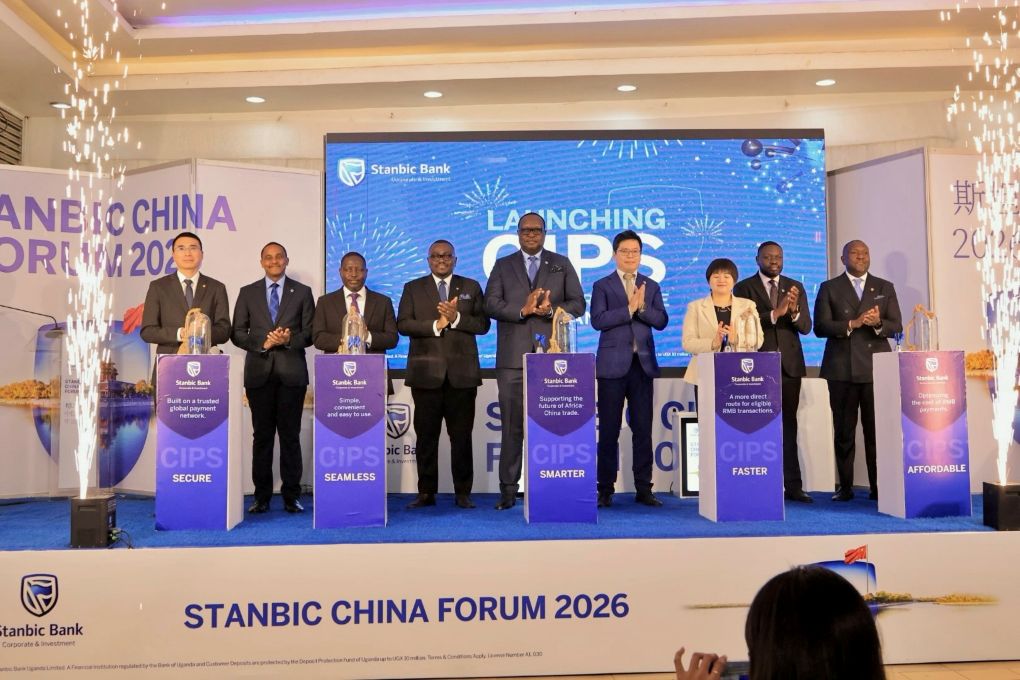 Minister David Bahati (3rd left) posing for a photo with the Stanbic Uganda team led by the Bank’s Chief Executive Mumba Kalifungwa(centre) after the launch.JPG
Stanbic’s adoption of CIPS could reshape how businesses settle trade by bypassing intermediary currencies
Ugandan businesses trading with China have gained access to a new payment infrastructure that promises to make cross-border transactions faster, cheaper and less exposed to foreign exchange risks, as Stanbic Bank Uganda becomes the country’s first financial institution to connect to China’s Cross-Border Interbank Payment System (CIPS).
While the announcement is significant for Stanbic, the bigger story lies in what CIPS as a financial tool designed to remove one of the biggest friction points in international commerce—the movement of money; represents for Uganda’s growing trade relationship with China.
For years, many Ugandan importers buying goods from China have had to route payments through intermediary banks and convert Ugandan shillings into US dollars before ultimately settling invoices in Chinese yuan (RMB). Each step added transaction costs, settlement delays and exposure to currency fluctuations.
Officials further explained that direct yuan settlement removes an exchange-rate risk faced by Ugandan businesses that previously converted shillings into US dollars before making payments in yuan. The two-step process left traders vulnerable to movements in the USD/UGX rate, even where the shilling-yuan relationship remained relatively stable.
CIPS changes that equation by allowing participating banks to settle cross-border payments directly in RMB through China’s official payment infrastructure.
The system, launched by the People’s Bank of China in 2015, has become the backbone of international yuan settlements as China seeks to make its currency more widely used in global trade.
For Uganda, whose imports from China reached USD3.3 billion in 2025 against exports of just USD118 million, the implications extend beyond payment efficiency.
The platform offers exporters easier access to Chinese buyers while giving importers greater certainty over payment timelines and foreign exchange costs.
Stanbic Bank Uganda Chief Executive Mumba Kalifungwa said direct RMB settlement would modernise trade finance by reducing dependence on intermediary currencies.
“The system will give Ugandan businesses a competitive edge and significantly contribute to government’s efforts to grow the economy tenfold to USD500 billion by 2040,” Kalifungwa said.
He noted that settling directly in yuan reduces foreign exchange volatility while accelerating payment processing between Ugandan and Chinese businesses.
The launch was announced during the revived Stanbic–China Trade Forum in Kampala, where government and business leaders highlighted the growing importance of financial infrastructure in supporting trade.
Minister of State for Industry David Bahati described the platform as addressing longstanding payment and information bottlenecks affecting Uganda-China commerce.
“China is one of Uganda’s most significant bilateral partners. This solution removes key bottlenecks and opens practical pathways for deeper industrial and commercial collaboration,” Bahati said.
Beyond facilitating payments, the new system could improve cash-flow management for businesses by shortening settlement cycles, enabling importers to receive goods sooner while allowing exporters to access funds more quickly.
For banks, direct settlement also reduces operational complexity by eliminating multiple correspondent banking relationships traditionally required for international transactions.
Andrew Mashanda, Standard Bank Group’s Head of Business and Commercial Banking for Africa Regions and Offshore, said Africa’s next phase of engagement with China would depend less on trade volumes and more on deeper industrial partnerships.
“Africa-China trade has been a key driver of growth across the continent. The next chapter will be defined not just by trade volumes, but by what we build together—manufacturing capacity, value addition and infrastructure,” he said.
The introduction of CIPS also aligns with Uganda’s ambition to position itself as a regional commercial gateway serving the wider East African market.
Complementing the payment platform is Stanbic’s partnership with Guomao, a business platform that links Ugandan companies with one of Beijing’s largest wholesale trading districts, providing direct sourcing opportunities for local importers.
Although CIPS will not alter Uganda’s trade imbalance with China overnight, it removes one of the financial barriers that has complicated commercial transactions between the two countries.
As more African financial institutions connect to China’s payment infrastructure, businesses are likely to judge success not by the technology itself, but by whether it lowers transaction costs, improves access to suppliers and buyers, and ultimately makes regional companies more competitive in one of the world’s largest trading relationships.
Related Posts
 Frankfurt Airport Malaria Outbreak Raises Questions Over Aviation-Related Health Risks
 What Maps Communicate: UN Resolution Challenges World Maps that Make Africa Look Smaller
 Independence Marathon Turns to Blood Storage Gap in Maternal Health Drive
 Fine Spinners Injects Fresh USD5m Into Technology as Uganda Textile Maker Targets African, European Markets
 Equity Trade Mission Puts Uganda’s Manufacturing Capacity to Regional Test
 Uganda Seeks to Calm Coffee, Cocoa Markets as Global Prices Fluctuate on Positive Sentiment
Get business news delivered to you everyday
Latest News

JPMorgan Abandons Oil Price Baseline as Iran Conflict Deepens Market Uncertainty

Frankfurt Airport Malaria Outbreak Raises Questions Over Aviation-Related Health Risks

What Maps Communicate: UN Resolution Challenges World Maps that Make Africa Look Smaller

Independence Marathon Turns to Blood Storage Gap in Maternal Health Drive

Fine Spinners Injects Fresh USD5m Into Technology as Uganda Textile Maker Targets African, European Markets

Equity Trade Mission Puts Uganda’s Manufacturing Capacity to Regional Test

Uganda Green Entrepreneurs Set for Paris Visit as Stanbic-France Partnership Graduates 106

Entebbe Airport Passenger Traffic Recovers in August but Remains Below 2025 Levels

Nile Breweries, Next Media Renew Road Safety Push with Focus on Boda Boda Riders

Equity Bank Explores Value-Chain Financing to Support Zigoti Coffee Expansion