

Alan Greenspan (1926–2026): The Maestro Who Repriced the World—and Shaped Africa’s Financial Cycles
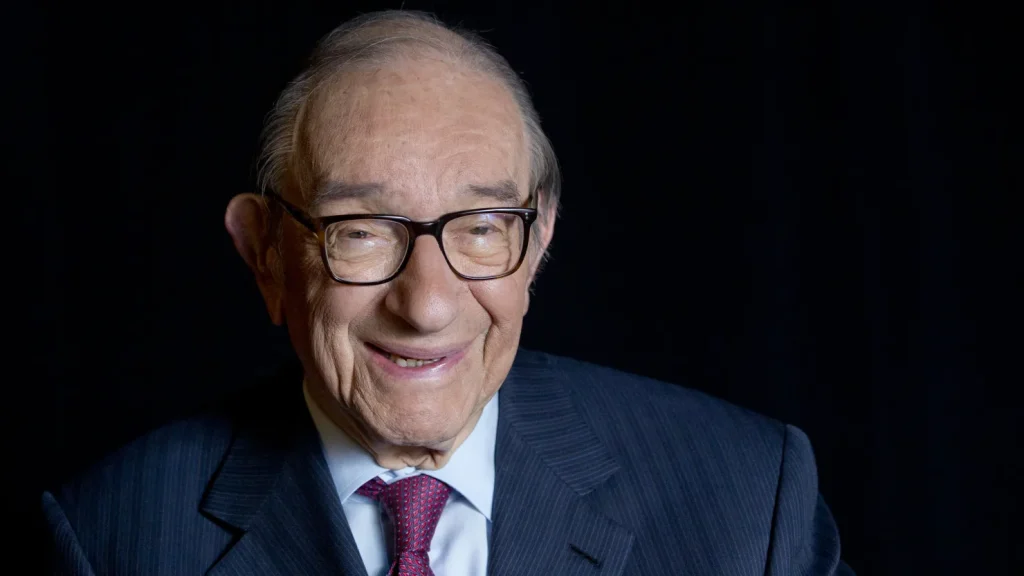
The death of Alan Greenspan at 100 closes a defining era in global monetary history—one whose influence extended far beyond Washington into emerging markets, including Africa. His policy framework helped drive global liquidity cycles that eased and tightened Africa’s access to capital, shaping sovereign borrowing costs, commodity exposure, and financial stability. While Africa was never at the policy table, it remained structurally inside the system his tenure helped define.
The death of Alan Greenspan at 100 closes one of the most consequential chapters in modern monetary history—an era in which US interest rate decisions increasingly functioned as a global pricing mechanism for capital, risk, and debt. While his policy remit was domestic, the effects of his framework extended deep into emerging economies, including Africa, where external financing conditions, commodity cycles, and sovereign balance sheets were repeatedly reshaped by liquidity waves originating in Washington.
Africa inside the Greenspan cycle, outside the decision room
Greenspan did not design policy for Africa, nor did African economies feature explicitly in his mandate. Yet over nearly two decades at the Federal Reserve, his approach to monetary stabilisation became embedded in global financial architecture in ways that made African economies highly sensitive to US cycles.
Low-interest rate regimes in the United States encouraged global portfolio expansion into higher-yielding emerging and frontier markets. African sovereigns and corporates increasingly tapped international capital markets through bonds and syndicated lending, often during periods of abundant global liquidity. These inflows supported infrastructure expansion and fiscal space in the short term.
The reverse cycle was more constraining. When the Federal Reserve tightened monetary policy, dollar strength increased and global liquidity contracted. For African economies with dollar-denominated obligations, debt servicing costs rose sharply, while refinancing conditions tightened. The result was a structural asymmetry: expansion phases offered access, but contraction phases amplified stress.
Commodity markets reinforced this mechanism. Oil, metals, and agricultural prices—key revenue sources for many African states—became increasingly sensitive to global liquidity conditions. Loose monetary cycles tended to support higher commodity prices and capital inflows; tightening cycles often produced simultaneous fiscal and external pressure.
In this framework, Africa became structurally embedded in what economists later described as the “Greenspan cycle”: not as a policy participant, but as a liquidity recipient shaped by external monetary impulses.
From $45-a-week economist to Washington’s most powerful technocrat
Before becoming the face of global monetary authority, Greenspan’s career developed within the technical and institutional core of American economic policymaking.
He worked at Brown Brothers Harriman and the National Industrial Conference Board before spending three decades at the Townsend-Greenspan consulting firm, which specialised in macroeconomic forecasting and policy analysis. His career trajectory briefly shifted into public service when he served as chairman of President Gerald Ford’s Council of Economic Advisers from 1974 to 1977.
He later chaired the National Commission on Social Security Reform from 1981 to 1983, a politically sensitive assignment that reinforced his reputation for technocratic problem-solving.
By the time he received his doctorate in economics in 1977, Greenspan had already moved through the intersection of government policy and private financial intelligence. His early reported earnings—around USD 45 a week—stood in stark contrast to the scale of influence he would later command as central banker.
Greenspan’s appointment as chairman of the Federal Reserve in August 1987 came only weeks before one of the most dramatic financial events of the late 20th century: Black Monday.
On October 19, 1987, global equity markets collapsed, with the Dow Jones Industrial Average falling 22.6pc in a single session. The scale and speed of the crash tested the credibility of modern financial systems and the capacity of central banks to respond in real time.
Greenspan’s response was immediate and unambiguous. The Federal Reserve signalled that it would act as a source of liquidity to stabilise the financial system. This shift marked a turning point in central banking practice. Liquidity provision became a first-line defence against market collapse.
Equity markets recovered a significant portion of losses within days. But more importantly, the episode established a behavioural expectation that would persist for decades—monetary authorities would intervene to prevent systemic breakdowns in financial markets.
This expectation later became known as the “Greenspan put” – the implicit assumption that central banks would cushion severe downside risk in asset markets.
The “Maestro” era and the doctrine of liquidity

Traders work on the floor of the New York Stock Exchange after the closing bell September 29, 2008 in New York City. U.S. stocks took a nosedive in reaction to the global credit crisis and as the U.S. House of Representatives rejected the $700 billion rescue package, 228-205. The Dow Jones Industrials recorded it’s biggest closing drop in history, as it fell 777 points in trading. (Photo by Spencer Platt/Getty Images)
Over the next 18 years, Greenspan presided over a sequence of global financial shocks that progressively expanded the scope of central bank intervention.
These included the early 1990s US recession, the Asian financial crisis of 1997, the Russian default and Long-Term Capital Management collapse in 1998, the dot-com boom and bust, and the economic aftermath of the September 11 attacks.
This period coincided with what policymakers later described as the “Great Moderation”—a phase of relatively low inflation and reduced macroeconomic volatility in advanced economies. However, beneath this surface stability, financial markets grew in importance as the primary transmission channel of economic activity.
Monetary policy increasingly responded to asset price movements, credit conditions, and systemic risk indicators rather than inflation alone. Interest rate adjustments became more frequent and more sensitive to financial market sentiment.
In 1996, Greenspan’s warning about “irrational exuberance” briefly unsettled global markets. Yet the equity boom continued, reinforcing his reputation as a central banker whose signals could move trillions in valuation without necessarily altering underlying momentum.
Credit, housing, and the limits of low rates
Greenspan’s policy philosophy emphasised inflation control, market flexibility, and limited regulatory interference in credit allocation. Supporters credit this approach with contributing to sustained US growth and relatively stable inflation over nearly two decades.
Critics, however, argue that prolonged periods of low interest rates and aggressive liquidity support encouraged excessive risk-taking in credit markets—particularly in housing finance.
The expansion of mortgage lending, including subprime segments, became a focal point of post-crisis analysis. Greenspan later acknowledged that while he was aware of evolving risk structures in lending markets, he underestimated their systemic interconnections.
He defended the policy stance on the grounds that lower rates supported broader homeownership and financial inclusion, while regulatory frameworks—not monetary policy alone—were responsible for credit quality oversight.
The collapse of the US housing market after his tenure ended intensified a long-running debate in macroeconomics: whether monetary accommodation stabilises economic cycles or merely delays the accumulation of financial imbalances.
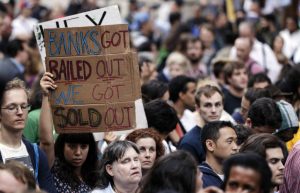
A demonstrator from the Occupy Wall Street campaign holds aloft a sign as the march enters a courtyard near the New York Police Department headquarters in New York September 30, 2011. Protesters who have camped out near Wall Street for two weeks gathered on Friday to march to police headquarters over what they viewed as excessive force and unfair treatment of minorities and Muslims.The Occupy Wall Street movement, whose members have vowed to stay through the winter, are protesting issues including the 2008 bank bailouts, foreclosures and high unemployment. More than 500 people were gathered ahead of the start of the planned late afternoon march to One Police Plaza, the center of police operations, in downtown Manhattan. REUTERS/Lucas Jackson (UNITED STATES – Tags: BUSINESS CIVIL UNREST)
Intellectual legacy and the question of control
After leaving the Federal Reserve in 2006, Greenspan remained an influential commentator on global financial systems. He consistently defended central bank independence and criticised fiscal policy decisions across successive US administrations.
In his later reflections, however, he acknowledged a fundamental limitation of monetary authority: that financial crises are ultimately driven by behavioural cycles that lie outside precise policy control.
“Fear and euphoria are dominant forces,” he observed in post-Fed commentary. “Contagion is the critical phenomenon which causes the thing to fall apart.”
This view reflected a shift in interpretation of his own legacy—from confidence in policy steering mechanisms to recognition of systemic complexity and feedback loops in global finance.
The final assessment
Greenspan’s legacy occupies an uneasy position between stabilisation and amplification. He expanded the role of central banking into real-time market support, helping prevent systemic collapse in multiple crises. At the same time, his framework reinforced expectations of intervention that may have increased leverage, risk-taking, and financial fragility over time.
For Africa, his impact is best understood not as direct policy influence but as structural exposure. Through global liquidity cycles, interest rate transmission, and dollar strength dynamics, African economies became deeply embedded in a system shaped by Federal Reserve reactions to US domestic conditions.
Debt costs, capital inflows, commodity cycles, and refinancing risks all became partially dependent on decisions made in Washington.
In that sense, Greenspan was not merely a US central banker. He was a key architect of a global monetary environment in which liquidity became the dominant pricing signal—and in which Africa, though absent from the decision-making table, remained fully inside the system’s consequences.
Related Posts
 Uganda Coffee Roasters Tap Richard Rugaya as Executive Director, with Focus on Commercial Growth
 Why Africa’s Institutions Must Turn Knowledge and Investment into Farmer Prosperity
 Forbes ranks MTN Group third globally on best telecom employer list
 Stanbic experts offer investment insights to navigate current market uncertainty
 Africa Carbon Markets Urged to Turn Potential into Investment and Delivery
 Corporate Buyers Could Help Unlock SAF Market Worth Millions of Tonnes by 2030
Get business news delivered to you everyday
Latest News

SITA Acquisition of Collins Airport Solutions Signals Moves to Consolidate Aviation Technology

Uganda Coffee Roasters Tap Richard Rugaya as Executive Director, with Focus on Commercial Growth

Equity Bank Reports UGX37.6 Billion in Green Loans as Uganda Seeks to Scale Climate Investment

Why Africa’s Institutions Must Turn Knowledge and Investment into Farmer Prosperity

Forbes ranks MTN Group third globally on best telecom employer list

Stanbic experts offer investment insights to navigate current market uncertainty

Africa Carbon Markets Urged to Turn Potential into Investment and Delivery

Bank of Uganda hikes base rate from 9.75% to 12% amidst global tensions

Airbus sees USD420bn Global Aviation Services Boom: Can Africa Capture its Share?

Nile Breweries Celebrates 75 Years of Growing with Uganda