

A New Theatre, A Shorter Journey: Partnerships Bring Maternal Healthcare Closer to Karamoja Mothers
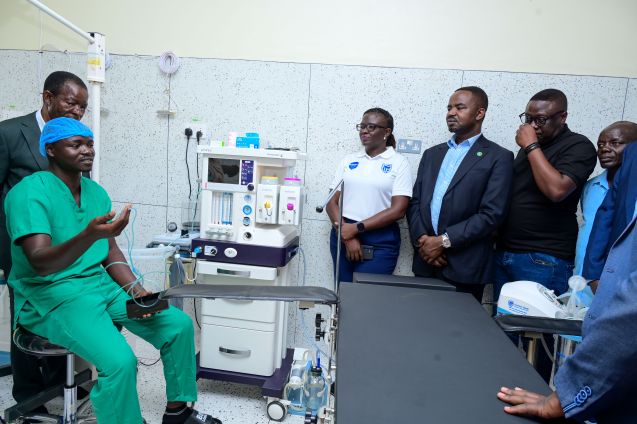 An anesthetist from Karita Health Centre IV explains how the different theatre equipment operates to the different stakeholders
For expectant mothers in Uganda’s remote Karamoja sub-region, childbirth often means navigating long distances, costly referrals and life-threatening delays. A new operating theatre at Karita Health Centre IV is changing that equation, illustrating how partnerships can help bridge healthcare access gaps in some of the country’s hardest-to-reach communities.
For years, geography has been one of the greatest risks facing expectant mothers in Uganda’s Karamoja sub-region. In Karita, a remote settlement in Amudat District near the Uganda-Kenya border, childbirth complications often trigger a race against distance. Families must navigate poor roads, search for transport and, in many cases, travel dozens or even hundreds of kilometres to access emergency obstetric care.
For Maria Chepsok, a Traditional Birth Attendant in Karita sub-county, those challenges became painfully personal only weeks ago when her sister-in-law developed complications during childbirth.
An ambulance was available, but fuel was not. As the situation worsened, the family embarked on a desperate 24-kilometre journey to Kacheliba Hospital in neighbouring West Pokot County, Kenya. Neither the mother nor the baby survived.
“It was a very painful experience,” Chepsok recalls. “If the theatre was operational by that time, perhaps my sister would have been saved.”
Her story reflects a wider challenge facing maternal healthcare in Karamoja, where health facilities often operate across vast distances and with limited specialised services.
Karita Health Centre IV serves a catchment population of more than 37,000 people drawn from Amudat District, neighbouring districts and communities across the border in Kenya. Yet until recently, the facility lacked a functional operating theatre capable of handling emergency obstetric procedures.
According to Dr George Ogwang, the facility’s in-charge, referral distances have long complicated emergency care.
“Moroto Regional Referral Hospital is about 210 kilometres away. Mbale is approximately 164 kilometres from here, while Amudat Hospital is about 90 kilometres away,” he explains. “Because of these distances, we sometimes refer patients to Kacheliba Hospital in Kenya, which is only 24 kilometres away.”
The challenge highlights a broader reality facing healthcare delivery in remote regions. While Uganda has made significant progress in reducing maternal mortality, access to timely emergency care remains uneven, particularly in hard-to-reach districts.
Nationally, Uganda’s maternal mortality ratio has declined to about 189 deaths per 100,000 live births. However, achieving the Sustainable Development Goal target of fewer than 70 maternal deaths per 100,000 live births by 2030 will require faster progress, especially in underserved regions.
In Karamoja, demographic pressures add another layer of complexity. While Uganda’s national fertility rate has fallen to approximately four children per woman, parts of Karamoja continue to record fertility rates exceeding seven children per woman, increasing demand for maternal and reproductive healthcare services.
Against this backdrop, the rehabilitation and equipping of an operating theatre at Karita Health Centre IV represents more than an infrastructure upgrade. It is an investment in reducing the cost of healthcare access.
The facility upgrade was made possible through a partnership involving Stanbic Bank, the Ministry of Health, Doctors with Africa (CUAMM), Amudat District Local Government and other partners. In addition to funding the theatre rehabilitation, Stanbic donated 200 Mama Kits and assorted medical supplies and equipment valued at approximately Shs96 million.
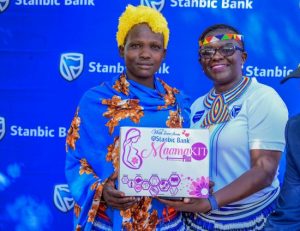
Diana Ondoga Manager CSI Stanbic Bank hands over a mama kit to an expectant mother
Diana Ondoga, Stanbic Bank’s Manager for Corporate Social Investment, says the intervention seeks to address longstanding barriers that have prevented expectant mothers from accessing timely care.
“We are not merely unveiling a new building, but opening doors to safer motherhood, improved healthcare outcomes and renewed hope for thousands of families in this region,” she says.
For communities where transport costs, distance and delayed referrals often determine health outcomes, bringing surgical and maternity services closer to patients could significantly reduce risks associated with childbirth.
Dr Richard Mugahi, Commissioner for Reproductive, Maternal and Child Health at the Ministry of Health, says such collaborations are increasingly important in extending healthcare services to underserved areas.
“Through collaboration between Stanbic, Doctors with Africa (CUAMM), the Ministry of Health and other partners, we are working to ensure that no mother, newborn or child is left behind,” he says.
Residents are already optimistic about the difference the new facility could make.
Esther Chepakori, a resident of Chebinyin village, says referrals have traditionally imposed both financial and emotional burdens on families.
“Many people have experienced difficulties when they are told they must be referred elsewhere and have to find money for transport or ambulance fuel,” she says.
Today, Karita Health Centre IV offers outpatient, inpatient, antenatal, maternity, immunisation and family planning services. With the addition of a functional theatre and laboratory, healthcare workers believe the facility is better positioned to respond to emergencies that previously required lengthy referrals.
Yet challenges remain. Dr Ogwang notes that additional medical personnel will be needed to fully utilise the expanded infrastructure.
“Now that we have a theatre and laboratory in place, the number of critical staff should be increased,” he says.
His appeal underscores a lesson that extends beyond Karamoja. Infrastructure is essential, but sustainable healthcare outcomes require a combination of facilities, equipment, skilled personnel and reliable financing.
For Karita’s mothers, however, the immediate significance is simpler. A journey that once required travelling across districts—or even across borders—may now end much closer to home.
And in maternal healthcare, shorter journeys often mean saved lives.
Related Posts
 Uganda Coffee Roasters Tap Richard Rugaya as Executive Director, with Focus on Commercial Growth
 Why Africa’s Institutions Must Turn Knowledge and Investment into Farmer Prosperity
 Forbes ranks MTN Group third globally on best telecom employer list
 Stanbic experts offer investment insights to navigate current market uncertainty
 Africa Carbon Markets Urged to Turn Potential into Investment and Delivery
 Corporate Buyers Could Help Unlock SAF Market Worth Millions of Tonnes by 2030
Get business news delivered to you everyday
Latest News

SITA Acquisition of Collins Airport Solutions Signals Moves to Consolidate Aviation Technology

Uganda Coffee Roasters Tap Richard Rugaya as Executive Director, with Focus on Commercial Growth

Equity Bank Reports UGX37.6 Billion in Green Loans as Uganda Seeks to Scale Climate Investment

Why Africa’s Institutions Must Turn Knowledge and Investment into Farmer Prosperity

Forbes ranks MTN Group third globally on best telecom employer list

Stanbic experts offer investment insights to navigate current market uncertainty

Africa Carbon Markets Urged to Turn Potential into Investment and Delivery

Bank of Uganda hikes base rate from 9.75% to 12% amidst global tensions

Airbus sees USD420bn Global Aviation Services Boom: Can Africa Capture its Share?

Nile Breweries Celebrates 75 Years of Growing with Uganda