

Solar irrigation helping cocoa take root in northern Uganda
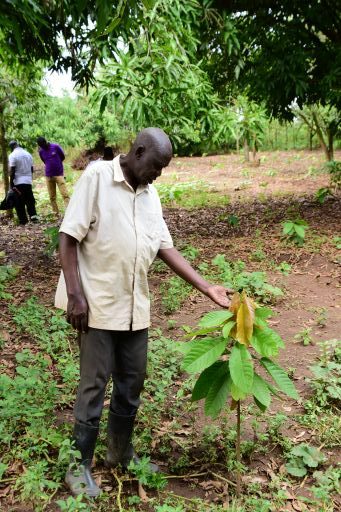 Ogwal showcasing some of the his growing cocoa plants
A Lira farmer is challenging long-held assumptions about cocoa cultivation in northern Uganda, using solar-powered irrigation to expand seedling production and introduce a high-value cash crop to hundreds of farmers across the Lango sub-region.
For decades, cocoa was considered an unlikely crop for northern Uganda. The prevailing view among farmers and agricultural experts was that Lira’s climate was too dry to support a crop traditionally associated with the wetter regions of western Uganda and West Africa.
That perception is now being tested by Joseph Ogwal Oyuk, a farmer and director of Acanga Farm Estates in Lira City West, who is using solar-powered irrigation to demonstrate that cocoa can thrive in the region under the right conditions.
The experiment is gaining attention as farmers search for alternatives to traditional cash crops such as cotton and oilseeds, whose returns have often been constrained by price volatility and limited value addition.
On his farm, Ogwal has dedicated an acre to cocoa production and established a nursery with more than 30,000 seedlings destined for farmers across the Lango sub-region.
His journey with cocoa began more than two decades ago but was hampered by a persistent shortage of water.
“When I started, I used a watering can, then a treadle pump, then a petrol pump,” Ogwal said. “We carried water manually from the source. Workers got exhausted, the process was slow, and costs were high.”
The economics changed when he adopted a solar-powered irrigation system that pumps water directly to the nursery and fields.
According to Ogwal, tasks that previously consumed hours of labour can now be completed in minutes, allowing the farm to double nursery production from 15,000 to 30,000 seedlings.
The irrigation system was supplied by Tulima Solar through a Results-Based Financing programme supported by Equity Bank Uganda, an arrangement designed to make productive-use renewable energy technologies more accessible to farmers and small businesses.
The increase in seedling production comes at a time when interest in cocoa is growing. Rising prices have made the crop increasingly attractive to farmers looking for higher-value agricultural enterprises.
Industry players say the experience in Lira highlights how irrigation and climate-smart farming technologies are expanding the range of crops that can be grown outside their traditional production zones.
For Ogwal, the opportunity extends beyond his own farm.
Through a field training centre established at Acanga Farm Estates, he provides practical instruction on cocoa production and farm management. More than 200 farmers have already received seedlings and technical support.
“People come here to learn how to grow cocoa profitably,” he said.
The farm has evolved into a demonstration site for agricultural diversification, showing how technology can reduce production risks and unlock new opportunities for farmers.
Equity Bank Uganda says its support for renewable energy financing is intended to increase access to technologies that improve productivity and rural incomes.
“Our vision is a Uganda where every household and business can access clean energy without taking on unmanageable debt,” said Virginia Semakula, the bank’s Manager for Energy, Environment and Climate Change.
Ogwal is now planning a major expansion, targeting production of up to 300,000 cocoa seedlings and increasing the acreage under cultivation.
If successful, the initiative could accelerate the emergence of cocoa as a commercial crop in a region where it was once considered impossible to grow, creating a new income stream for farmers and further diversifying northern Uganda’s agricultural economy.
Related Posts
 Uganda Coffee Roasters Tap Richard Rugaya as Executive Director, with Focus on Commercial Growth
 Why Africa’s Institutions Must Turn Knowledge and Investment into Farmer Prosperity
 Forbes ranks MTN Group third globally on best telecom employer list
 Stanbic experts offer investment insights to navigate current market uncertainty
 Africa Carbon Markets Urged to Turn Potential into Investment and Delivery
 Corporate Buyers Could Help Unlock SAF Market Worth Millions of Tonnes by 2030
Get business news delivered to you everyday
Latest News

SITA Acquisition of Collins Airport Solutions Signals Moves to Consolidate Aviation Technology

Uganda Coffee Roasters Tap Richard Rugaya as Executive Director, with Focus on Commercial Growth

Equity Bank Reports UGX37.6 Billion in Green Loans as Uganda Seeks to Scale Climate Investment

Why Africa’s Institutions Must Turn Knowledge and Investment into Farmer Prosperity

Forbes ranks MTN Group third globally on best telecom employer list

Stanbic experts offer investment insights to navigate current market uncertainty

Africa Carbon Markets Urged to Turn Potential into Investment and Delivery

Bank of Uganda hikes base rate from 9.75% to 12% amidst global tensions

Airbus sees USD420bn Global Aviation Services Boom: Can Africa Capture its Share?

Nile Breweries Celebrates 75 Years of Growing with Uganda