UN Women, Equity Bank chart new path in push for women’s economic inclusion
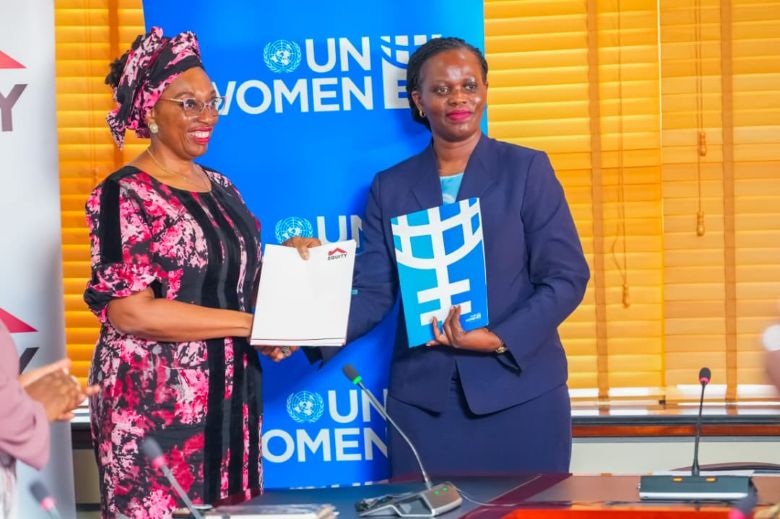
A new partnership between UN Women and Equity Bank Uganda aims to deepen women’s economic inclusion in Uganda by pairing financial access with skills, enterprise support and clean energy financing, highlighting a shift from access to impact.
A new partnership between UN Women and Equity Bank Uganda is bringing renewed focus on the distance between financial access and meaningful economic participation for women; a persistent gap in Uganda’s growth story.
Signed this week in Kampala, the two-year collaboration running from April 2026–March 2028, is designed to expand women’s access to financial services while pairing that access with skills, enterprise support and clean energy financing. The initiative will target underserved groups, including women in refugee-hosting communities, where economic vulnerability is often most acute.
At one level, the partnership plays on the familiar development template of providing credit, training and market access. But its structure also signals a more deliberate shift toward tackling the layered nature of financial exclusion, where access alone has often proved insufficient.
“This partnership reflects our shared commitment to ensuring that women—especially those in underserved and vulnerable communities—have the tools, resources, and opportunities to thrive economically,” said Adekemi Ndieli, UN Women Deputy Country Representative in Uganda. “By working together, we can accelerate progress toward inclusive growth and sustainable development.”
The emphasis on combining finance with capability—financial literacy, digital skills and entrepreneurship training reinforces a growing recognition among policymakers and lenders that traditional banking models have struggled to fully integrate women operating in informal and rural economies.
For Equity Bank Uganda, the partnership dovetails into the lenders social agenda that has for long approached inclusion, less as a compliance obligation and more as a growth frontier.
“Equity Bank Uganda is proud to partner with UN Women to dismantle barriers that prevent women from achieving economic autonomy,” said Equity Bank Uganda Managing Director Gift Shoko. “Our commitment goes beyond financial products; we are offering training, digital literacy and clean energy solutions to ensure women can compete and succeed in today’s economy.”
Uganda’s financial inclusion rates have improved in recent years, driven by mobile money and agency banking. Yet disparities remain pronounced, particularly for women in agriculture and informal trade, where access to credit, markets and formal financial tools remains uneven.
The partnership’s focus on women-led agribusinesses and cooperatives points to an attempt to bridge that gap by linking finance to productive sectors where women are already dominant but undercapitalised.
UN Women will provide technical expertise, community mobilization, and policy support, while Equity Bank Uganda will offer tailored financial products, training and advisory services. The partnership will be implemented through a jointly developed work plan with clear targets and measurable impact.
According to the partners, the initiatives implemented under this pact are expected to benefit thousands of women across Uganda by enabling them to access inclusive financial services, expand their economic opportunities, and strengthen their capacity to contribute to inclusive and sustainable development. This includes supporting women’s participation in national and regional markets under the African Continental Free Trade Area (AfCFTA), which has the potential to unlock greater market access, scale women led enterprises, and amplify women’s role as drivers of regional economic growth.
By aligning with opportunities under the African Continental Free Trade Area, the initiative positions women not just as local entrepreneurs but as potential participants in cross-border trade—an area where scale and competitiveness have historically been constrained by limited access to finance and information.
Equally notable is the integration of clean energy financing into the programme. For many low-income households and small enterprises, energy access remains a critical bottleneck, affecting productivity and costs. Linking financing to energy solutions could, analysts say, unlock incremental gains in both household welfare and business performance.
Shoko framed the effort in broader economic terms: “We believe inclusive finance is the foundation of inclusive growth. Together, we will empower women to transform their enterprises and their communities.”
For development actors, that framing underscores a 360-degree shift from viewing women as beneficiaries of inclusion to recognising them as drivers of economic expansion.
Related Posts
 China’s GPMI Interface Leapfrogs HDMI, USB With 192Gbps Speeds and 480W Power
 Stanbic Seeks Northern Uganda Business Feedback as It Marks 35 Years in Country
 Uganda Emerges as Africa’s Largest Organic Farming Country as Exports Reach USD225 Million
 SITA Acquisition of Collins Airport Solutions Signals Moves to Consolidate Aviation Technology
 Uganda Coffee Roasters Tap Richard Rugaya as Executive Director, with Focus on Commercial Growth
 Equity Bank Reports UGX37.6 Billion in Green Loans as Uganda Seeks to Scale Climate Investment
Get business news delivered to you everyday
Latest News

China’s GPMI Interface Leapfrogs HDMI, USB With 192Gbps Speeds and 480W Power

Stanbic Seeks Northern Uganda Business Feedback as It Marks 35 Years in Country

Uganda Emerges as Africa’s Largest Organic Farming Country as Exports Reach USD225 Million

SITA Acquisition of Collins Airport Solutions Signals Moves to Consolidate Aviation Technology

Uganda Coffee Roasters Tap Richard Rugaya as Executive Director, with Focus on Commercial Growth

Why Africa’s Institutions Must Turn Knowledge and Investment into Farmer Prosperity

Forbes ranks MTN Group third globally on best telecom employer list

Stanbic experts offer investment insights to navigate current market uncertainty

Africa Carbon Markets Urged to Turn Potential into Investment and Delivery

Bank of Uganda hikes base rate from 9.75% to 12% amidst global tensions