

Stanbic, agribusiness leaders push unified front against counterfeit inputs as food security concerns rise
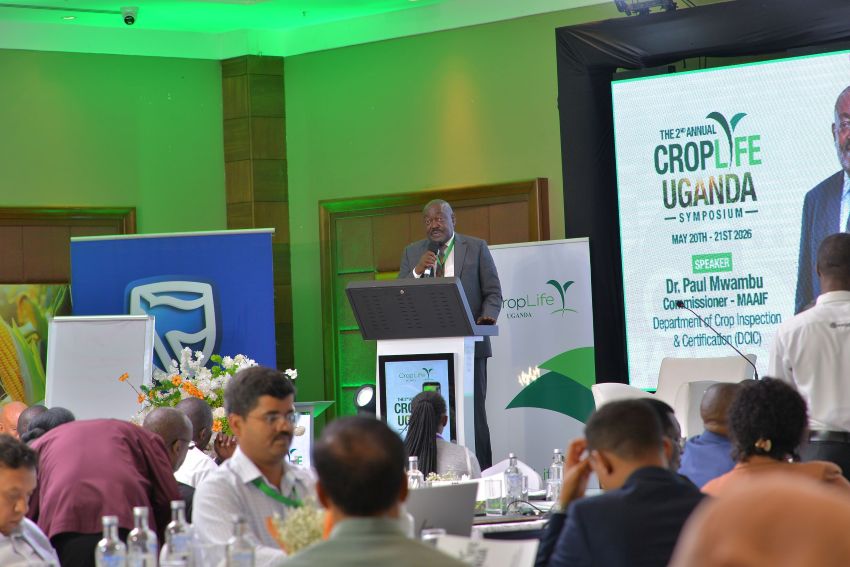
Stakeholders in Uganda’s agriculture sector have renewed calls for coordinated action to eliminate counterfeit agro-inputs, warning that weak regulation and market distortions continue to threaten food safety and productivity.
Uganda’s agricultural sector is intensifying calls for coordinated action among financiers, regulators, manufacturers and farmers to curb the spread of counterfeit agricultural inputs, amid growing concerns over food safety and long-term regional food security.
The appeal emerged during the second edition of the CropLife Uganda Symposium held at Sheraton Kampala Hotel, which convened policymakers, agribusiness leaders, regulators, researchers, development partners and farmers under the theme: “Emerging trends in seeds, crop protection and fertiliser industry: Embracing change and sustainability to ensure food security, health and safety.”
Discussions centred on regulatory enforcement, agricultural innovation, market integrity and the financing systems required to support a more resilient and productive farming ecosystem across Sub-Saharan Africa.
Dr. Paul Mwambu, Commissioner for Crop Inspection and Certification at the Ministry of Agriculture, Animal Industry and Fisheries (MAAIF), said Uganda has made measurable progress in tackling counterfeit agricultural inputs but warned that enforcement gaps remain a major risk.
“We have made strides in fighting counterfeits in the country. The ministry is actively involved in crackdowns, but as an industry, we need punitive action,” Mwambu said.
He proposed stricter sanctions, including deregistration of agro-input dealers found culpable.
“Every two years, dealers receive certificates for their premises and dealership operations. Those caught counterfeiting should be deregistered so they understand that endangering farmers carries serious consequences.”
Agnes Mbabazi, Chairperson of CropLife Uganda, said the agro-input sector must adopt stronger self-regulation mechanisms, stressing that counterfeit products pose a direct threat to national food systems.
“This industry is not an ordinary business, but an ecosystem about feeding the nation. Poison in food could endanger Uganda’s 47 million people, which is why counterfeiting must be treated seriously,” she said.
She noted that CropLife Uganda is working closely with regulators and stakeholders to improve compliance and strengthen oversight across the value chain.
“As an umbrella body, we understand the importance of whistleblowing and dialogue so that all stakeholders can work towards a common agenda. Through engagement with MAAIF, CropLife helped achieve clarity on products that are banned and those that are restricted.”
 Melissa Nyakwe, Head of Commercial Banking at Stanbic Bank Uganda, said the bank’s involvement in the symposium reflects its broader strategy to support Uganda’s economic transformation through agriculture.
“Uganda is our home; we drive her growth,” Nyakwe said.
She said the bank’s Positive Impact Agenda prioritises financial inclusion, climate resilience, enterprise development, infrastructure financing and social investment.
According to Nyakwe, Stanbic is deliberately working to de-risk agriculture by expanding structured financing across the entire value chain—from multinational input suppliers and distributors to cooperatives and smallholder farmers.
“We are intentionally building climate-smart financing frameworks to help agribusinesses adapt, protect the environment and survive seasonal shocks,” she said.
She also highlighted programmes such as the Stanbic Business Incubator and Stanbic For Her, which support youth- and women-led enterprises through financial literacy, mentorship and access to agricultural technologies.
Nyakwe warned that financing alone cannot resolve structural weaknesses in the sector.
“Capital alone cannot solve the counterfeit crisis, nor can it fix regulatory bottlenecks. We need strong policy direction, ethical stewardship and quality assurance across the agricultural ecosystem.”
Regulators urged to accelerate innovation readiness
Stella Simiyu, Team Lead at CropLife Middle East (CLAME), called for faster, more science-driven regulatory systems capable of keeping pace with agricultural innovation.
She argued that farmers remain central to economic stability and food security, but regulatory delays continue to slow access to critical technologies.
“Farmers are central to our economies, food security and trade. We cannot achieve food security, sustainability or increased agricultural investment unless regulatory systems enable timely, science-based and risk-proportionate decisions.”
Simiyu pointed to emerging tools such as biological crop protection products, precision agriculture, drones and artificial intelligence, noting that their impact depends on regulatory efficiency and regional harmonisation.
“We must accelerate harmonisation, invest in expertise and digital systems, strengthen science-based risk assessment and improve anti-counterfeiting efforts. Regulatory readiness is not only a policy issue—it is a food security, trade and livelihoods priority.”
Given Mudenda, Managing Director for East and Southern Africa at Syngenta, warned that Sub-Saharan Africa faces mounting pressure to expand food production amid rapid population growth.
He noted that the region’s population is projected to nearly double from about 1.3 billion today to 2.6 billion by 2050, intensifying demand for food systems transformation.
“If our population is expected to double, then food production must also increase significantly. Yet many countries in Sub-Saharan Africa are already struggling to feed their populations,” Mudenda said.
He highlighted persistently low yields among smallholder farmers, with maize productivity in many countries still below one tonne per hectare, compared to up to 12 tonnes in commercial farming systems.
Mudenda called for expanded investment in farmer training, climate-resilient technologies, post-harvest systems and quality input distribution networks.
He also pointed to external trade barriers, including stringent food safety requirements in key export markets, as ongoing challenges for African producers.
“The goal should be a balance between ensuring food safety and sustainability while also protecting food security, farmer livelihoods and economic growth across the region.”
Participants at the symposium converged on a central conclusion: tackling counterfeit inputs, improving access to affordable financing and strengthening regulatory systems are interdependent priorities.
They warned that without coordinated reform, counterfeit products will continue to undermine productivity gains, erode farmer confidence and weaken efforts to achieve food security across Uganda and the wider region.
Related Posts
 Independence Marathon Turns to Blood Storage Gap in Maternal Health Drive
 Fine Spinners Injects Fresh USD5m Into Technology as Uganda Textile Maker Targets African, European Markets
 Equity Trade Mission Puts Uganda’s Manufacturing Capacity to Regional Test
 Uganda Green Entrepreneurs Set for Paris Visit as Stanbic-France Partnership Graduates 106
 Entebbe Airport Passenger Traffic Recovers in August but Remains Below 2025 Levels
 Equity Bank Explores Value-Chain Financing to Support Zigoti Coffee Expansion
Get business news delivered to you everyday
Latest News

Independence Marathon Turns to Blood Storage Gap in Maternal Health Drive

Fine Spinners Injects Fresh USD5m Into Technology as Uganda Textile Maker Targets African, European Markets

Equity Trade Mission Puts Uganda’s Manufacturing Capacity to Regional Test

Uganda Seeks to Calm Coffee, Cocoa Markets as Global Prices Fluctuate on Positive Sentiment

Uganda Green Entrepreneurs Set for Paris Visit as Stanbic-France Partnership Graduates 106

Entebbe Airport Passenger Traffic Recovers in August but Remains Below 2025 Levels

Nile Breweries, Next Media Renew Road Safety Push with Focus on Boda Boda Riders

Uganda Breaks Ground on USD310m Kampala Fuel Terminal, Targets September 2028 Completion

Uganda Will Not Close Its 2.4-Million-Unit Housing Deficit with Ribbon-Cuttings in Kira

Nairobi’s 2029 World Athletics Win Draws Doping Scrutiny in UK Media