

Uganda Unveils Global Coffee Identity as it Transitions From Commodity to Brand
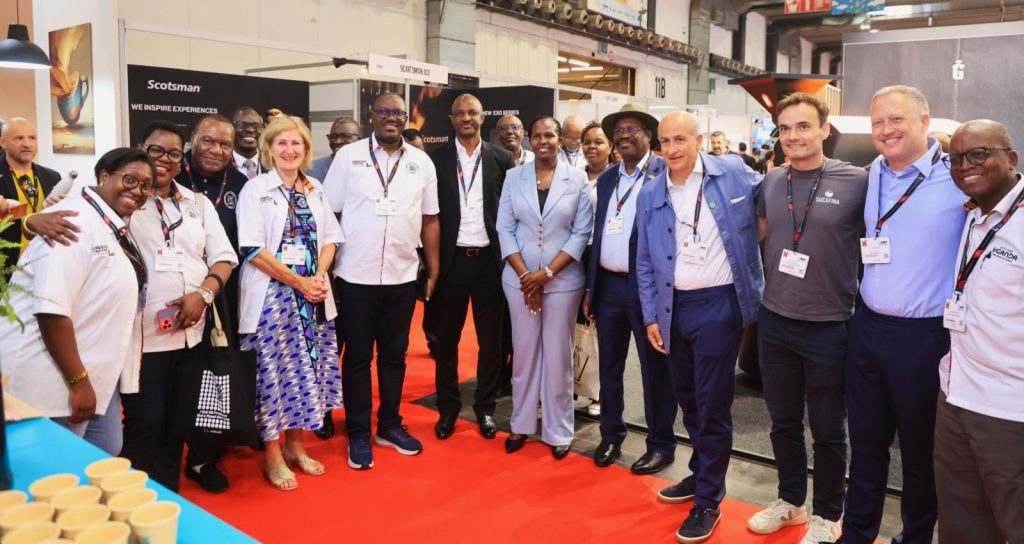
‘Uganda Coffee: It’s in Our Nature’ marks strategic shift from commodity exporter to premium origin brand as coffee earnings surge past USD2.3 billion.
Uganda has launched its first national coffee brand, Uganda Coffee: It’s in Our Nature, as the country seeks to transition from being a leading commodity exporter to a premium coffee origin. The move comes as coffee export earnings climb to USD2.38 billion, reinforcing the crop’s position as Uganda’s leading merchandise export.
Uganda has unveiled its first national coffee brand in a landmark move aimed at repositioning the country from one of the world’s largest coffee exporters to a premium origin capable of commanding greater recognition—and potentially higher value—in international markets.
Launched at the World of Coffee exhibition in Brussels, the new brand, Uganda Coffee: It’s in Our Nature, represents the country’s most ambitious effort yet to build a distinct global identity for a sector that has become Uganda’s leading merchandise export.
The initiative seeks to ensure that international buyers, roasters and consumers recognise Uganda not simply as a supplier of coffee beans, but as a premium coffee origin with a compelling story rooted in quality, sustainability and heritage.
The launch comes as Uganda’s coffee industry enjoys unprecedented momentum.
Over the 12 months to April 2026, the country exported 8.78 million 60-kilogramme bags of coffee worth USD2.38 billion, representing growth of 22 percent in export volumes and 23 percent in export value compared with the previous year.
In April alone, coffee exports reached 591,687 bags valued at USD155.5 million, underlining coffee’s enduring importance as Uganda’s largest foreign exchange earner.
While Uganda has long been recognised as Africa’s largest coffee exporter by volume and the birthplace of Robusta coffee, policymakers increasingly believe the country’s next opportunity lies beyond increasing production.
Instead, the focus is shifting towards capturing greater value through branding, quality differentiation and direct engagement with international markets.
Junior minister for Agriculture Desire Muhooza said the new national identity reflects Uganda’s ambition to build a globally trusted coffee brand while strengthening compliance with increasingly demanding international market requirements.
“Uganda’s coffee sector is charting a bold path forward—anchored in stronger quality systems, full compliance with the EU Deforestation Regulation, and expanded entry into Europe’s markets,” Muhooza said.
“In line with President Museveni’s vision of coffee as a strategic national asset, Uganda is determined to transform its beans into a global brand of trust, sustainability, and economic strength.”
The branding strategy arrives at a critical moment for the industry as consumers increasingly seek traceable, sustainably produced coffees with distinctive origins rather than undifferentiated commodity products.
Europe, which accounted for 52 percent of Uganda’s coffee exports in April 2026, remains the country’s largest export destination, with Italy and Germany among its biggest buyers.
Brussels, home to both the World of Coffee exhibition and the European Union institutions, provided a strategic platform for introducing Uganda’s new identity to the world’s largest coffee-consuming market.
The brand’s central promise—”It’s in Our Nature”—is designed to communicate both Uganda’s natural coffee-growing conditions and the country’s cultural relationship with coffee.
According to the campaign, the phrase refers not only to Uganda’s fertile soils, favourable altitude, abundant water and biodiversity, but also to values of trust, hospitality and resilience that have historically been associated with coffee-growing communities.
The new visual identity incorporates coffee beans into the national wordmark alongside the Crested Crane, Uganda’s national bird, while drawing on the country’s national colours and coffee-inspired tones intended to distinguish Uganda in an increasingly competitive global marketplace.
The launch forms part of a broader trade promotion strategy that will extend beyond exhibitions into export marketing, buyer engagement, packaging, digital campaigns and international promotional activities.
It also reflects a wider trend among commodity-exporting countries seeking to build stronger national brands capable of improving price realisation and customer loyalty.
Uganda’s participation as the Portrait Country at this year’s World of Coffee exhibition gave the country a prominent showcase that included coffee tastings, cultural performances and meetings with international buyers.
The campaign has been supported through MARKUP II, the European Union-funded Market Access Upgrade Programme implemented by the International Trade Centre.
Uganda’s Ambassador to Belgium, Mirjam Blaak Sow, said the initiative offers an opportunity to strengthen commercial relationships with Europe’s coffee industry while attracting new investment into Uganda’s value chain.
“The World of Coffee in Brussels offers a unique platform for Uganda to present its coffee story directly to the European market, the world’s largest coffee-consuming region,” she said.
“Through this campaign, we aim to strengthen trade relations, attract investment, and elevate Uganda’s brand as a producer of world-class coffee.”
For Uganda, the significance of the new brand extends beyond marketing.
As global coffee markets become increasingly competitive and consumers place greater emphasis on provenance, sustainability and quality assurance, building a recognised national coffee identity could help the country secure stronger market positioning and greater export value.
If successful, Uganda Coffee: It’s in Our Nature could mark the beginning of a new chapter in the country’s coffee industry—one in which Uganda exports not only more coffee, but a stronger global brand.
Related Posts
 Uganda Coffee Roasters Tap Richard Rugaya as Executive Director, with Focus on Commercial Growth
 Why Africa’s Institutions Must Turn Knowledge and Investment into Farmer Prosperity
 Forbes ranks MTN Group third globally on best telecom employer list
 Stanbic experts offer investment insights to navigate current market uncertainty
 Africa Carbon Markets Urged to Turn Potential into Investment and Delivery
 Corporate Buyers Could Help Unlock SAF Market Worth Millions of Tonnes by 2030
Get business news delivered to you everyday
Latest News

SITA Acquisition of Collins Airport Solutions Signals Moves to Consolidate Aviation Technology

Uganda Coffee Roasters Tap Richard Rugaya as Executive Director, with Focus on Commercial Growth

Equity Bank Reports UGX37.6 Billion in Green Loans as Uganda Seeks to Scale Climate Investment

Why Africa’s Institutions Must Turn Knowledge and Investment into Farmer Prosperity

Forbes ranks MTN Group third globally on best telecom employer list

Stanbic experts offer investment insights to navigate current market uncertainty

Africa Carbon Markets Urged to Turn Potential into Investment and Delivery

Bank of Uganda hikes base rate from 9.75% to 12% amidst global tensions

Airbus sees USD420bn Global Aviation Services Boom: Can Africa Capture its Share?

Nile Breweries Celebrates 75 Years of Growing with Uganda