

Study charts pathways for expanding employment opportunities for refugees in Uganda
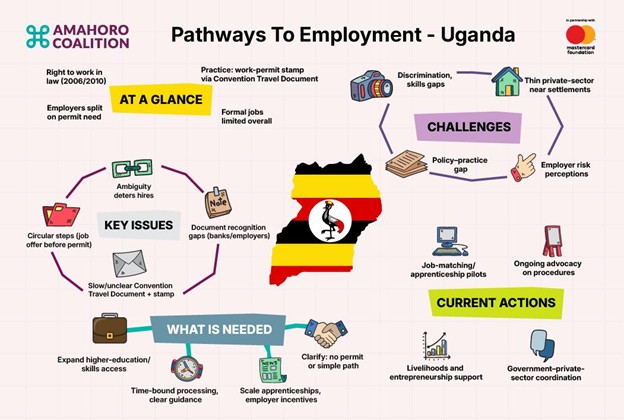
A new 15-country study finds that while Uganda’s refugee laws are among the most progressive globally, administrative hurdles, labour market gaps and limited private sector engagement continue to restrict formal employment opportunities. The report outlines practical reforms to bridge the gap between policy and practice.
A new multi-country study has outlined practical steps to expand formal employment opportunities for refugees in Uganda, warning that progressive laws alone are not enough to translate the right to work into real jobs.
The Uganda report is part of a 15-country “Pathways to Employment” research series commissioned by the Amahoro Coalition and conducted by the Refugee-Led Research Hub at the University of Oxford. The series assess how labour markets, policy frameworks and private sector demand shape access to work for refugees and host communities across Africa.
Uganda is widely recognised for its refugee-friendly legal framework. Under the Refugee Act and the Refugee Regulations, refugees are permitted to move freely, seek employment, establish businesses, access public services, open bank accounts and apply for loans. However, the study finds that significant administrative and structural barriers continue to limit access to formal employment.
Work permits and documentation gaps
Although refugees have the legal right to work, uncertainty persists around documentation requirements. According to the Ministry of Internal Affairs, refugees are expected to obtain work permits. Yet the specific procedures are not clearly outlined in publicly accessible regulations.
In practice, refugees must first secure a Conventional Travel Document before obtaining a work permit stamp. The document costs about USD 60 and requires travel to Kampala — a cost that can be prohibitive for refugees living in remote settlements. Processing delays further complicate the process.
Because work permits are not explicitly referenced in the 2006 Act or 2010 Regulations, interpretation varies. Some employers do not request permits, while others insist on full documentation. The absence of clear guidance and publicly available data on how many refugees have successfully obtained permits has led many to work informally. The study notes that such ambiguity creates uncertainty for employers and reduces the likelihood of structured recruitment from refugee communities.
Employment gap persists
Beyond documentation challenges, labour market disparities remain stark. Only 29 percent of refugees are actively working, compared to 64 percent of members of host communities.
Limited access to higher education constrains refugees’ competitiveness in skilled sectors. Even qualified professionals often work below their level of training and earn lower wages than their Ugandan counterparts.
The report also highlights discrimination as a barrier. Some private firms require sustained engagement before considering refugee applicants, even in refugee-hosting districts. Within the humanitarian sector, refugees are frequently engaged as volunteers or incentive workers, with modest stipends and limited pathways into senior leadership positions.
Entrepreneurship potential
At the same time, the study identifies refugee entrepreneurship as a key opportunity area. While the process of obtaining a business licence is generally described as straightforward, hidden costs and limited access to credit restrict growth.
Financial institutions may perceive refugees as higher-risk borrowers, limiting access to loans that could enable expansion and job creation. The report argues that improving access to finance could strengthen local economies and benefit both refugees and host communities.
Encouraging examples of collaboration between government, humanitarian agencies and private companies demonstrate what is possible. Apprenticeship schemes and job-matching initiatives that directly involve employers have shown potential to create employment while addressing misconceptions about refugee documentation and skills.
Mercy Kusiwaa Frimpong, Strategy Custodian for Communications at the Amahoro Coalition, said the next phase of Uganda’s refugee inclusion agenda will depend on stronger business leadership.
“Uganda has built a progressive legal framework. The opportunity now is for the private sector to step forward as a key partner in delivering on that promise. Refugees are entrepreneurs, workers and consumers. With clearer guidance, practical incentives and stronger partnerships, businesses can play a transformative role in advancing inclusive growth,” she said.
Recommendations
The study recommends simplifying administrative processes, clarifying work permit procedures, expanding apprenticeship and job-matching programmes, and creating incentives to encourage private sector recruitment.
It also calls for increased investment in university access through scholarships and blended learning models, as well as improved access to credit for refugee-led enterprises.
Researchers conclude that while Uganda’s policy framework has laid the foundation, sustained private sector engagement will be essential to ensure that the right to work becomes a practical reality — and that refugee inclusion contributes to long-term economic resilience.
Related Posts
 Air Tanzania Moscow Suspension Highlights rising Geopolitical Risks for African Airlines
 Uganda Airlines Separates CEO and Accountable Manager Roles in Major Leadership Reset
 Boeing Holds Bullish Africa Aviation Outlook as Fleet Set to More than Double by 2045
 Inside Dr Silver Mugisha and NWSC’s Long Game to Keep Kampala’s Taps Running into the Future
 Oil Money’s First Test Will be Uganda’s Ability to Stop it Leaking Through Flawed Procurement
 Uber exits Uganda after a decade in Kampala
Get business news delivered to you everyday
Latest News

TAAG Joins Westbrook Racing as Race Partner for Luanda E1 Grand Prix

IFAD, Equity Launch USD200m Mechanism to Take Climate Finance to East Africa’s Farmers

Air Tanzania Moscow Suspension Highlights rising Geopolitical Risks for African Airlines

Uganda Airlines Separates CEO and Accountable Manager Roles in Major Leadership Reset

Boeing Holds Bullish Africa Aviation Outlook as Fleet Set to More than Double by 2045

Inside Dr Silver Mugisha and NWSC’s Long Game to Keep Kampala’s Taps Running into the Future

Oil Money’s First Test Will be Uganda’s Ability to Stop it Leaking Through Flawed Procurement

Appellation: Uganda Gives its Crude a Brand as ‘Pearl Sweet’ Ahead of November First Oil

Equity Financing Helps Vurra Secondary School turn Enrolment Pressure into Growth Opportunity

El Niño Puts More Than 162 Million Children at Risk Across Africa as UNICEF warns of worsening drought, flooding and extreme heat hazard