

Moses Ali: The Giant Who Carried Uganda’s Burdens
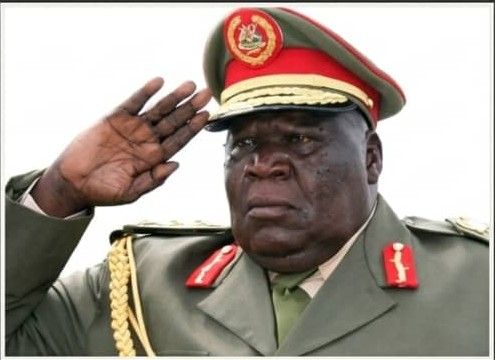
Soldier, rebel, cabinet minister, deputy prime minister and survivor of Uganda’s most turbulent political eras, Gen. Moses Ali’s life mirrored the country’s post-independence journey. This Orbit reflects on a towering yet deeply complex figure whose triumphs, controversies and enduring legacy remain inseparable from Uganda’s own history.
Michael Wakabi
His shadow loomed large over Uganda and in his prime, former Ugandan soldier and politician Gen. Moses Ali, whose earthly remains were interred on July 22, 2025, was a giant of Brobdingnagian proportions. It is perhaps no surprise then, that he sometimes regarded fully grown men around him as tiny Lilliputians.
“You boy!” he once barked at a middle-aged civil servant who had been sent to deliver a letter.
“You passed the reception, the undersecretary and the permanent secretary just to deliver this letter to me?”
The unfortunate messenger stood speechless.
One day in early 1993, suddenly bumping into this writer around a bend in a narrow government corridor, Ali gently held me by the shoulders, moved me aside without uttering a word and eased his imposing frame past.
On another occasion in the mid-1990s, a young journalist ambushed him as he emerged from Parliament, hoping to ask about the performance of the tourism sector, for which Ali was then minister. Rather than wave him away, Ali beckoned him into his official car. They made the one-minute drive from Parliament to Farmers House on Parliament Avenue, where the ministry was headquartered. Once there, Ali summoned half a dozen senior officials into his cramped office before inviting the reporter to ask whatever questions he wished.
The three episodes captured the contradictions that defined Moses Ali. He could be intimidating, even imperious, yet equally capable of magnanimity openness.
Voltaire observed that every man is a product of his time. Ultimately, the environment in which one lives determines life choices and shapes character. Few Ugandans embodied that truth more completely than Moses Ali. Few Ugandan public figures traversed so many political epochs, military campaigns and governments while remaining a central figure in national life.
Born on April 5, 1939, in Maliaderi, Ataboo Parish, Pakele Division in today’s Adjumani District, Ali emerged from one of colonial Uganda’s most isolated regions. His own curriculum vitae records that he completed primary education at Erepi Church of Uganda in 1957, obtained his Junior School Certificate at Church of Uganda Junior Secondary School in 1958–59, and earned his General Certificate of Education at Old Kampala Secondary School in 1966. By then he was already 27 years old.
Today such a timeline appears extraordinary. In colonial northern Uganda, however, it reflected reality. Schools were few, distances immense and many children waited until they were physically old enough to make the long daily walk before beginning formal education.
Like many educated northerners of his generation, the military offered one of the few clear paths to advancement. While the cash-crop economy had created alternative opportunities in much of central and southern Uganda, military service remained one of the principal ladders of social mobility in the north.
After joining the Uganda Army, Ali underwent officer cadet training in Israel in 1968, followed by Paratrooper Instructors’ Training in 1969 and the Company Commanders’ Course in 1970. In 1972 he graduated from the Staff College at Camberley in the United Kingdom, earning the prestigious Passed Staff College (PSC) qualification.
His rise through the ranks was rapid. Commissioned as a Second Lieutenant in 1969, he became commander of Uganda’s Paratrooper School before rising to Major, Colonel and Brigadier in quick succession.
His military career also coincided with Uganda’s most turbulent political period.
Ali was among the officers who participated in the January 1971 coup that overthrew President Milton Obote and ushered Idi Amin into power. In 1973 Amin appointed him Minister of Provincial Administration before entrusting him with the Finance Ministry in 1975, one of the most difficult portfolios in a collapsing economy beset by sanctions, shortages and rigid foreign exchange controls.
Yet no amount of reinvention would entirely remove the albatross of the Amin years. It became the burden he carried through every subsequent chapter of his public life. Whatever offices he later held, history invariably led back to those turbulent years.
One decision from that period would haunt his legacy.
In her autobiography It’s A Pity She’s Not a Boy (2019), the late Joyce Rovincer Mpanga recounted the anguish her family experienced when seeking foreign exchange to pay for treatment in Nairobi for her husband, lawyer A.F. Mpanga, who was suffering from pancreatic cancer. According to her account, after initially instructing her to send her husband to Kenya and later return with the hospital bills, Ali tore up her application for foreign exchange and discarded it. Unable to secure the funds through official channels, she relied on friends for support. Her husband eventually returned to Uganda and later died.
Decades afterwards, Joyce Mpanga publicly forgave Moses Ali, and the two would later serve together in President Yoweri Museveni’s government. Yet her account remains one of the most poignant reminders that decisions taken in high office often leave deeply personal and enduring consequences.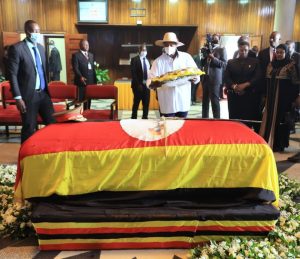
When Amin’s government collapsed in April 1979, Ali fled to Sudan, where he formed one of several insurgent movements fighting Obote’s second administration. Following Tito Okello’s brief military government in 1985, Ali again found himself on the winning side of history’s shifting alliances.
When Museveni captured power in January 1986, Ali chose accommodation over continued rebellion. His Uganda National Rescue Front was integrated into the National Resistance Army, making him one of the earliest examples of reconciliation between former enemies.
Even then, his fortunes remained uncertain.
On April 7, 1990, while serving as Minister of Youth, Culture and Sports, he was arrested and charged with treason and illegal possession of firearms. Prosecutors alleged he was training athletes abroad as guerrillas and plotting to overthrow the government.
He spent roughly two and a half years in detention before the High Court acquitted him completely in 1992.
His acquittal restored his freedom, but not his relationship with history. The Amin years remained the albatross around his neck—one that every subsequent election, cabinet appointment and military promotion could lighten, but never entirely remove.
Instead of retreating from public life, Ali staged one of the most remarkable political comebacks in Uganda’s history.
He joined the Constituent Assembly, won election as Member of Parliament for East Moyo in 1996 and would remain one of the country’s longest-serving cabinet ministers. He headed ministries responsible for Tourism, Internal Affairs and Disaster Preparedness while also serving at different times as Third, Second and First Deputy Prime Minister.
Remarkably, he continued studying while in public office. He obtained a Certificate of Higher Education in Law from the University of Wolverhampton, a Bachelor of Laws from Makerere University, a Diploma in Legal Practice from the Law Development Centre and, later, a Master of Arts in Intelligence Studies from the American Military University. It was an uncommon demonstration that education need not end with age or high office.
His longevity was extraordinary. Few Ugandans have served under Idi Amin, fought against Milton Obote, joined Tito Okello’s Military Council, reconciled with Museveni’s government and remained in Cabinet until 2026.
Like many men forged in Uganda’s violent decades after independence, Moses Ali carried his triumphs and his albatrosses together. One cannot honestly be told without the other. He inspired admiration among supporters who viewed him as a patriot and bridge-builder, while critics remembered his role in successive military governments and some of the painful decisions taken under authoritarian rule. History will probably remember both.
One little-known exchange during the 1994 Constituent Assembly debates perhaps best illustrated Moses Ali’s philosophy of reconciliation. Daniel Omara Atubo, the former minister who had been arrested and brutally tortured in 1992, often spoke with the bitterness of a man still carrying deep wounds. Ali, who only a few years earlier had stood trial for treason as an enemy of the state before reconciling with President Yoweri Museveni and returning to public life, gently intervened. Turning to Atubo, he offered simple but profound counsel: “My brother Omara Atubo, stop being angry.” It was not a dismissal of Atubo’s suffering, but a reflection of Ali’s conviction that personal reconciliation was often a prerequisite for national healing.
As the curtain falls on his remarkable life, he leaves behind a country still wrestling with many of the same questions that shaped his career – the place of the military in politics, the exercise of power, the cost of reconciliation and the moral weight of decisions taken in public office.
Related Posts
 Uganda Coffee Roasters Tap Richard Rugaya as Executive Director, with Focus on Commercial Growth
 Why Africa’s Institutions Must Turn Knowledge and Investment into Farmer Prosperity
 Forbes ranks MTN Group third globally on best telecom employer list
 Stanbic experts offer investment insights to navigate current market uncertainty
 Africa Carbon Markets Urged to Turn Potential into Investment and Delivery
 Corporate Buyers Could Help Unlock SAF Market Worth Millions of Tonnes by 2030
Get business news delivered to you everyday
Latest News

SITA Acquisition of Collins Airport Solutions Signals Moves to Consolidate Aviation Technology

Uganda Coffee Roasters Tap Richard Rugaya as Executive Director, with Focus on Commercial Growth

Equity Bank Reports UGX37.6 Billion in Green Loans as Uganda Seeks to Scale Climate Investment

Why Africa’s Institutions Must Turn Knowledge and Investment into Farmer Prosperity

Forbes ranks MTN Group third globally on best telecom employer list

Stanbic experts offer investment insights to navigate current market uncertainty

Africa Carbon Markets Urged to Turn Potential into Investment and Delivery

Bank of Uganda hikes base rate from 9.75% to 12% amidst global tensions

Airbus sees USD420bn Global Aviation Services Boom: Can Africa Capture its Share?

Nile Breweries Celebrates 75 Years of Growing with Uganda