

Millions set to benefit as National Water and Sewerage Corporation expands Katosi water network to north Kampala

Millions of residents in North and West Kampala are set to gain reliable water supply as the National Water and Sewerage Corporation, supported by the Agence Française de Développement, expands the Katosi water network. The project includes new reservoirs, extended pipelines, and pro-poor standpipes, bridging gaps between production and demand to stabilise Kampala Water City.
Millions of residents in the Greater Kampala Metropolitan Area are set to gain improved access to clean and reliable water as the National Water and Sewerage Corporation (NWSC), with financing from the Agence Française de Développement (AFD), advances a major network expansion linking the Katosi Water Treatment Plant to North and West Kampala.
The works form part of the broader rehabilitation, restructuring, rezoning and extension of the Greater Kampala Metropolitan Area water supply network, aimed at stabilising supply across what NWSC refers to as Kampala Water City.
French Ambassador Virginie Leroy on Thursday toured the project, describing the French-funded Package 2B works as a strategic investment designed to ensure that high water production at Katosi translates into reliable supply at the consumer end.
At the Katosi plant, Manager Joseph Tweheyo Baine said the facility has the capacity to produce 160 million litres per day but currently operates at about 52pcdue to historical gaps in the transmission and distribution network. The ongoing expansion is intended to eliminate those bottlenecks.
Launched in February 2025, the project involves laying 70 kilometres of primary transmission pipelines and constructing major reservoirs at Kanyanya, Kabulengwa and Mutungo to bridge the gap between production and surging demand in Wakiso and northern Kampala.
At Kanyanya Hill, excavation works for the reservoir site are complete and piling for the foundation is ongoing. The site will host a 10 million-litre capacity reservoir.
At Mutungo Hill, foundation works are underway for a 1 million-litre elevated steel water reservoir, while excavation works at Kabulengwa Hill are scheduled to commence in February ahead of construction of a 2.5 million-litre reinforced concrete reservoir.
NWSC engineers say the new storage facilities are critical to pressure management, supply balancing and long-term network stability across the metropolitan area.
Areas set to benefit include Kira, Kasangati, Gayaza, Matugga, Kawempe, Nansana and Wakiso, alongside dozens of surrounding communities under the Wakiso, Kakiri, Gayaza, Nansana, Kanyanya, Luteete and Matugga branches.
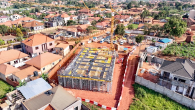 Pipe laying is already underway in the Mpererwe–Kawempe–Nansana corridor, with overall completion targeted for July 2027. The low-level bulk water transmission pipeline serving Kiira–Kasangati is scheduled for completion by December 2026 and will supply Namugongo, Kiira, Buwaate, Bulindo, Mulawa and surrounding areas.
Ambassador Leroy commended NWSC’s execution capacity and focus on value for money, noting that the project integrates a pro-poor component co-funded with KfW. That initiative has already delivered 1,400 prepaid public standpipes and 64 sanitation facilities serving approximately 450,000 residents in informal settlements.
She described the Katosi Water Treatment Plant as a model of infrastructure efficiency and international cooperation, adding that France’s €480 million investment through AFD reflects a long-term commitment to Uganda’s water and sanitation sector.
Following the effective utilisation of initial financing, AFD’s board in December 2025 approved additional funding to increase Katosi’s production capacity by 80,000 cubic metres per day and extend the water network by a further 50 kilometres. The broader programme is also supported by the European Union and the European Investment Bank.
NWSC senior adviser for engineering services Alex Gisagara described the expansion as the “missing link” ensuring that the significant investment at Katosi benefits households directly.
The development comes amid rapid institutional growth at NWSC. Since 2013, under Managing Director Eng. Dr. Silver Mugisha, the utility has expanded its operational footprint from 23 towns to 287 towns nationwide by early 2026. Its asset base has grown from Shs650 billion to approximately Shs5 trillion, with more than one million active water connections serving an estimated 22 million people.
Under its 2024–2027 Corporate Plan, NWSC aims to increase connections to 1.1 million and extend services to 24 million Ugandans.
Once complete, the Katosi network expansion and reservoir upgrades are expected to unlock the plant’s full capacity, stabilise supply across Kampala Water City and deliver reliable water to millions of households by the end of the decade.
Related Posts
 Uganda Emerges as Africa’s Largest Organic Farming Country as Exports Reach USD225 Million
 Uganda Coffee Roasters Tap Richard Rugaya as Executive Director, with Focus on Commercial Growth
 Why Africa’s Institutions Must Turn Knowledge and Investment into Farmer Prosperity
 Forbes ranks MTN Group third globally on best telecom employer list
 Stanbic experts offer investment insights to navigate current market uncertainty
 Africa Carbon Markets Urged to Turn Potential into Investment and Delivery
Get business news delivered to you everyday
Latest News

Uganda Emerges as Africa’s Largest Organic Farming Country as Exports Reach USD225 Million

SITA Acquisition of Collins Airport Solutions Signals Moves to Consolidate Aviation Technology

Uganda Coffee Roasters Tap Richard Rugaya as Executive Director, with Focus on Commercial Growth

Equity Bank Reports UGX37.6 Billion in Green Loans as Uganda Seeks to Scale Climate Investment

Why Africa’s Institutions Must Turn Knowledge and Investment into Farmer Prosperity

Forbes ranks MTN Group third globally on best telecom employer list

Stanbic experts offer investment insights to navigate current market uncertainty

Bank of Uganda hikes base rate from 9.75% to 12% amidst global tensions

Corporate Buyers Could Help Unlock SAF Market Worth Millions of Tonnes by 2030

Airbus sees USD420bn Global Aviation Services Boom: Can Africa Capture its Share?