

IATA Calls for Aviation Supply Chain Overhaul as Engine Maintenance Crisis Grounds 648 Jets

A new IATA study warns that shortages of spare parts, limited repair capacity and engine durability issues are creating a major bottleneck in global aviation. With hundreds of aircraft grounded and maintenance demand set to surge, airlines face rising costs and operational disruption unless the industry reforms the aircraft engine aftermarket.
The global aviation industry’s recovery is increasingly being constrained by a growing maintenance bottleneck that is grounding hundreds of modern aircraft, forcing airlines to retain older jets, extend leases and absorb billions of dollars in additional costs.
A new study released by the International Air Transport Association (IATA) and consulting firm Emerton warns that shortages of spare parts, limited repair capacity and durability issues affecting the latest generation of aircraft engines are disrupting airline operations worldwide and could worsen significantly over the next decade.
The report, Single Aisle Aircraft Engines MRO: Strategic Levers to Address Supply Chain Challenges, paints a troubling picture of an industry struggling to keep pace with the maintenance demands of its fastest-growing aircraft fleets.
At the centre of the challenge are two of the world’s most widely used single-aisle engine families: the LEAP engines manufactured by CFM International and the Geared Turbofan (GTF) engines produced by Pratt & Whitney. These power aircraft such as the Airbus A320neo family, Boeing 737 MAX and Airbus A220, which collectively form the backbone of airline growth strategies across the globe.
According to IATA, the number of Pratt & Whitney GTF-powered aircraft grounded while awaiting engine shop visits, spare engines or replacement parts peaked at 648 aircraft in March 2025. That represented 28 percent of the global GTF fleet.
The scale of the disruption has forced airlines to rethink fleet plans, delay retirements of older aircraft and incur additional leasing costs to maintain schedules.
“Engine MRO bottlenecks are disrupting airline operations,” said Willie Walsh, IATA’s Director General.
“Without significant changes, this will only get worse as the fleet of latest-generation single-aisle aircraft grows. Manufacturers are investing in additional capacity, but capacity alone will not be enough.”
A problem hidden beneath aviation’s growth story
The maintenance challenge comes as global aviation enters another period of sustained expansion.
Passenger traffic is expected to grow by approximately 3.6 percent annually through 2044, while the global commercial aircraft fleet is projected to almost double from 24,730 aircraft in 2024 to more than 49,000 aircraft over the next two decades.
Single-aisle aircraft are expected to account for a large share of that growth.
Engine deliveries illustrate the scale of expansion underway. In 2024, manufacturers delivered approximately 2,000 latest-generation single-aisle engines, including 1,200 LEAP engines and 800 GTF engines.
Between 2030 and 2040, annual deliveries are expected to stabilise at roughly 3,700 engines a year, comprising 2,500 LEAP engines and 1,200 GTF engines.
While that growth represents a significant opportunity for airlines and manufacturers, it also creates a looming maintenance challenge.
The report estimates that annual LEAP engine shop visits will rise from between 600 and 800 visits in 2025 to more than 5,000 by 2040. GTF engine shop visits are expected to increase from approximately 1,000 annually today to more than 2,000 during the same period.
Without corresponding investments in maintenance capacity, spare parts availability and repair infrastructure, the industry risks replacing one bottleneck with another.
Why modern engines are spending less time on wing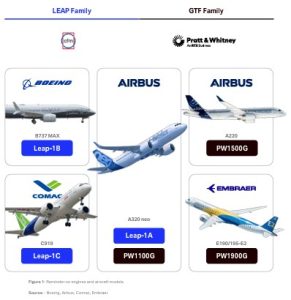
A key concern highlighted in the study is that many next-generation engines have not yet achieved the durability levels originally expected.
Engine manufacturers refer to “time on wing” as the period an engine can remain in service before requiring removal for maintenance.
For mature single-aisle engines operating under normal conditions, time on wing can reach between 15,000 and 20,000 flight cycles.
However, both the LEAP and GTF programmes have experienced technical issues that have shortened those intervals.
For LEAP engines, airlines have reported premature deterioration of high-pressure turbine blades, coating degradation in hot sections of the engine and fuel nozzle problems that can affect performance and reliability, particularly in hot and dusty operating environments common in parts of Africa, the Middle East and South Asia.
Several airlines, including IndiGo, Iberia and Cathay Pacific, have publicly reported operational impacts linked to these issues.
The situation has been even more severe for Pratt & Whitney’s GTF programme.
Since entering service in 2016, the engine has experienced a series of technical challenges ranging from oil leaks and vibration issues to component wear and durability concerns.
More recently, a powdered-metal manufacturing anomaly affecting critical engine disks triggered an industry-wide inspection programme that significantly increased demand for maintenance shop visits.
The result has been a surge in aircraft groundings as operators wait for maintenance slots, spare engines and replacement parts.
Under normal conditions, inspections and repairs might take around 120 days. However, some airlines have reported turnaround times extending to as much as 300 days.
The cost of disruption
For airlines, the consequences extend far beyond maintenance departments.
Aircraft that remain grounded for months generate no revenue while continuing to incur financing and leasing costs.
Many carriers have responded by retaining older aircraft that would otherwise have been retired, extending leases on ageing fleets or acquiring additional aircraft through short-term leasing arrangements.
Indian low-cost carrier IndiGo, one of the world’s largest A320neo operators, retained older Airbus A320 aircraft and extended leases on dozens of others while also sourcing additional leased aircraft to offset the impact of grounded GTF-powered jets.
European budget airline Wizz Air reported that engine-related issues reduced capacity by at least 10 percent during parts of its operations.
The broader impact is a reduction in fuel efficiency, increased maintenance expenditure and slower progress toward sustainability goals as airlines continue operating older aircraft for longer than planned.
A call for structural reform
IATA argues that simply increasing maintenance capacity will not solve the problem.
Instead, the association is calling for a broader overhaul of the aviation aftermarket ecosystem.
Among its recommendations are increasing spare parts availability, accelerating approval of repair solutions, expanding licensed component production and improving access to serviceable used parts recovered from retired engines.
The association is also calling for greater competition in the maintenance market by reducing barriers facing independent maintenance, repair and overhaul providers.
Airlines, IATA argues, need fair access to repair information, spare parts and specialised tooling if the industry is to create sufficient capacity to meet future demand.
The report further recommends that airlines and lessors negotiate stronger protections around long-term spare parts access when purchasing aircraft and engines, helping reduce future exposure to supply-chain disruptions.
Ultimately, IATA believes the industry’s long-term resilience will depend on a more transparent and competitive aftermarket environment.
“Resolving today’s disruption is the immediate priority,” Walsh said.
“But long-term resilience will depend on a more transparent, competitive and collaborative aftermarket. The goal is to get engines back on wing faster, reduce avoidable disruption and ensure that future fleet growth is supported by the maintenance capacity and market access airlines need.”
For airlines across Africa, many of which are investing heavily in fleet renewal and network expansion, the findings serve as a reminder that acquiring aircraft is only part of the growth equation. Ensuring those aircraft can be maintained efficiently may prove just as critical to the continent’s aviation ambitions in the decades ahead.
Related Posts
 SITA Acquisition of Collins Airport Solutions Signals Moves to Consolidate Aviation Technology
 Uganda Coffee Roasters Tap Richard Rugaya as Executive Director, with Focus on Commercial Growth
 Equity Bank Reports UGX37.6 Billion in Green Loans as Uganda Seeks to Scale Climate Investment
 Nile Breweries Celebrates 75 Years of Growing with Uganda
 Stanbic installs solar power system at Mbale School for the Deaf
 Airbus-Kratos Valkyrie Unmanned Combat Aircraft Completes First Flight Ahead of 2029 Combat Target
Get business news delivered to you everyday
Latest News

SITA Acquisition of Collins Airport Solutions Signals Moves to Consolidate Aviation Technology

Uganda Coffee Roasters Tap Richard Rugaya as Executive Director, with Focus on Commercial Growth

Equity Bank Reports UGX37.6 Billion in Green Loans as Uganda Seeks to Scale Climate Investment

Why Africa’s Institutions Must Turn Knowledge and Investment into Farmer Prosperity

Forbes ranks MTN Group third globally on best telecom employer list

Stanbic experts offer investment insights to navigate current market uncertainty

Africa Carbon Markets Urged to Turn Potential into Investment and Delivery

Bank of Uganda hikes base rate from 9.75% to 12% amidst global tensions

Corporate Buyers Could Help Unlock SAF Market Worth Millions of Tonnes by 2030

Airbus sees USD420bn Global Aviation Services Boom: Can Africa Capture its Share?