

Entebbe International Airport sees steady growth but faces near-term pressure from Gulf airspace disruptions
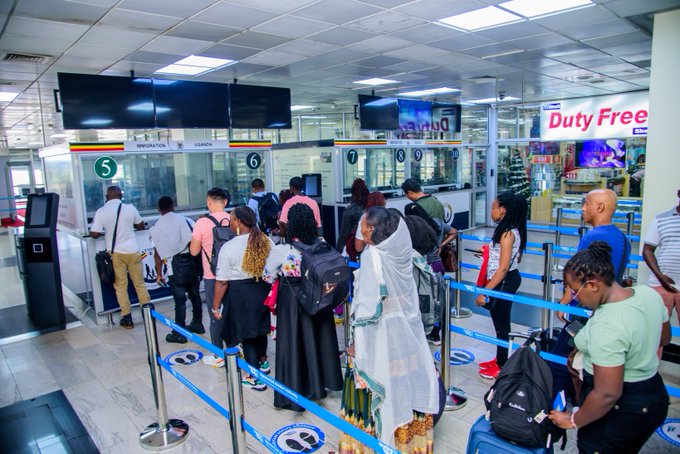
Entebbe International Airport continues to post rising passenger and cargo traffic, yet ongoing Middle East airspace closures signal potential headwinds for March operations.
Entebbe International Airport recorded 189,575 international passengers in February 2026 — 90,007 arrivals and 99,568 departures, averaging roughly 6,770 per day, according to the Uganda Civil Aviation Authority’s traffic update. This marks a 26 percent increase over January 2026 and surpasses February 2025 figures by nearly 30,000 passengers, reflecting sustained post-pandemic recovery and growing connectivity.
Cargo volumes also rose, totalling 4,498 metric tonnes in February, up from 3,982 tonnes in January 2026, driven largely by Uganda’s exports of fresh produce, fish, and flowers.
The strong growth underscores Entebbe’s resilience, but the airport now faces near-term operational pressure. Since February 28, 2026, closures in parts of Middle Eastern airspace have disrupted flights for several operators, prompting a phased resumption of services. Analysts expect this to dampen March traffic, highlighting how offshore geopolitical events can rapidly affect Uganda’s air connectivity.
Over 2025, Entebbe handled 2,486,893 international passengers, up 10.8 percent from 2,243,104 in 2024. Uganda Airlines, now the airport’s largest operator, accounted for 27 percent of passenger traffic and revenue, expanding a network that includes 17 destinations with three intercontinental routes to Dubai, London, and Mumbai. Within Africa, the carrier transported 37 percent of passengers and generated 49 percent of revenue from regional routes.
On the cargo side, 2025 saw 69,595 metric tonnes handled, continuing a gradual upward trend since 2022. Exports consistently outpaced imports, reinforcing Entebbe’s role as a gateway for Uganda’s trade.
Despite these structural strengths, the conflict-driven airspace disruptions serve as a reminder of the vulnerability of global air transport to external shocks. For Entebbe, the coming months will test the airport’s operational resilience, balancing robust demand with risks from international instability.
Related Posts
 Equity Wraps up Uganda Leg of Regional Trade Mission as Value Addition Drive Gains Traction
 JPMorgan Abandons Oil Price Baseline as Iran Conflict Deepens Market Uncertainty
 Frankfurt Airport Malaria Outbreak Raises Questions Over Aviation-Related Health Risks
 Independence Marathon Turns to Blood Storage Gap in Maternal Health Drive
 Fine Spinners Injects Fresh USD5m Into Technology as Uganda Textile Maker Targets African, European Markets
 Equity Trade Mission Puts Uganda’s Manufacturing Capacity to Regional Test
Get business news delivered to you everyday
Latest News

Equity Wraps up Uganda Leg of Regional Trade Mission as Value Addition Drive Gains Traction

JPMorgan Abandons Oil Price Baseline as Iran Conflict Deepens Market Uncertainty

Frankfurt Airport Malaria Outbreak Raises Questions Over Aviation-Related Health Risks

What Maps Communicate: UN Resolution Challenges World Maps that Make Africa Look Smaller

Independence Marathon Turns to Blood Storage Gap in Maternal Health Drive

Fine Spinners Injects Fresh USD5m Into Technology as Uganda Textile Maker Targets African, European Markets

Uganda Seeks to Calm Coffee, Cocoa Markets as Global Prices Fluctuate on Positive Sentiment

Uganda Green Entrepreneurs Set for Paris Visit as Stanbic-France Partnership Graduates 106

Entebbe Airport Passenger Traffic Recovers in August but Remains Below 2025 Levels

Nile Breweries, Next Media Renew Road Safety Push with Focus on Boda Boda Riders